
Bergama Museum
Europe, Turkey
 1 / 6
1 / 6Museum Information
Opening Hours
08:30 – 19:30
Open Days
About Bergama Museum
BERGAMA MUSEUM
The first archaeological research and excavations in
Bergama (Pergamon) began in 1865, following the discovery of the high-relief
sculptures of the Altar of Zeus within the Byzantine walls of the Acropolis.
Between 1878 and 1886, excavations led by C. Humann and A. Conze were
transformed into official archaeological campaigns. In order to protect the
unearthed artifacts, a small storage museum was established in the garden of
the excavation house.
Between 1900 and 1913, excavations on the Acropolis were
carried out by W. Dörpfeld, H. Hepding, and P. Schatzmann. In 1924, some of the
archaeological finds were transferred to a building in the city center—later
used as the People’s House (Halkevi) in 1934—where they were put on display.
Appointed as museum director in 1928, Osman Bayatlı expanded the collection by
adding ethnographic materials, thereby transforming the institution into an
Archaeology and Ethnography Museum.
Excavations interrupted by World War I resumed in 1927
under the direction of T. Wiegand. As archaeological activities expanded to
include the Asklepion, the growing number of finds rendered the existing museum
building insufficient. During his visit to Bergama in 1932, Marshal Fevzi
Çakmak took a keen interest in the issue and ordered the construction of a new
museum.
Within the framework of Turkish–German cooperation, a new
museum project was designed by architects Bruno Meyer and Harold Hanson. At the
request of İzmir Governor Kazım Dirik, the foundation stone was laid in 1933 on
the site of a former cemetery. The architectural plan of the building was
inspired by the Altar of Zeus. In 1934, during a visit to Bergama to observe a
military exercise, Mustafa Kemal Atatürk toured the Asklepion and inspected the
construction of the museum building. The Bergama Museum, completed on 30
October 1936, was officially opened to visitors by İzmir Governor Fazlı Güleç.
The majority of artifacts displayed in the archaeological
halls originate from excavations conducted at the Acropolis, Asklepion, Red
Basilica (Kızılavlu), and Musalla Cemetery. Additional exhibits come from
nearby ancient cities such as Pitane (Çandarlı), Myrina, and Gryneion (Yeni
Şakran), as well as more recent excavations at Kestel and the Yortanlı Dam
reservoir area. Finds from urban rescue and survey excavations carried out by
the Museum Directorate in the Ertuğrul, Turabey, and İnkılap neighborhoods are
also displayed.
Among the museum’s notable artifacts are Yortanlı pottery
from the Bronze Age, spouted vessels, locally produced Megarian bowls, appliqué
ceramics, Pergamene sigillata, oil lamps, and cistophoric coins, first minted
in Pergamon. Sculptural works from the Pergamon School of Sculpture, the Bust
of Diodoros Pasparos and relief panels from his funerary monument, a statue of
Roman Emperor Hadrian, the iconic Nike statue of Pergamon, sarcophagi,
ostothecae, and figurative stelae reflecting ancient burial traditions are also
featured. Other significant works include the Nymph statue from the rescue
excavations at Paşa Ilıcası (Allianoi), an Archaic kouros statue, a
Medusa-decorated mosaic, and Hellenistic terracotta figurines.
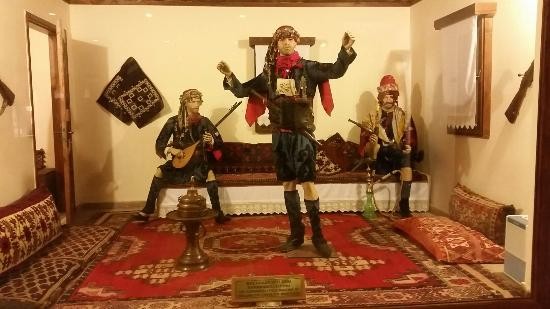
The Ethnography Section of the museum presents a rich
collection reflecting the traditional social life and cultural values of
Bergama and its surroundings. These include regional costumes of the Yörük,
Türkmen, and Çepni tribes, bridal and everyday garments from Bergama, as well
as carpets, kilims, and saddlebags from Yuntdağı, Kozak, and Yağcıbedir, all
important carpet-producing regions. The personal clothing worn by Tuzcu Efe,
one of Bergama’s renowned local leaders, during the Turkish War of Independence,
also constitutes a significant group of exhibits.
BERGAMA ACROPOLIS
Despite repeated invasions and destruction throughout its
history, Pergamon was continuously inhabited due to its strategic location and
never disappeared from the historical stage. Archaeological excavations
indicate that the earliest settlement dates back to 2000 BCE or even earlier.
Written sources reveal that the region first came under Persian rule and later
passed into the hands of Philetairos, the commander of the fortress, following
the division of Alexander the Great’s empire among his successors.
With the kingdom established by Philetairos, Pergamon
entered its most brilliant era, lasting approximately 150 years during the 3rd
and 2nd centuries BCE. Among the rulers of the Attalid Dynasty, Eumenes II (2nd
century BCE) stands out as the period when Pergamon’s School of Sculpture
shaped Hellenistic art with its distinctive style. The city also developed a
unique architectural tradition adapted to its steep terrain, characterized by
broad courtyards surrounded by colonnaded galleries, which later served as a
model for other cities.
These courtyards, used in both public buildings and
residential architecture, were constructed on large terraces carved into the
hillside. Pergamon maintained its importance during the Roman Period,
continuing its urban development. The 1st-century Roman author and philosopher
Pliny the Elder described the city as “the most famous and distinguished
city of Asia Minor.”
The city developed as an upper and lower city, featuring
a grid-planned urban layout with palaces, monumental temples, and social and
cultural buildings. The Upper City, home to kings and military commanders,
contained royal palaces, arsenals, and major temples. The Lower City, designed
for public use, included structures such as the Temple of Demeter, Temple of
Hera, Gymnasium, and the Lower Agora, reflecting a more modest architectural
approach.
In the Upper City, the Temple of Trajan (2nd century CE),
built for Roman emperors Trajan and Hadrian, demonstrates exceptional
engineering skill in supporting a monumental structure on steep terrain using
massive substructures and vaults. Immediately south of the temple’s lower
terrace stood the famous Library of Pergamon, which housed approximately
200,000 volumes during the Hellenistic Period. Closely associated with the
Temple of Athena, the library gained prominence with the invention of
parchment, developed in Pergamon as a new writing material, allowing it to
rival the Library of Alexandria.
The Temple of Athena (4th century BCE), the earliest
temple of Pergamon, was dedicated to the city’s patron goddess. Distinguished
by its orientation, monumental entrance, votive statues in the temenos, and
marble balustrades decorated with reliefs of Galatian weapons taken as war
trophies, the temple remains a striking monument.
On the western slope of the Acropolis lies the Pergamon
Theatre, built during the Hellenistic Period, with a seating capacity of
approximately 10,000 spectators and a removable wooden stage structure. To the
north of the theatre terrace stands the Temple of Dionysus, architecturally and
symbolically linked to the theatre. Southwest of the theatre, on a lower
terrace, Eumenes II constructed the Altar of Zeus, dedicated to Zeus and Athena
following his decisive victory over the Galatians. The reliefs on the altar’s
friezes symbolically depict the conflict as a struggle between the Olympian
gods (Pergamenes) and Giants (Galatians). The dramatic and emotional expression
in these reliefs represents one of the most significant contributions of the
Pergamene style to ancient sculpture.
BERGAMA ASKLEPION
The Asklepion of Pergamon was one of the most important
healing centers of antiquity, comparable to those of Epidaurus and Kos.
According to Pausanias, the first Temple of Asklepios in Pergamon was
established in the early 4th century BCE. Dedicated to Asklepios, the god of
healing, the sanctuary was founded in a secluded valley on the slopes of Mount
Geyikli, near sacred springs believed to possess curative powers.
According to legend, Arkhias, a respected figure and
Pergamon’s first high official (prytaneis), was injured while hunting in Greece
and was cured at the Asklepion of Epidaurus. In gratitude, he introduced the
cult of Asklepios to Pergamon.
Prehistoric finds uncovered during excavations indicate
that the site was used prior to the 4th century BCE, though it gained
prominence during that period. The sanctuary reached its final architectural
form during the reign of Emperor Hadrian (117–138 CE) and became especially
renowned in the Roman Period for its treatment methods and famous physicians
such as Galen.
During the Roman Period, the sanctuary was connected to
the city of Pergamon by the Via Tecta (Sacred Way), a vaulted road
approximately 1 km long. It began at a monumental arched gate near the Roman
theatre of the lower city, known locally as the “Viran Gate.” Patients were
examined here by priest-physicians (Asklepiades); the terminally ill and
pregnant women were not permitted entry. According to tradition, an inscription
above the gate read:
“Death is forbidden to enter the Asklepion, sacred to all gods.”
The Via Tecta protected visitors from adverse weather and
extended to the sanctuary’s monumental entrance (propylon). Its final section,
redesigned during Hadrian’s reign, took the form of a colonnaded street lined
with shops selling votive offerings. On the southern side of this street stands
a monumental tomb dating to the reign of Emperor Augustus (27 BCE–14 CE),
likely belonging to a distinguished individual or hero. The Sacred Way ended at
a monumental entrance supported by four Corinthian columns.
The Asklepion’s large courtyard, measuring approximately
110 × 130 meters, is surrounded on three sides by galleries. The northern
gallery is the best preserved and has been restored with re-erected columns. As
part of the healing process, patients walked barefoot on the earthen floor.
At the northwestern end of the northern gallery lies a
3,500-seat theatre, carved directly into the bedrock. To the east stands a
square building that functioned as an imperial hall and library; its central
niche once housed a statue of Emperor Hadrian, now displayed in the Bergama
Museum. The western gallery, built during the reign of Eumenes II, includes a
large marble-clad hall at its southern end, believed to have served as a
banquet hall.
Our knowledge of medical treatments practiced at the
Asklepion comes from the work Hieroi Logoi by the orator Aelius
Aristides. Treatments included dream incubation, suggestion therapy, hot, cold,
and mud baths, herbal remedies, dietary regimens, massages with oils and
ointments, bloodletting, intestinal cleansing, sun therapy, and, when necessary,
surgical procedures.
BERGAMA RED BASILICA (KIZILAVLU)
During the Roman Period, the ancient city expanded
westward across the Bakırçay Plain, significantly enlarging its boundaries.
Rapid population growth—estimated at around 150,000 inhabitants—was the main
driving force behind this expansion. In this newly developed area, a monumental
temple was constructed in the 2nd century CE during the reign of Emperor
Hadrian. Owing to its brick construction, the structure became known locally as
the Red Basilica (Kızılavlu).
The temple was dedicated to the Egyptian deities Serapis,
Isis, and Harpocrates, reflecting the Roman interest in Egyptian cults.
Architecturally, the divine triad was expressed through a tripartite layout
consisting of a main temple flanked by two towers. The complex was built
diagonally over the Selinos River, which flowed beneath the forecourt.
The monument features a grand entrance and, behind it, a
massive gateway once clad in bronze. At the rear of the main cella stood two
tall podiums that supported cult statues. On either side of the main temple
were symmetrical towers with colonnaded courtyards, each containing two pools
used for ritual purification and worship. The colonnades surrounding the
courtyards were supported by caryatid columns in human form, reflecting strong
influences from Egyptian art.
In the 5th century CE, the interior of the main temple
was remodeled with two rows of columns dividing it into three naves, and an
apse was added to the eastern end, transforming the structure into one of the
Seven Churches of Asia Minor, among the earliest Christian churches in
Anatolia.