
-high.jpg&w=1920&q=75)
Pamukkale’s bright white terraces look almost unreal. From a distance, they can resemble snow-covered hills, frozen waterfalls, or enormous layers of cotton. But the famous landscape was created by a completely natural process involving underground thermal water, calcium carbonate, and thousands of years of mineral deposition.
The Pamukkale travertines were formed as calcium-rich hot spring water reached the surface and flowed down the hillside. As the water cooled and interacted with the air, calcium carbonate was deposited on the ground. Over time, these deposits accumulated and created the white terraces, pools, and formations visible today.
What Are Pamukkale Travertines?
Travertine is a type of limestone formed when mineral-rich water deposits calcium carbonate.
Pamukkale is located in an area with significant geothermal activity. Water travels underground, where it is heated and enriched with dissolved minerals before returning to the surface through natural springs.
When this thermal water emerges and begins flowing across the hillside, its chemical balance changes.
Calcium carbonate gradually separates from the water and settles onto the surface.
Layer after layer of this mineral material eventually forms travertine.
Pamukkale is therefore not made of snow, salt, or ice. The white landscape is primarily the result of calcium carbonate deposited by thermal spring water.
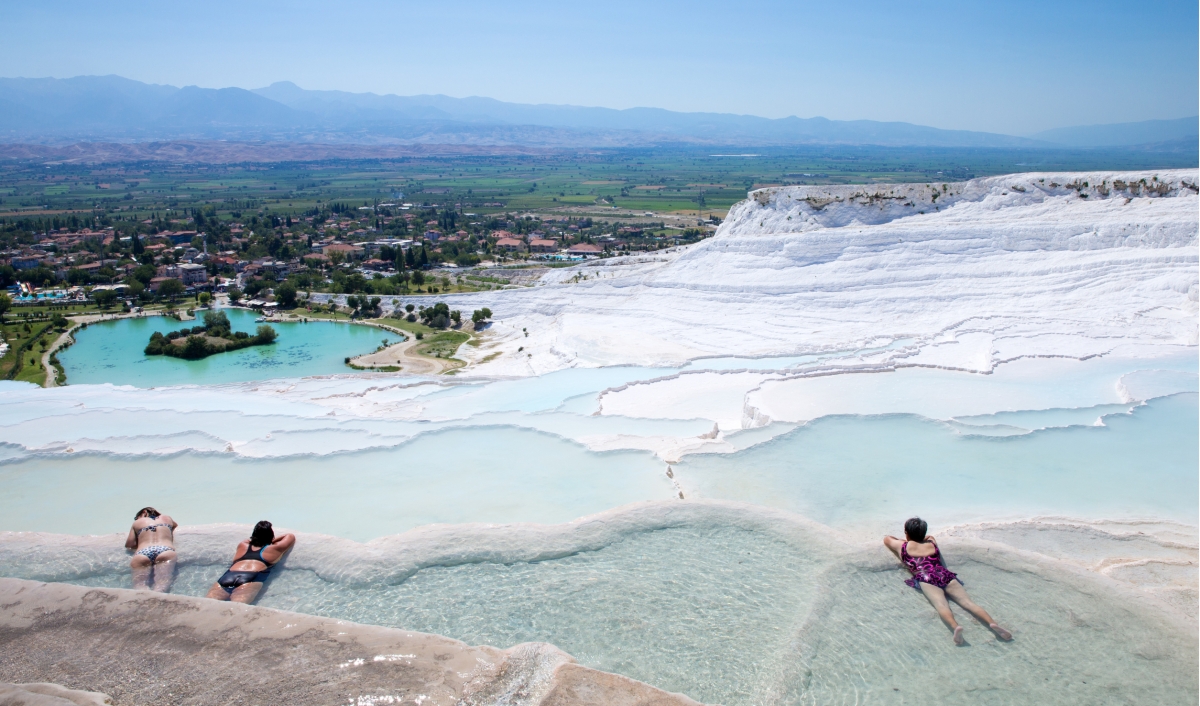
Where Does Pamukkale’s Water Come From?
The water responsible for Pamukkale originates underground.
The region sits within an active geological zone containing faults and geothermal systems. Water enters underground rock formations, where it is heated and interacts with mineral-rich rocks.
During this journey, the water absorbs dissolved minerals, including calcium.
Pressure then pushes the thermal water back toward the surface through natural springs.
Once it emerges, the water begins flowing downhill across the terraces. This continuous movement of mineral-rich water is the key process behind the formation of Pamukkale.
Visitors can see both the natural formations and the surrounding ancient landscape through different Pamukkale Tours.
Why Are the Pamukkale Travertines White?
Pamukkale's famous white color comes from calcium carbonate.
When thermal water first flows across the surface, the calcium carbonate deposit can initially have a softer, gel-like consistency. As it settles and hardens, it forms the bright white travertine associated with Pamukkale.
Repeated mineral deposition gradually covers the hillside.
This process is why Pamukkale appears dramatically different from the surrounding landscape.
The Turkish name “Pamukkale,” meaning “Cotton Castle,” also comes from this distinctive white appearance.
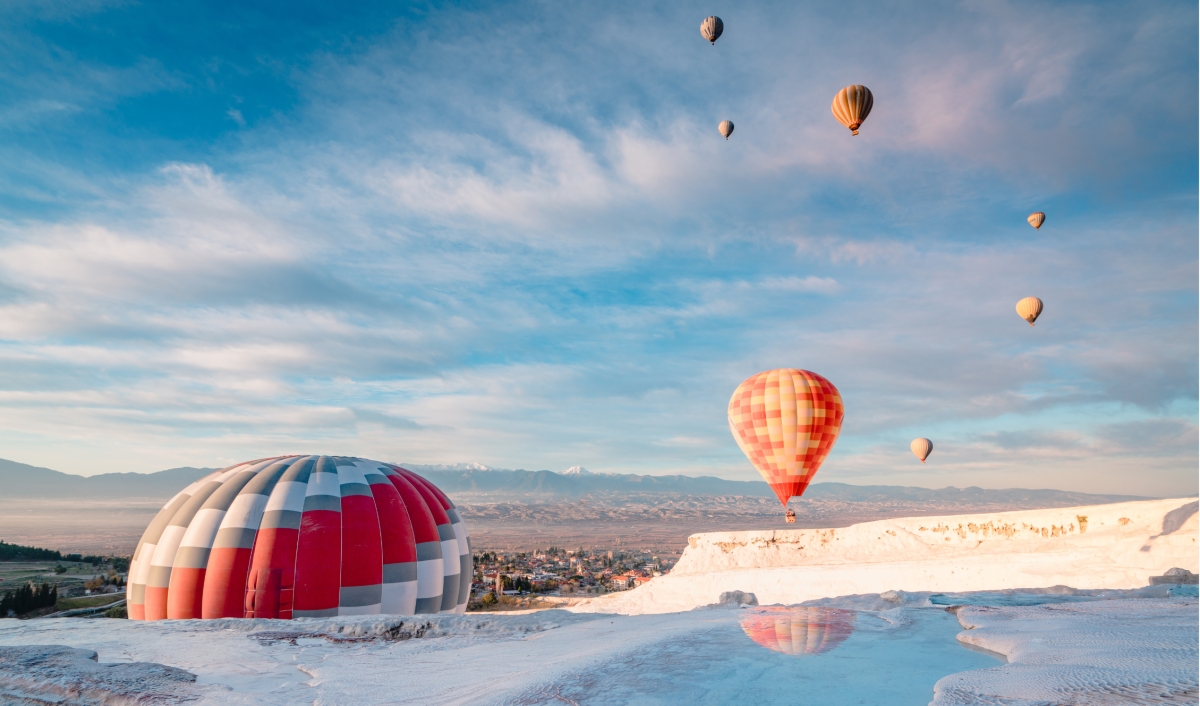
How Did the Terraces Form?
The shape of Pamukkale is just as interesting as its color.
Thermal water does not flow evenly across a perfectly flat surface. It follows slopes, channels, cracks, and natural depressions in the landscape.
As calcium carbonate accumulates, it can create small barriers.
Water collects behind these barriers and forms shallow pools. As more minerals are deposited around the edges, the barriers grow and new pools can develop.
Over long periods, this repeating process creates the stepped appearance of the landscape.
This is how Pamukkale developed its characteristic sequence of white terraces and pools rather than becoming one solid layer of limestone.
A Daily Pamukkale Tour allows visitors to explore these formations together with the nearby ruins of Hierapolis.
How Long Did Pamukkale Take to Form?
Pamukkale did not form overnight, nor was it created during a single historical period.
The landscape developed gradually over thousands of years as thermal water continuously transported minerals from underground and deposited them across the hillside.
There is no simple date that marks when Pamukkale was “completed.”
In fact, describing it as completed would be misleading because travertine formation is an ongoing natural process.
Some sections are older than others, while the appearance of individual terraces can change depending on water flow and mineral deposition.
Are the Pamukkale Travertines Still Forming?
Yes. The natural process responsible for creating Pamukkale continues today.
Thermal water still emerges from underground springs and flows across controlled sections of the travertines.
Where suitable conditions exist, calcium carbonate can continue to accumulate.
However, water distribution is carefully managed today to help protect the landscape. Not every terrace receives the same amount of thermal water at the same time.
This management is important because the appearance and preservation of the white terraces depend heavily on water flow.
Why Does Water Flow Matter?
The white appearance of Pamukkale depends on a close relationship between water and mineral deposition.
If thermal water stops reaching a section for a long period, environmental conditions can affect its appearance. On the other hand, uncontrolled water flow and excessive human activity can also damage delicate formations.
For this reason, modern conservation efforts regulate how thermal water moves across different parts of Pamukkale.
Visitors are also restricted from entering certain areas.
These measures help protect both existing terraces and the natural processes that continue to shape the landscape.
Did People Create Pamukkale?
No. Pamukkale is a natural geological formation.
Humans have lived around and used its thermal waters for more than two thousand years, but they did not create the travertines.
The ancient city of Hierapolis developed beside the thermal springs because people recognized the importance of the water.
During the Hellenistic and Roman periods, the springs became closely connected with bathing and thermal culture. The Romans constructed baths and other facilities around the natural water sources.
The relationship between Hierapolis and Pamukkale is therefore an example of a civilization developing around an existing geological phenomenon.
Today, visitors can see this connection by exploring the travertines and Hierapolis during the same visit.
Why Did Pamukkale Form in This Location?
Pamukkale exists here because several geological conditions come together in the same area.
The region has active fault systems, underground water, geothermal heat, and rocks capable of enriching the water with minerals.
Without these conditions, the thermal springs would not carry the same concentration of calcium compounds to the surface.
The slope of the landscape is also important.
Once the water reaches the surface, gravity carries it downhill. This allows mineral-rich water to spread across a large area and gradually build terraces at different elevations.
Pamukkale's appearance is therefore the result of geology, chemistry, water movement, and time working together.
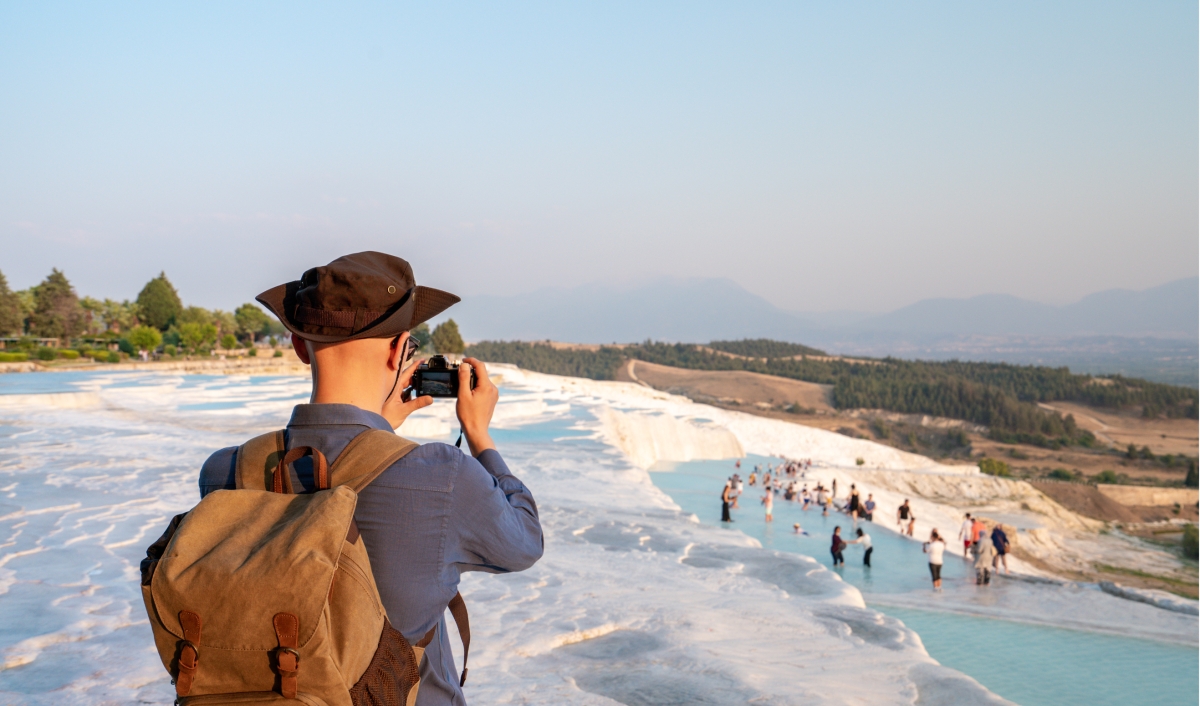
Can You See the Travertines from Above?
Yes, and seeing Pamukkale from above makes the formation of the landscape easier to understand.
From ground level, visitors mainly see individual pools and white terraces. From the air, it becomes easier to recognize how the thermal formations spread across the hillside and contrast with the surrounding landscape.
A Pamukkale Hot Air Balloon Tour offers an aerial perspective of the travertines, Hierapolis, and the surrounding area.
Visiting the Pamukkale Travertines
Pamukkale can be visited independently or as part of an organized tour.
Travelers already staying near Pamukkale can choose a Daily Pamukkale Tour to explore the travertines and Hierapolis together.
Visitors coming from other major destinations also have day-trip options. The Daily Pamukkale Tour from Istanbul connects Istanbul with Pamukkale, while the Pamukkale Tour from Antalya is an option for travelers staying on Türkiye's Mediterranean coast.
You can also explore all available Pamukkale Tours to compare different ways of visiting the Cotton Castle and Hierapolis.
A Natural Process Thousands of Years in the Making
The formation of Pamukkale can be explained through a simple natural cycle.
Water travels underground, becomes heated and enriched with minerals, rises through geothermal springs, and flows across the hillside. As carbon dioxide escapes from the water, calcium carbonate is deposited on the surface.
Those deposits accumulate.
Small barriers become pools. Pools become terraces. Layer after layer creates the white landscape.
Repeated over thousands of years, this process produced what we now know as the Pamukkale travertines.
And because the thermal springs are still active, Pamukkale is not simply a geological formation from the distant past. It is a living landscape that continues to be shaped by water, minerals, and time.
Loading comments…