
.jpg&w=1920&q=75)
Sumela Monastery is one of Turkey's most remarkable historical and religious landmarks, built into a steep cliff overlooking the green mountains of Trabzon. Located in the Black Sea region, the monastery is famous for its Byzantine history, ancient frescoes, dramatic architecture, and unique position approximately 1,200 meters above sea level.
According to tradition, Sumela Monastery was founded in the 4th century AD and became an important religious center for Orthodox Christians. Over the centuries, it was expanded under the Byzantine Empire, the Empire of Trebizond, and the Ottoman Empire. Its remote mountain location and religious significance made it one of the most distinctive monasteries in the region.
Today, Sumela Monastery attracts travelers interested in history, Christian heritage, architecture, and the natural beauty of Turkey's Black Sea coast. Visitors can explore the monastery and surrounding attractions through Trabzon Tours, which offer opportunities to discover the region's cultural and natural landmarks.
Where Is Sumela Monastery Located?
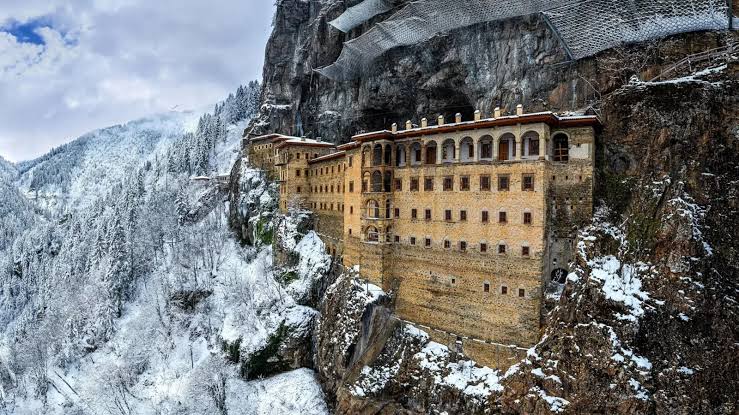
Sumela Monastery is located in the Macka district of Trabzon Province, northeastern Turkey, within Altindere Valley National Park. It stands on the steep slopes of Mount Karadag, approximately 1,200 meters above sea level.
The monastery is situated around 45–50 kilometers south of Trabzon city center. Surrounded by dense forests, mountain streams, and deep valleys, it is one of the most recognizable historical attractions in the Black Sea region.
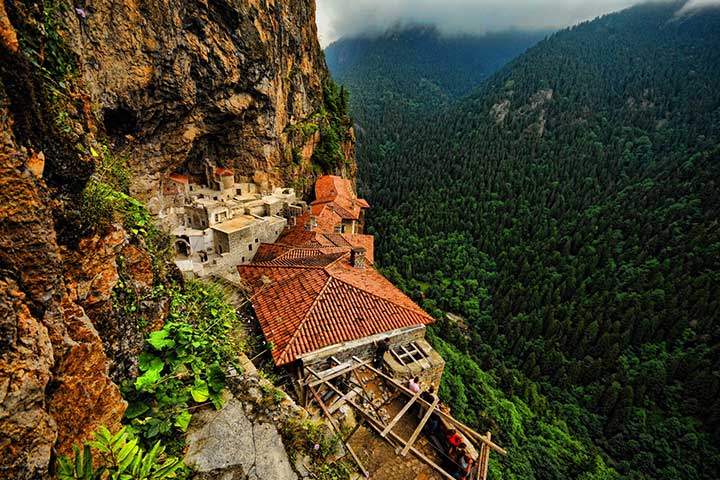
What makes its location particularly unusual is the way the monastery was constructed directly against a nearly vertical rock face. From a distance, the buildings appear to be attached to the mountain, creating an impressive view above Altindere Valley.
The surrounding national park is also known for its natural scenery, making the monastery a popular destination for travelers who want to combine history with outdoor exploration.
History of Sumela Monastery
The history of Sumela Monastery traditionally begins in AD 386, during the reign of Roman Emperor Theodosius I.
According to religious tradition, two monks from Athens, Barnabas and Sophronios, established the monastery after discovering a sacred icon of the Virgin Mary in a cave on Mount Karadag. Although this foundation story is widely associated with Sumela, the exact circumstances of its earliest construction remain uncertain.
The monastery gradually developed into an important Orthodox Christian religious center. Its historical significance increased during the Empire of Trebizond, which ruled the eastern Black Sea region between 1204 and 1461.
During this period, the monastery received support from the rulers of Trebizond. Emperor Alexios III, who ruled from 1349 to 1390, played an important role in its development and is closely associated with its religious and architectural history.
Following the Ottoman conquest of Trabzon in 1461, Sumela Monastery continued to function as an Orthodox Christian institution. The monastery maintained its religious activities and underwent several renovations and expansions during the Ottoman period.
Many of the structures visible today, including residential buildings and additional rooms, reflect architectural developments from the 18th and 19th centuries.
Following the population exchange between Greece and Turkey in the early 1920s, the monastery's religious community departed, and the complex ceased functioning as a permanent monastic institution.
Over time, the buildings experienced deterioration, environmental damage, and vandalism. Restoration and conservation projects were later undertaken to protect the monastery's historical architecture and religious frescoes.
Today, Sumela Monastery is preserved as a cultural monument and remains one of the most important historical attractions in Trabzon.
Who Built Sumela Monastery and Why?
According to Orthodox Christian tradition, Sumela Monastery was founded by two Athenian monks, Barnabas and Sophronios, during the late 4th century.
The monastery's foundation is connected to a religious legend involving an icon of the Virgin Mary, traditionally attributed to Saint Luke the Evangelist.
According to the story, the monks were guided to a cave in the mountains near Trabzon, where they discovered the sacred icon and decided to establish a place of worship.
The monastery was dedicated to the Virgin Mary and became known as Panagia Soumela.
Its primary purpose was to provide a peaceful and isolated environment for Christian monks to practice prayer, worship, and religious study.
Over the following centuries, Sumela developed into a larger monastic complex containing a rock church, chapels, living quarters, a library, kitchens, and other facilities.
The monastery also became an important pilgrimage destination for Orthodox Christians because of its association with the Virgin Mary.
Although the traditional foundation date is AD 386, the surviving buildings were constructed and expanded during different historical periods. The monastery's present appearance reflects centuries of architectural development rather than a single construction project.
Why Was Sumela Monastery Built on a Cliff?
One of the most interesting questions about Sumela Monastery is why its founders chose such a remote and difficult mountain location.
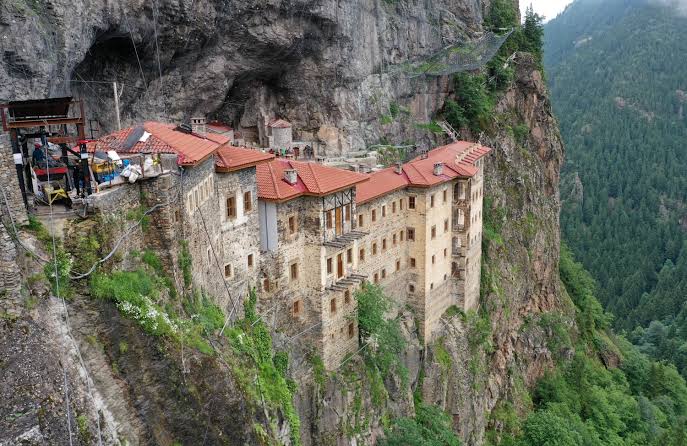
The monastery was constructed against a steep rock face overlooking Altindere Valley, creating a setting that is unusual even among historical monasteries.
Several religious and geographical factors help explain the location.
Religious isolation
Early Christian monks often preferred remote locations where they could focus on prayer, meditation, and spiritual discipline without the distractions of everyday life.
Mountains, caves, and isolated valleys were particularly suitable for this form of religious practice.
Sumela Monastery's location reflects this tradition of monastic isolation.
The sacred cave
According to the monastery's foundation legend, the location was chosen because of the sacred icon of the Virgin Mary discovered inside a natural cave.
The cave became the spiritual center of the monastery, and additional buildings were gradually constructed around it.
Natural protection
The steep cliffs and difficult access routes provided a degree of natural protection.
Although Sumela was not designed primarily as a military fortress, its remote position helped separate the monastic community from surrounding settlements.
Natural resources
Despite its difficult location, the monastery had access to freshwater sources and the natural resources of Altindere Valley.
The historic aqueduct and water-distribution systems demonstrate how the monks adapted to living in a challenging mountain environment.
The combination of religious beliefs, geographical isolation, and practical considerations helps explain why Sumela Monastery was established on such an extraordinary cliffside.
Sumela Monastery Architecture and Frescoes
Sumela Monastery is an impressive example of religious architecture adapted to a steep mountain landscape.
Unlike monasteries constructed on flat ground, Sumela developed around a natural cave and along the rocky slopes of Mount Karadag.
The complex includes a rock church, chapels, monks' rooms, student rooms, a library, kitchens, guest accommodations, and other facilities that supported the religious community.
One of the most recognizable features is the multi-story residential structure built against the cliff, with rows of windows overlooking Altindere Valley.
The monastery also contains a historic aqueduct, which was used to transport water to the complex.
The Rock Church
The rock church is the religious center of Sumela Monastery.
Built around the natural cave associated with the monastery's foundation, the church contains some of its most important surviving religious artwork.
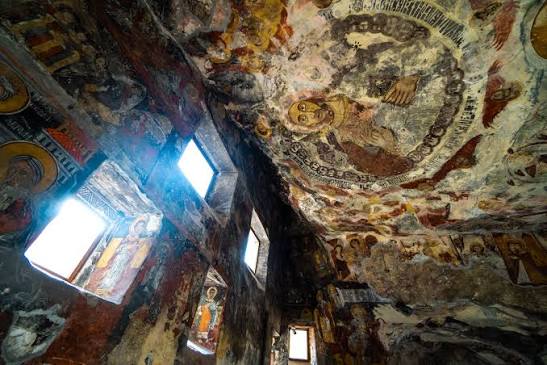
Its walls and ceilings are decorated with frescoes depicting scenes from the Bible and important figures in Orthodox Christianity.
These paintings reflect different artistic periods, with surviving examples particularly associated with Byzantine and later religious decoration.
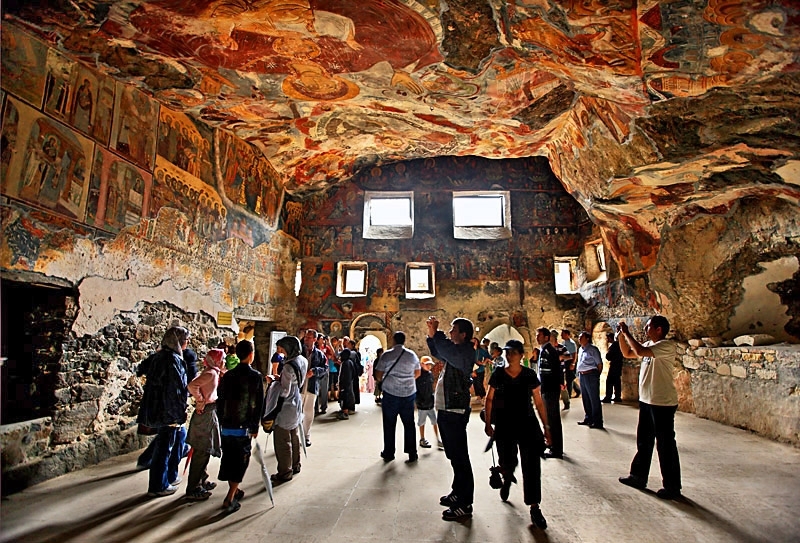
What Do the Frescoes Represent?
The frescoes at Sumela Monastery illustrate important events and figures in Christian religious tradition.
Among the subjects represented are scenes from the life of Jesus Christ, the Virgin Mary, apostles, angels, and saints.
Some paintings depict biblical events such as the Annunciation, the Nativity, and the Crucifixion.
The frescoes were intended to communicate religious teachings through visual imagery, making them an important part of the monastery's spiritual and educational function.
Over time, environmental exposure, deterioration, and human damage affected portions of the paintings. Conservation efforts have focused on protecting the surviving artwork and preserving the monastery's architectural heritage.
For visitors interested in Byzantine art and Christian history, these frescoes are among the most significant features of Sumela Monastery.
How to Get to Sumela Monastery
Sumela Monastery is located approximately 45–50 kilometers from Trabzon city center. The journey generally takes around one hour by car, depending on traffic, weather conditions, and road access.
The most common route follows the road from Trabzon to Macka before continuing into Altindere Valley National Park. Visitors can reach the area by private vehicle, taxi, or organized tour.
The monastery cannot normally be reached directly by car. Visitors use designated parking and transport arrangements before continuing toward the entrance along a walking path with stone steps.
From Trabzon City Center
Travelers staying in Trabzon can join the Daily Sumela Monastery Tour, which provides an organized option for discovering the monastery and its historical surroundings.
From Trabzon Airport
Trabzon Airport is approximately 50–60 kilometers from Sumela Monastery, depending on the route. Visitors can arrange private transportation or travel through Trabzon city center.
Sumela Monastery and Nearby Attractions
The surrounding region offers several destinations that can be explored alongside the monastery, including Zigana Mountain and Hamsikoy Village.
Travelers interested in combining historical sightseeing with mountain landscapes and traditional Black Sea villages can consider the Sumela Monastery, Zigana and Hamsikoy Village Tour.
Another option is the Sumela Tour, designed for travelers who want to discover this important historical landmark.
Sumela Monastery Entrance Fee and Opening Hours
Sumela Monastery is a ticketed historical attraction managed by Turkey's Ministry of Culture and Tourism.
The published entrance fee for international visitors aged eight and above is €20. Turkish citizens have separate admission arrangements, and MuseumPass is accepted under the applicable conditions.
Opening hours vary depending on the season and current visitor arrangements. The monastery generally opens at 08:00, while closing times may change between 17:00 and 19:00.
Some sections may be temporarily inaccessible because of restoration, conservation work, or safety precautions.
Visitors should confirm current admission prices, opening hours, and access conditions before traveling.
Spring, summer, and early autumn are popular periods to visit Sumela Monastery. During these seasons, Altindere Valley is particularly green, although rainfall and fog are common in the Black Sea region.
Visitors should allow approximately one to two hours to explore the accessible parts of the monastery, with additional time for walking, transportation, and enjoying the surrounding scenery.
Frequently Asked Questions
How Old Is Sumela Monastery?
According to tradition, Sumela Monastery was founded in AD 386, giving it a history associated with more than 1,600 years of Christian religious heritage. However, much of the surviving architecture dates from later Byzantine and Ottoman periods.
Why Is Sumela Monastery Famous?
Sumela Monastery is famous for its unusual cliffside location, Byzantine and Orthodox Christian history, religious frescoes, and dramatic views over Altindere Valley. Its combination of architecture and natural scenery makes it one of the most distinctive monasteries in Turkey.
Who Built Sumela Monastery?
Religious tradition attributes its foundation to two Athenian monks, Barnabas and Sophronios. The complex was expanded and renovated over the centuries, particularly during the Empire of Trebizond and the Ottoman period.
Is Sumela Monastery a UNESCO World Heritage Site?
Sumela Monastery is included on Turkey's UNESCO World Heritage Tentative List. It has not yet been inscribed on the main UNESCO World Heritage List.
Is Sumela Monastery Still Used for Religious Ceremonies?
Sumela Monastery primarily functions as a historical and cultural attraction. However, special Orthodox Christian religious services have occasionally been permitted, particularly in connection with celebrations honoring the Virgin Mary.
How High Is Sumela Monastery?
Sumela Monastery stands approximately 1,150–1,200 meters above sea level and around 300 meters above the valley floor. Its elevated position provides impressive views of the surrounding forests and mountains.
Is Sumela Monastery Worth Visiting?
Sumela Monastery is especially worthwhile for travelers interested in Byzantine history, Christian heritage, architecture, and the landscapes of Turkey's Black Sea region. Its location, historical structures, and religious frescoes make it an unusual cultural attraction.
How Long Does It Take to Visit Sumela Monastery?
Most visitors should allow approximately one to two hours to explore the accessible monastery complex. Including transportation from Trabzon and the walk to the entrance, a half-day excursion is generally suitable.
Loading comments…