
-high.jpg&w=1920&q=75)
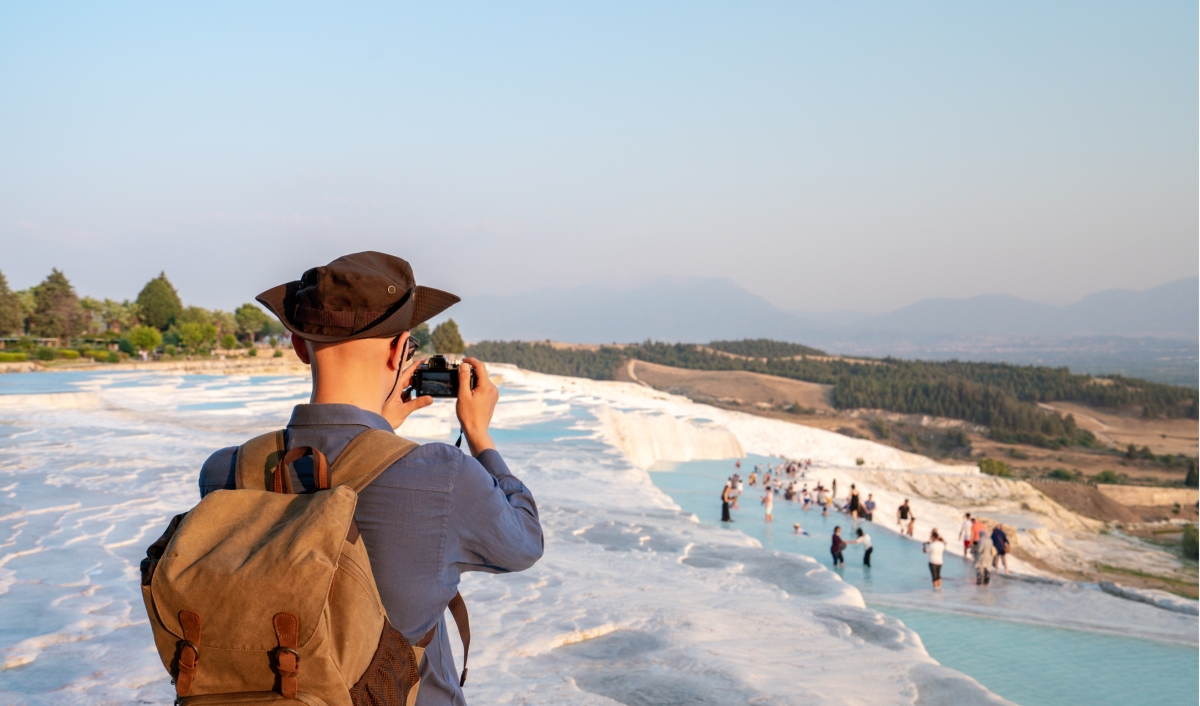
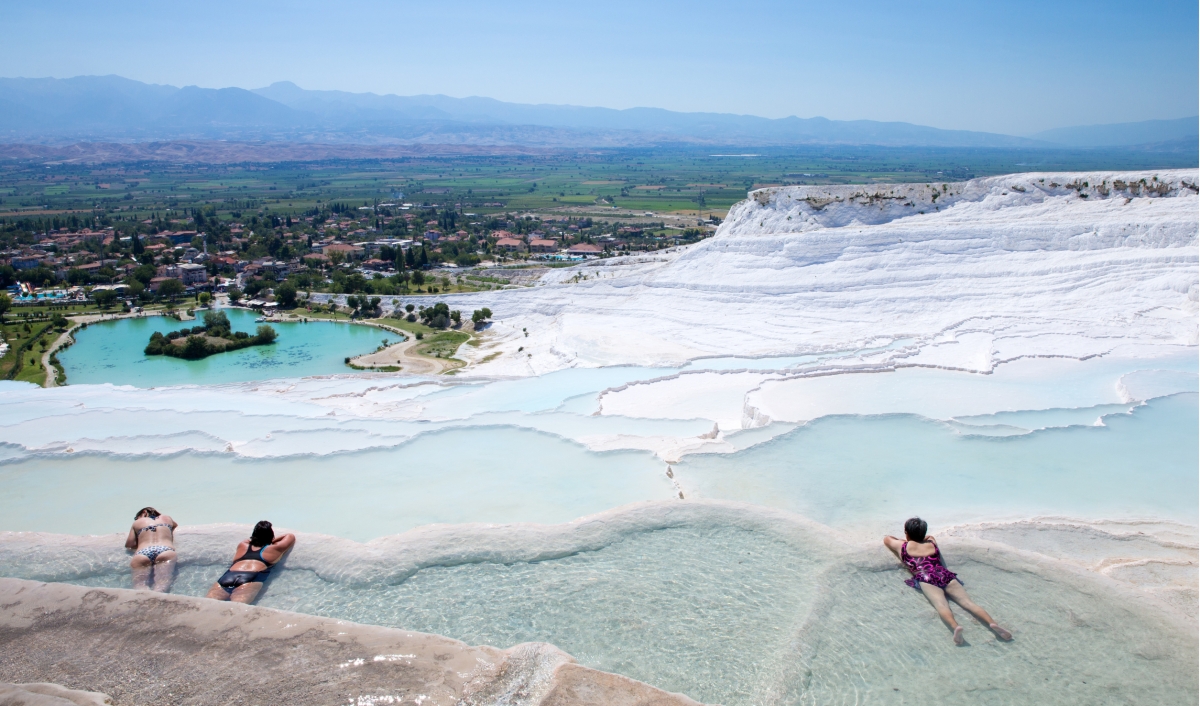
Pamukkale is one of Türkiye’s most recognizable natural landmarks, famous for its white terraces that descend across the hillside like frozen waterfalls. Although the landscape may look as if it was shaped by snow or ice, the Pamukkale travertines are the result of mineral-rich thermal waters flowing over the same slopes for thousands of years.
The history of Pamukkale, however, is not only a geological story. The thermal springs attracted ancient communities to the area, contributed to the development of the ancient city of Hierapolis, and eventually turned the region into an important thermal and religious center during the Hellenistic and Roman periods.
Today, the travertines and the ruins of Hierapolis form a single UNESCO World Heritage Site, bringing together the natural and human history of Pamukkale.
How Did the Pamukkale Travertines Form?
The history of the Pamukkale travertines begins long before the construction of Hierapolis.
Pamukkale lies in a geologically active area where underground thermal waters rise toward the surface through faults in the earth. These waters contain high concentrations of dissolved calcium compounds.
When the hot water reaches the surface and flows down the hillside, it comes into contact with the air. Carbon dioxide is released from the water, and calcium carbonate begins to settle on the ground.
Over long periods of time, layer after layer of calcium carbonate accumulated across the slope.
These deposits gradually created the white formations seen today: terraces, shallow pools, channels and formations resembling frozen waterfalls.
The process is natural and continues as long as mineral-rich thermal water flows across the surface.

How Old Are the Pamukkale Travertines?
There is no single exact date that can be given for the beginning of the Pamukkale travertines.
Unlike an ancient building, the terraces were not created at one moment in history. They developed gradually through a continuing geological process involving thermal water and calcium carbonate deposits.
This means the natural history of Pamukkale is much older than the ancient settlements built around it.
Long before the Romans constructed baths and temples here, thermal water had already been shaping the white hillside.
The ancient inhabitants of the region therefore did not create the travertines. They settled beside a natural formation that already existed and learned how to use its thermal waters.
The Beginning of Hierapolis
The most important chapter in the human history of Pamukkale began with the establishment of Hierapolis.
The city developed under the Attalid kings of Pergamon toward the end of the 2nd century BC. Its location was closely connected to the thermal springs of Pamukkale.
The springs were one of the area's greatest attractions.
People in the ancient world visited thermal centers for bathing, relaxation and treatments associated with health and healing. As Hierapolis developed, the natural hot springs became part of the city's identity.
This relationship between the ancient city and the travertines remains visible today. Visitors exploring Pamukkale can walk between a natural landscape formed over thousands of years and the remains of a Greco-Roman city.
Travelers who want to explore both parts of the site can find different guided experiences among our Pamukkale Tours.
Pamukkale During the Roman Period
Roman rule marked one of the most important periods in the history of Hierapolis and Pamukkale.
After the region came under Roman control, Hierapolis continued to develop and became particularly prosperous during the 2nd and 3rd centuries AD.
The city's thermal waters remained central to everyday life.
Bath complexes were constructed around the springs, while the city expanded with monumental structures including a theater, temples, fountains, streets and an extensive necropolis.
Thermal water was not used only for bathing. The springs were also connected with economic activities, including the processing of wool.
This makes ancient Pamukkale more than an early holiday or spa destination. Its unusual natural resources played a role in the economy, culture and development of Hierapolis.
Much of this history can still be explored on foot. The Daily Pamukkale Tour combines the famous white terraces with the archaeological remains of Hierapolis, allowing visitors to understand how closely the ancient city developed around the thermal landscape.
Earthquakes and the Changing City
Pamukkale and Hierapolis are located in an active geological region.
The same geological forces responsible for bringing thermal water to the surface also made the area vulnerable to earthquakes.
Hierapolis suffered significant earthquake damage during its history. A particularly destructive earthquake struck in AD 60. The city was subsequently rebuilt and continued to develop under Roman rule.
Earthquakes would affect Hierapolis again in later centuries.
For archaeologists and historians, these events help explain why structures from different periods can be found throughout the site and why some ancient architectural remains collapsed.
They also reveal an interesting contrast in Pamukkale's history: geological activity was both a source of prosperity and a source of destruction.
Without the faults beneath the region, Pamukkale's thermal springs and travertines would not exist in their present form. Yet those same geological conditions repeatedly threatened the city built beside them.
Pamukkale and Early Christianity
Hierapolis also became important in the history of Christianity.
During the Roman and Byzantine periods, Christianity spread through the region, and Hierapolis eventually became an important Christian center.
The city is traditionally associated with Saint Philip, one of the apostles of Jesus. A monumental religious structure known as the Martyrium of St. Philip was constructed in the city during the Byzantine period.
Churches, religious buildings and other remains demonstrate that Hierapolis had developed beyond its earlier identity as a thermal city.
By this period, the area represented several layers of history at once: an ancient spa destination, a Roman city and an important center of early Christianity.
Why Is Pamukkale Called the Cotton Castle?
The name Pamukkale comes from Turkish and means “Cotton Castle.”
The origin of the name becomes obvious when the landscape is seen from a distance.
The calcium carbonate covering the hillside creates a brilliant white appearance. From the valley below, the terraces can resemble enormous layers of cotton spread across the mountain.
The name therefore describes the appearance of the natural formation rather than how it was created.
Cotton also has a long association with the wider region, but the famous white color of Pamukkale itself comes from calcium carbonate deposited by its thermal waters.
What Happened to Hierapolis?
Hierapolis remained important for centuries, but its influence gradually declined.
Repeated earthquakes, political changes and changing regional conditions affected the city. Over time, the ancient urban center was largely abandoned.
The travertines, however, did not disappear with the city.
Thermal water continued flowing across the hillside and depositing minerals, meaning the natural process responsible for Pamukkale continued long after the decline of ancient Hierapolis.
This is one reason Pamukkale is unusual among major archaeological destinations. The natural feature that originally attracted people to the area is still active today.
Pamukkale in Modern History
Pamukkale became increasingly recognized as both an archaeological site and an exceptional natural landscape during the modern era.
As tourism expanded, protecting the white terraces became increasingly important.
Development close to the travertines and heavy visitor use created pressure on the natural formations. Conservation measures were therefore introduced to better control access and thermal water distribution.
Some former tourism structures near the terraces were removed, vehicle access was restricted, and visitor routes were reorganized.
Today, visitors cannot simply walk across every part of the white landscape. Access is controlled in order to protect the terraces and maintain the flow of thermal water across important sections.
When Did Pamukkale Become a UNESCO World Heritage Site?
Hierapolis-Pamukkale was added to the UNESCO World Heritage List in 1988.
Its importance comes from the combination of two different forms of heritage.
The first is natural: the extraordinary white landscape created by calcium-rich thermal springs.
The second is cultural: the remains of Hierapolis and its long history as a Hellenistic, Roman and Byzantine city.
This combination makes Pamukkale different from sites valued only for their scenery or only for their archaeological remains.
Here, the natural landscape directly influenced where people settled, how the city developed and how its inhabitants used the environment around them.
What Makes Pamukkale Historically Important?
Pamukkale is historically important because its story connects geology and human civilization.
The thermal springs created the travertines.
The travertines and hot springs attracted people.
Those people established and developed Hierapolis.
The Romans expanded the city's thermal culture, while later Christian communities gave Hierapolis new religious importance.
The result is a landscape where thousands of years of natural processes and more than two millennia of documented human history can be explored in the same place.
It is difficult to fully understand Hierapolis without understanding the thermal springs, just as it is difficult to understand the historical importance of Pamukkale by looking only at its white terraces.
Visiting Pamukkale Today
Modern visitors can experience Pamukkale from several perspectives.
Walking through the travertine area reveals the geological side of its history, while Hierapolis provides a much clearer picture of how ancient civilizations used and lived alongside the thermal springs.
For visitors already staying in the area, the Daily Pamukkale Tour offers a straightforward way to explore the travertines and ancient remains together.
Pamukkale can also be viewed from above. A Pamukkale Hot Air Balloon Tour provides a completely different perspective, revealing the scale of the white terraces and the ancient landscape surrounding Hierapolis.
Travelers based farther away can still visit the site through organized day trips. The Daily Pamukkale Tour from Istanbul is designed for visitors traveling from Istanbul, while the Pamukkale Tour from Antalya connects Antalya with the Cotton Castle and Hierapolis.
For more options, including different itineraries and tour styles, explore all Pamukkale Tours.
Pamukkale: A Landscape Still Being Formed
Perhaps the most fascinating part of Pamukkale's history is that the story has not ended.
The ancient city belongs to the past, but the geological process responsible for the travertines continues.
Thermal water still rises from underground. Minerals are still carried toward the surface. Calcium carbonate can still be deposited as water moves across the landscape.
Pamukkale is therefore not simply an ancient natural monument preserved exactly as it once was. It is an active geological landscape that has been changing for thousands of years.
From the first mineral deposits on the hillside to the rise of Hierapolis, the Roman thermal culture, the Byzantine period and modern conservation efforts, the history of the Pamukkale travertines is ultimately the story of how one extraordinary natural phenomenon shaped human life around it.
Loading comments…