
.jpg&w=1920&q=75)
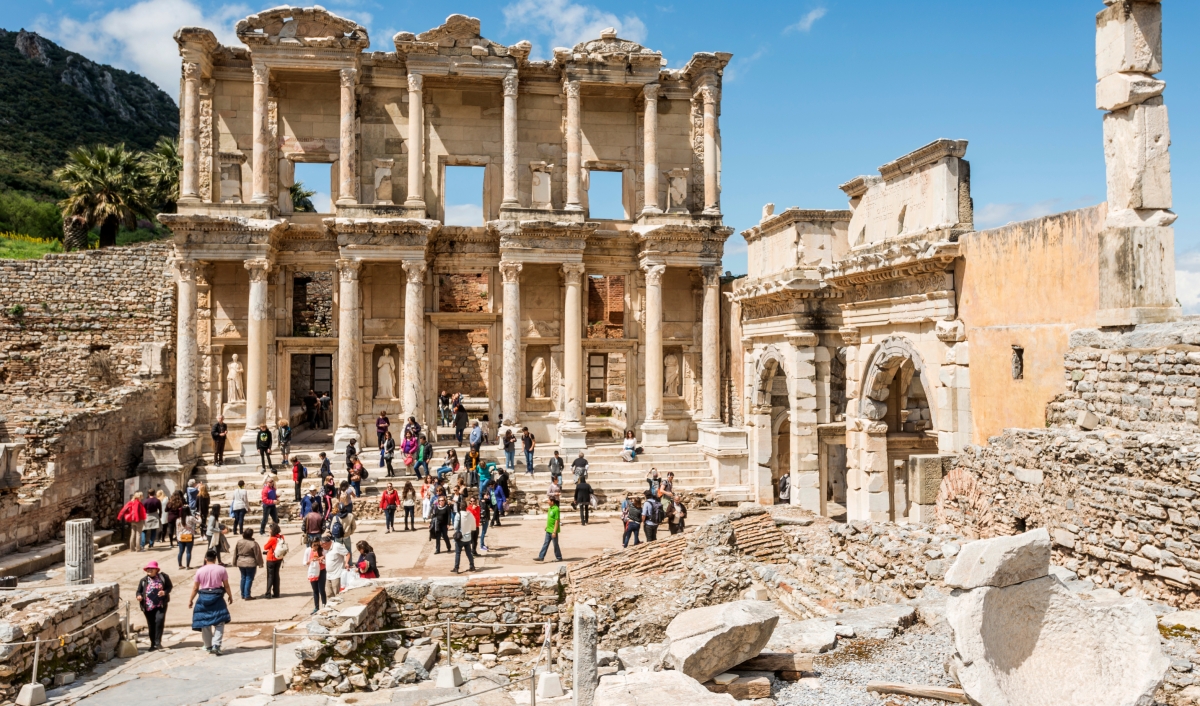
The Library of Celsus is one of the most famous landmarks of the ancient city of Ephesus and one of the finest surviving examples of Roman architecture in Turkey. With its monumental marble façade, columns, statues, and carefully designed entrance, the library has become one of the most recognizable symbols of Ephesus.
However, the Library of Celsus was more than a place for storing books. It was built as a monument to an important Roman statesman, served as a center of knowledge, and also contained the tomb of the man whose name it still carries today.
Travelers who want to see the library and the surrounding archaeological site can explore available Ephesus Tours, including guided visits to the Library of Celsus, Great Theatre, Temple of Hadrian, and other important monuments of ancient Ephesus.
When Was the Library of Celsus Built?
The Library of Celsus was constructed during the Roman period in the early 2nd century AD. Construction began around AD 110 and the building was completed during the following decades.
The library was commissioned by Tiberius Julius Aquila in honor of his father, Tiberius Julius Celsus Polemaeanus.
Celsus was an influential Roman politician who had served as consul in Rome and later as proconsul, or governor, of the Roman province of Asia. Ephesus was the provincial capital, making it one of the most politically and economically important cities in Roman Asia Minor.
The construction of such an elaborate building reflected both the importance of Celsus and the prosperity of Ephesus during the Roman period.
Who Was Celsus?
Tiberius Julius Celsus Polemaeanus was a prominent Roman statesman who lived during the 1st and early 2nd centuries AD.
He became a Roman consul in AD 92 and later served as proconsul of the province of Asia between approximately AD 105 and 107.
His political career was particularly significant because he came from the eastern provinces of the Roman Empire and rose to some of the highest positions within the Roman administration.
After his death, his son Tiberius Julius Aquila financed the construction of the library in his memory.
The name “Library of Celsus” therefore comes directly from the man the monument was designed to honor.
Why Was the Library of Celsus Built?
The Library of Celsus had several purposes.
Its most obvious function was to serve as a public library where written works could be stored and consulted. Ancient texts were generally written on scrolls rather than bound books, and the interior of the building contained niches designed to hold collections of these scrolls.
But the building was also a memorial.
Celsus was buried beneath the library in a sarcophagus, making the structure both a library and a monumental tomb. This combination makes the building especially unusual among surviving Roman libraries.
Its impressive architecture also demonstrated the wealth and status of Celsus's family while contributing an important public building to the city of Ephesus.
How Many Books Were in the Library of Celsus?
The Library of Celsus is traditionally believed to have held approximately 12,000 scrolls.
The manuscripts were stored in niches built into the interior walls. The building incorporated a space between the inner and outer walls, which likely helped protect the manuscripts from humidity and changes in temperature.
Although the original collection has not survived, the scale of the building shows the importance placed on written knowledge and education in Roman Ephesus.
Visitors can walk through this part of the ancient city today on tours such as the Ephesus City Tour from Kusadasi, which includes the Library of Celsus along with other major monuments of Ephesus.
Architecture of the Library of Celsus
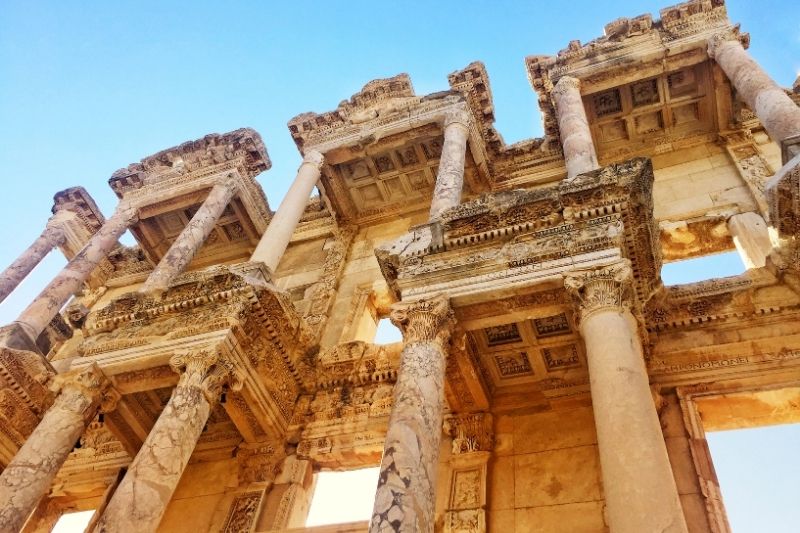
The façade is the most famous feature of the Library of Celsus.
It was designed with two levels of columns, decorative architectural elements, windows, and statues. The arrangement creates an impression that the building is larger and taller than its actual dimensions.
Three large entrances provided access to the library's main reading hall.
The façade also featured statues representing four virtues associated with Celsus: wisdom, knowledge, intelligence, and excellence.
The statues visible at the archaeological site today are replicas. The surviving originals were taken to Vienna after archaeological excavations and are preserved in the Ephesos Museum.
The architectural design of the façade is one of the main reasons the Library of Celsus has become such a recognizable symbol of Ephesus.
The Library of Celsus and Ancient Ephesus
To understand why such an impressive library was built here, it is important to understand the importance of Ephesus itself.
During the Roman period, Ephesus was one of the leading cities of Asia Minor. Its location near major trade routes and its connection with an important harbor helped transform the city into a major commercial and administrative center.
Public buildings, temples, baths, marketplaces, fountains, theatres, and monumental streets reflected the city's wealth.
The Library of Celsus stood close to the Commercial Agora and near Curetes Street, placing it within one of the busiest areas of ancient Ephesus.
Visitors interested in seeing these monuments together can join the Daily Best of Ephesus Tour from Izmir, which explores the Library of Celsus together with the Great Theatre, Terrace Houses, Temple of Artemis, and other important sites.
What Happened to the Library of Celsus?
The Library of Celsus did not survive the centuries completely intact.
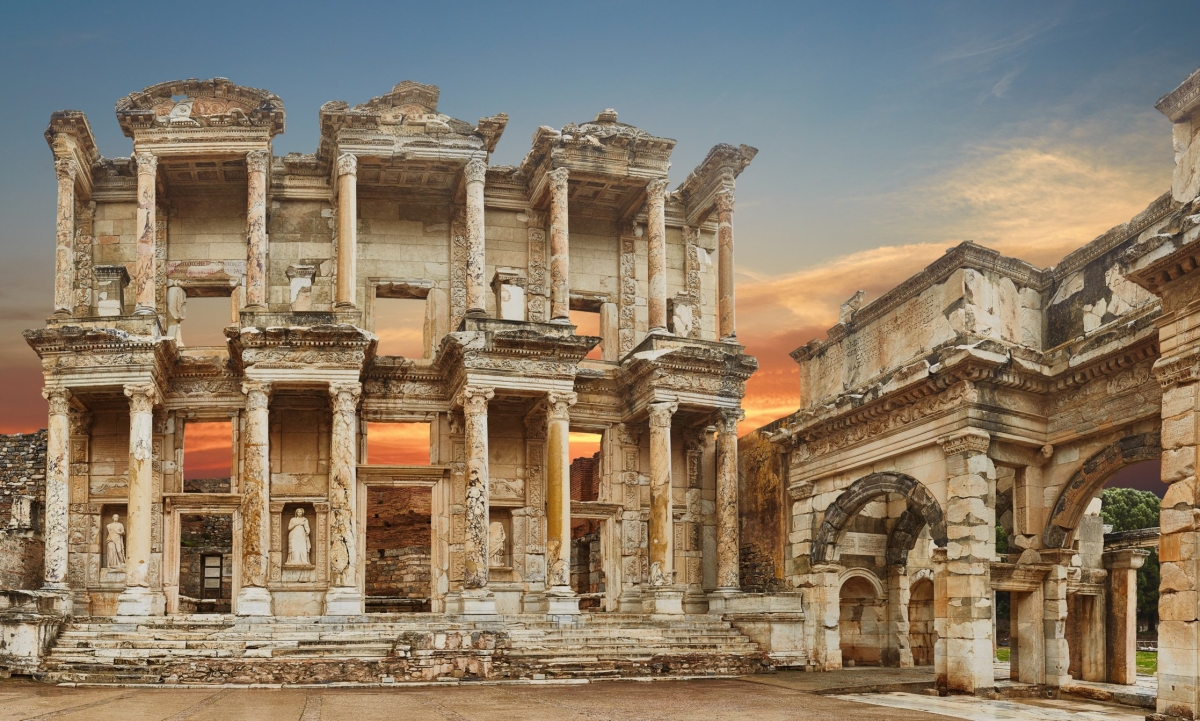
Ephesus experienced earthquakes, fires, political changes, and a gradual decline in importance. The interior of the library was eventually destroyed, while the monumental façade was also damaged over time.
For centuries, much of the structure remained in ruins.
Archaeological excavations at Ephesus later uncovered surviving architectural pieces belonging to the library. During the 20th century, archaeologists carried out a major reconstruction project using original architectural elements wherever possible.
The restored façade that visitors see today is therefore the result of extensive archaeological research and conservation.
Why Is the Library of Celsus Important?
The Library of Celsus is important because it provides valuable information about Roman architecture, education, public life, and funerary traditions.
It demonstrates that libraries could serve purposes beyond simply storing written works. The building was simultaneously a center of learning, a public monument, a display of family prestige, and a memorial to an important Roman official.
It is also one of the most visually impressive surviving structures at Ephesus.
Together with the Great Theatre, Temple of Hadrian, Terrace Houses, Curetes Street, and Temple of Artemis, the library helps visitors understand the scale and sophistication of ancient Ephesus.
Can You Visit the Library of Celsus Today?
Yes. The Library of Celsus is located inside the archaeological site of Ephesus near Selçuk in İzmir Province, Turkey.
Visitors can walk along the ancient streets of Ephesus and see the reconstructed façade of the library from close range.
There are several ways to visit depending on where you are staying. Travelers coming from the coast can choose an Ephesus City Tour from Kusadasi, while visitors based in İzmir can consider the Daily Ephesus & Sirince Village Tour from Izmir.
It is also possible to visit from Istanbul with the Daily Ephesus Tour from Istanbul, which includes the Library of Celsus and other major archaeological landmarks.
For travelers who want to combine two of Turkey's most famous ancient destinations, the 2-Day Ephesus & Pamukkale Tour from Istanbul combines Ephesus with the ancient city of Hierapolis and the travertine terraces of Pamukkale.
What Else Can You See Near the Library of Celsus?
The Library of Celsus is only one part of the extensive Ephesus archaeological site.
Nearby attractions include Curetes Street, the Temple of Hadrian, Commercial Agora, Terrace Houses, Great Theatre, Marble Street, Odeon, Trajan's Fountain, and the remains of Roman baths.
Outside the main archaeological area, visitors can also explore the Temple of Artemis, Basilica of St. John, House of the Virgin Mary, and the town of Selçuk.
Because these sites are closely connected historically, exploring them together provides a much clearer picture of Ephesus during the Greek, Roman, and early Christian periods.
You can compare guided day trips, private tours, cultural tours, and multi-day itineraries on the Ephesus Tours page.
Frequently Asked Questions About the Library of Celsus
How Old Is the Library of Celsus?
The Library of Celsus was built in the early 2nd century AD, making it approximately 1,900 years old.
Who Built the Library of Celsus?
The library was commissioned by Tiberius Julius Aquila in honor of his father, Tiberius Julius Celsus Polemaeanus, a prominent Roman statesman and former governor of the province of Asia.
Why Is It Called the Library of Celsus?
It was named after Tiberius Julius Celsus Polemaeanus. The building was constructed as a memorial to him, and his tomb was placed beneath the library.
How Many Scrolls Did the Library of Celsus Hold?
The library is generally estimated to have had space for approximately 12,000 scrolls stored in niches along its interior walls.
Is Celsus Buried in the Library?
Yes. Celsus was buried in a sarcophagus beneath the library, which makes the structure both a public library and a funerary monument.
Is the Library of Celsus Still Standing?
The original building suffered extensive damage over the centuries. Its famous façade was reconstructed by archaeologists using surviving original architectural elements, allowing visitors to see much of its monumental Roman design today.
Where Is the Library of Celsus?
The Library of Celsus is located inside the ancient city of Ephesus near modern-day Selçuk in İzmir Province, western Turkey.
Can You Visit the Library of Celsus from Istanbul?
Yes. Travelers can reach the Ephesus region by flying from Istanbul to İzmir and continuing by road to the archaeological site. Organized options such as the Daily Ephesus Tour from Istanbul combine transportation with a guided visit to Ephesus.
Loading comments…