
Afyonkarahisar Museum
Europe, Turkey
 1 / 10
Museum Information
Opening Hours
08:30 – 17:30
Open Days
About Afyonkarahisar Museum
Serving as a combined Archaeology and Ethnography Museum
between 1933 and 1970 within the historic Taş Medrese, the Afyonkarahisar
Museum moved to its second building in 1971 and was finally relocated to its
current modern facility in 2023.
Spread across five exhibition floors, the museum presents a rich chronological
journey through the Chalcolithic, Bronze, Hittite, Phrygian, Lydian, Persian,
Hellenistic, Roman, Byzantine, Seljuk, Ottoman, and Early Republican periods.Ceramics,
terracotta pieces, stone and marble works, bone artifacts, glassware, metal
vessels, sculptures, and coins offer important insights into the region’s daily
life, beliefs, production, and trade from as early as 3000 BCE to the present.
Due to the region’s long-standing marble industry, the museum also features an
extensive collection of marble sculptures, sarcophagi, tombstones, and
architectural elements. The rich exhibition design is supported with
reconstructions, realistic mannequins, and multimedia presentations.
The 5th floor of the museum is dedicated entirely to the Turkish War of
Independence.
In the museum garden, visitors can explore Roman and Byzantine steles,
sarcophagi, jars, sculptures, as well as Ottoman-era tombstones.
Highlights from the
Afyonkarahisar Museum Collection
Apameia Sarcophagus
Discovered during foundation excavations of the state
hospital in the Dinar district, this late 2nd-century CE sarcophagus is carved
from fine-grained white Docimeium (İscehisar) marble.
Attributed to Docimeium craftsmen, the garlanded sarcophagus features Nikai on
its corners and Medusa heads on both narrow sides. One long side depicts Erotes
carrying festoons, along with a dynamic scene showing Achilles and the Amazon
queen Penthesileia, as well as portrait busts believed to represent the
sarcophagus owners.
The opposite long side depicts another group of Erotes carrying garlands and,
between them, the mythological meeting of Perseus and Andromeda. The roof-like
lid features a shield within the pediment, corner acroteria, and lion-head
spouts on the sides.
Figurine-Head Jug
A rare ceremonial vessel from the Early Bronze Age, this
handmade jug has a round body, round base, red slip, a slightly beaked mouth,
and a single handle.
Artemis Statuette
A votive statuette of Artemis standing upon a base,
holding an arrow in her right hand and a bow in her left. She is accompanied by
a headless dog figure, and the base bears a two-line dedicatory inscription.
Synnada Coin
A bronze coin from Synnada (after 133 BCE).
The obverse shows a laureate head of Zeus; the reverse depicts two Dioscuri
caps (pileus) topped with a star, flanked by poppy and wheat motifs.
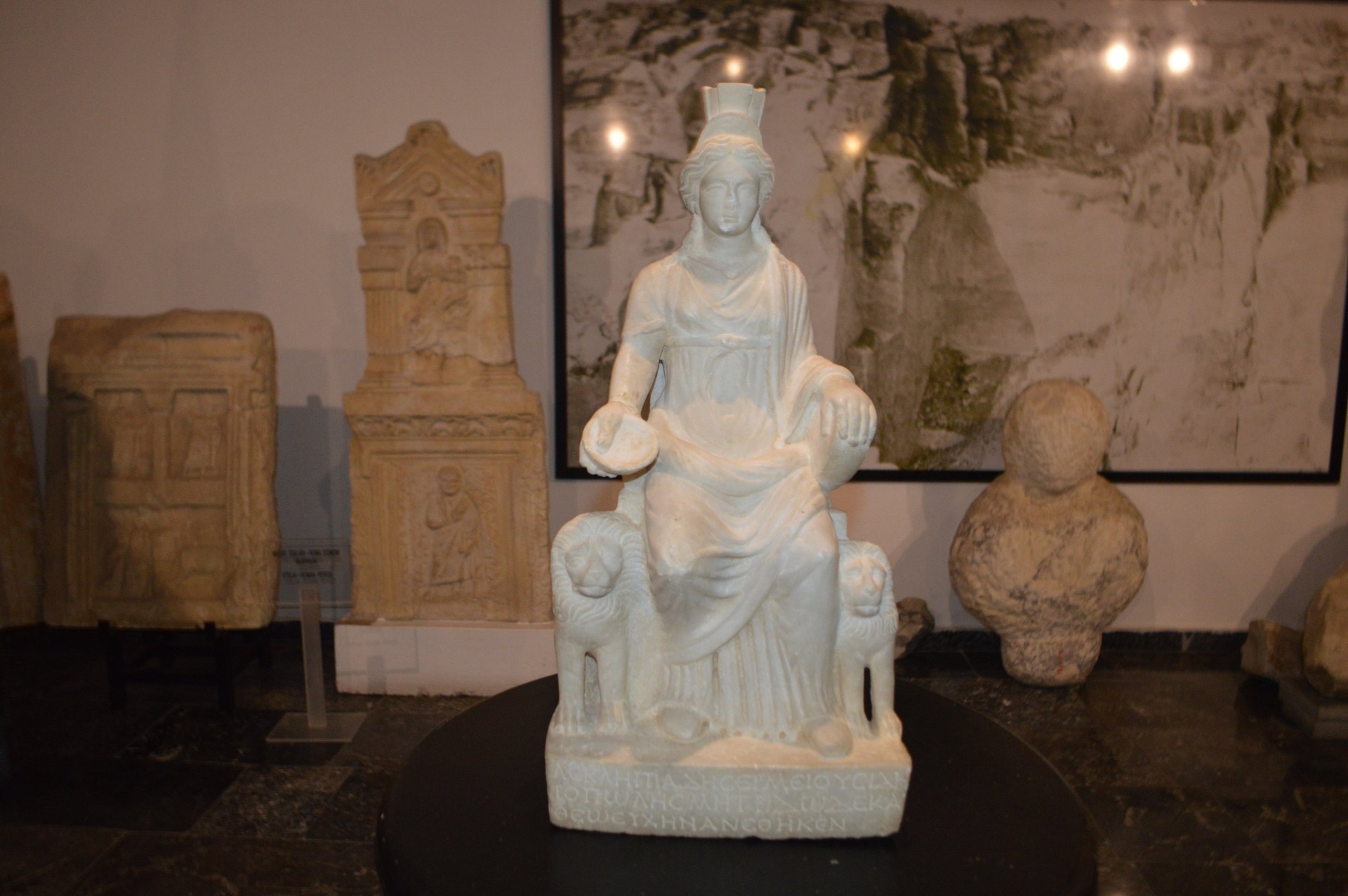
Çavdarlı–Kovalık Höyük
Sculpture Group
This unique group of 71 votive artifacts includes 37
statues and statuettes, 13 sculpture fragments, 9 votive stelae, 2 altars, 2
busts, 6 statue heads, and 2 animal figures ranging from 29 cm to 110 cm in
height.
The assemblage features a wide pantheon of gods and goddesses such as Apollo,
Zeus, Cybele, Artemis, Nike, Men, Eros, Asklepios, Hygeia, Leto, Tyche,
Aphrodite, Heracles, and even the legendary King Midas.
Dating to the late 2nd century CE, the group is considered a unique example
in the world in terms of its quantity and diversity. The recently
repatriated Kybele statue also belongs to this group.