
Akhisar Museum
Europe, Turkey
 1 / 2
1 / 2Museum Information
Opening Hours
08:00 – 19:00
Open Days
About Akhisar Museum
Akhisar Museum
Akhisar Museum is an archaeology and ethnography museum
located in the city of Akhisar, Manisa Province, Turkey. Situated adjacent to
the ancient city of Thyatira, the museum operates under the Manisa Museum
Directorate and was opened to visitors in 2012. It serves as an important
cultural institution showcasing the rich archaeological and ethnographic
heritage of Akhisar and its surrounding region.
The museum is housed in a historic building originally
constructed in 1932 as a hospital. Built by Ayşe Aloğlu in memory of her son
Ali Şefik, who died at a young age due to illness, the structure was named Ali
Şefik Hospital. Over the years, the building served multiple functions,
including use as a middle school and later as a teachers’ residence. Following
extensive restoration and adaptive reuse works, the building was converted into
a museum, preserving its historical character while accommodating modern
exhibition needs.
Museum Building and
Layout
The museum complex consists of independent units set
within a garden and includes the main exhibition building, an administrative
building, and a storage facility. The single-story museum building follows a
rectangular plan and offers approximately 650 square meters of indoor
exhibition space. In addition, the museum garden features an open-air
exhibition area of about 1,250 square meters, where stone artifacts and
architectural elements are displayed.
The museum is organized into three main sections:
- Archaeology
- Ethnography
- Arasta (Traditional Crafts Section)
History of the Museum
Prior to the establishment of the Akhisar Museum,
archaeological artifacts uncovered during excavations in and around Akhisar
were stored in depots due to insufficient exhibition space at the Manisa
Archaeological Museum. The continued excavations at Thyatira and nearby sites
increased the need for a local museum. Akhisar’s strategic location along major
tourism routes, such as İstanbul–İzmir and Bergama–Denizli, further emphasized
this necessity.
In 2006, under the leadership of the Manisa Provincial
General Assembly Culture and Tourism Commission, a decision was made to convert
the former teachers’ residence into a museum. Restoration works began in 2007
but faced delays due to structural issues, project revisions, and the
building’s location within a protected heritage area. After a lengthy six-year
process, the restoration was completed at a cost of approximately ₺1.54
million. The museum opened to the public on 18 May 2012 and was officially inaugurated
on 6 August 2012.
Collection
The museum’s collection was formed through donations,
purchases, confiscations, and transfers from the Manisa Archaeological Museum.
Artifacts unearthed during excavations at Thyatira and surrounding
archaeological sites constitute the core of the collection. While more than
1,000 artifacts were initially exhibited at the time of opening, approximately
689 artifacts are currently on display.
Archaeology Section
The archaeology section presents a chronological display
ranging from the Bronze Age to the Byzantine period, reflecting the region’s
long and diverse history. Fossil samples dated between 18 and 11 million years
ago, discovered in the coal mines of Soma, are also exhibited.
Notable artifacts include Chalcolithic marble idols and
stone tools from the Kulaksızlar region, ceramics from the Yortan culture, and
gold and silver objects from the Lydian period uncovered in tumulus
excavations. Among the most significant pieces are Attic lekythoi from the 5th
and 4th centuries BCE, a gold ram-shaped figurine dated to the early 5th
century BCE, and the Gökçeler Relief, also known as the “Young Man Relief,”
dating to the Archaic period.
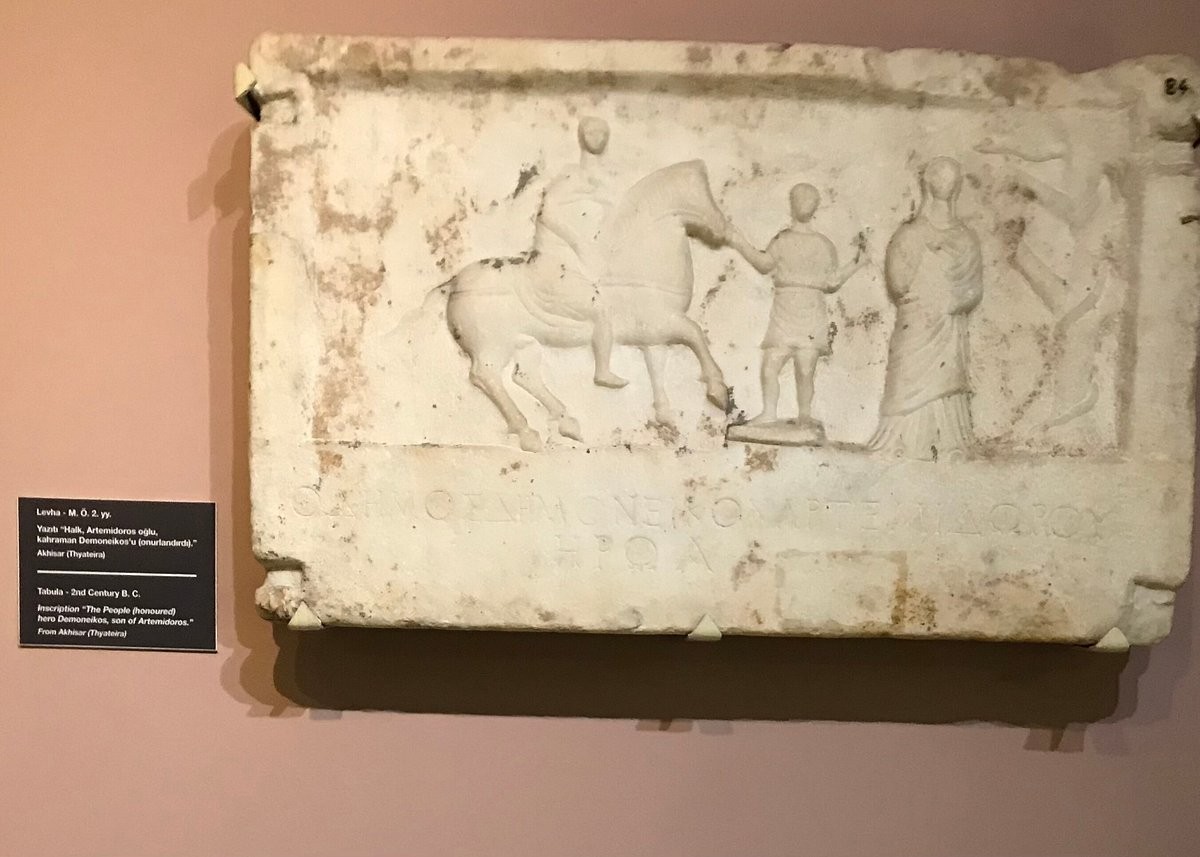
Roman and Byzantine artifacts such as ceramics, glass
vessels, unguentaria, metal objects, jewelry, ossuaries, inscriptions,
terracotta figurines, and a wide range of coins from Thyatira—spanning from the
Archaic period to the Ottoman era—are also displayed.
Ethnography Section
The ethnography section focuses on cultural life from the
Seljuk, Ottoman, and early Republican periods. Exhibits include Ottoman and
Seljuk coins, an 18th-century Quran, manuscripts, imperial edicts, and
calligraphic ceramic tiles. Traditional men’s and women’s clothing, jewelry,
carpets, kaftans, and Çanakkale ceramics illustrate local attire and
craftsmanship.
Daily-life objects such as kitchenware, coffee-making
tools, bathhouse items, glassware, hand-embroidered textiles, oil lamps,
weapons, and lighting devices provide insight into historical lifestyles and
social practices.
Arasta Section
The Arasta section highlights Akhisar’s traditional
trades and crafts. Displays focus on tobacco cultivation, a key economic
activity in the 19th and 20th centuries, featuring tools such as bale presses,
threading needles, hoes, and spraying equipment. The section also showcases
saddlery, tinsmithing, carriage-making, and felt production.