
Mardin Museum
Europe, Turkey
Museum Information
Opening Hours
08:30 – 17:10
Open Days
About Mardin Museum
MARDIN MUSEUM: MORE
THAN A MUSEUM
Throughout the history of humanity, people have
continuously resisted forgetting and being forgotten. This sensitivity against
oblivion has given rise to art, writing, libraries, archives, and museums.
Museums, which collect, research, and preserve a society’s cultural heritage,
have become one of the essential institutions of contemporary civilization and
today serve as role models for modern museology in Türkiye.
The Mardin Museum goes far beyond the conventional
identity of a place where historical artifacts are merely preserved and
displayed. It has evolved into a genuine educational, cultural, and
communication center that actively engages individuals, families, schools, and
the broader community. By offering inclusive educational programs for children,
the elderly, and people with disabilities, the museum supports learning
processes, fosters social interaction, promotes artistic engagement, and
contributes both to individual development and social progress.
With its thematic exhibition halls and a collection
exceeding 45,000 artifacts, the Mardin Museum connects the city’s
archaeological past—from the Paleolithic Age (c. 45,000 BCE)—to the present
day. Drawing on this rich collection, the museum has been conducting museum
education programs, modular courses, and workshops for over seven years,
introducing cultural heritage in depth. Through these activities, the museum
nurtures children’s natural curiosity, creativity, critical thinking skills,
imagination, and sense of discovery, raising generations who recognize,
protect, and sustain their cultural heritage; respect diversity; embrace
democratic values; value science; and grow as confident, socially responsible
individuals.
Archaeological
Excavations and Cultural Heritage Projects
The Mardin Museum continues extensive archaeological
excavations aimed at uncovering and preserving both movable and immovable
cultural assets. These efforts include ongoing excavations at Dara Ancient
City, Mor Yakup Church in Nusaybin, Mardin Fortress, Cizre Inner Citadel, and
numerous ancient settlements affected by the Ilısu Dam Hydroelectric Power
Project.
Beyond excavation work, the museum actively contributes
to the preservation and sustainability of tangible and intangible cultural
heritage. Through projects such as the Storytellers’ Gathering, Sounds of
Mardin promotional film, Kite Festival, Bilali Celebrations, Çelbira Grape
Harvest Festival, Accessible Mardin – Accessible Museum events, Museum Street
landscaping, Traditional Mardin Music and Reyhani Ensemble, Mardin Culinary
Culture Research, and initiatives to identify and sustain cultural heritage bearers,
the museum strives to revive and protect values at risk of disappearing.
Guided by the motto “Museums Can Change Lives,” the
Mardin Museum continues its mission by informing the public, consulting
communities, making collective decisions, acting collaboratively, and
supporting independent initiatives—firmly rooting itself within the social
fabric of the city.
Museum Buildings and
Architecture
Operating in two historic buildings located in the city
square, the Mardin Museum offers renewed thematic exhibition halls,
laboratories, educational spaces, and diverse activity areas in line with
contemporary museology principles.
The main museum building was constructed in 1895 by
Antioch Patriarch Ignatios Behnam Banni as the Syriac Catholic Patriarchate,
with the Virgin Mary Church located on its eastern side. Purchased from the
Syriac Catholic Foundation, the building was restored by the Ministry of
Culture and Tourism and opened as the Mardin Museum in 2000. With its
three-story, U-shaped plan facing the southern plains, the structure reflects
all the characteristic features of traditional Mardin house architecture.
Exhibition Areas and
Educational Facilities
In the entrance courtyard, stone and ceramic artifacts
from Mesopotamian civilizations—ranging from the Assyrian and Byzantine periods
to the Artuqid and Ottoman eras—are displayed in an open-air exhibition. This
level also includes a museum shop, café, and specially designed Museum
Education Halls.
Educational programs cater to general visitors, school
groups (by appointment), residents of the urban conservation area, and museum
guests. These programs are conducted by a multidisciplinary team consisting of
museum educators, archaeologists, visual arts teachers, sculptors, master
artisans, and museum volunteers. Visitors can participate in numerous
workshops, including coin minting, natural dye printing, marbling (ebru),
ceramics, and shadow puppetry.
South of the museum building lies an Archaeopark and a
500-seat amphitheater, where concerts, film screenings, and cultural events are
held. The Archaeopark features a Neolithic model house, tools, hand mills, and
excavation zones. In the excavation workshop, participants learn the scientific
processes of archaeology and conduct simulated excavations under professional
supervision.
Exhibition Floors
First Floor:
Includes an open exhibition area with Roman mosaics and stone artifacts, a 3D
cinema, seminar hall, storage units, and the Archaeological Excavations
Exhibition Hall, where finds from regional excavations are displayed.
Second Floor:
Features four closed thematic exhibition halls:
- Belief Hall
- Trade Hall
- Life Hall
- Forgery Hall
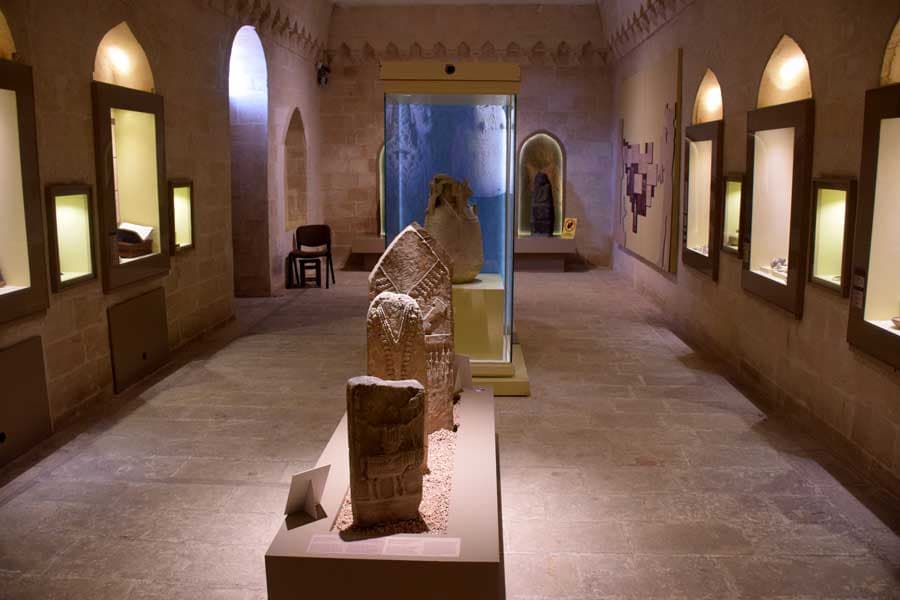
Artifacts discovered in Mardin are presented through
themes of belief, commerce, and daily life, combining both chronological and
thematic narratives. Visitors also encounter an exhibition dedicated to forged
artifacts and antiquities trafficking, raising public awareness—an initiative
that is a first in Türkiye.
Thematic Exhibition
Halls
Archaeological Excavations Hall
Artifacts uncovered from excavations conducted by the Mardin Museum are
displayed here, including finds from Boncuklu Tarla, Ilısu Höyük, Girnavaz,
Dara, Mor Yakup Church, and Mardin Fortress, spanning from the Halaf Period to
the Ottoman era.
Belief Hall
Explores belief systems that emerged in Mesopotamia, including ancient
mythologies, paganism, Christianity, and Islam, alongside burial traditions,
fertility, and ritual practices.
Trade Hall
Illustrates the evolution of trade in Mesopotamia, covering early payment
systems, the invention of mathematics and writing, transportation, weaving, and
the history of money. A highlight is the Sürekli Hoard, discovered in a rescue
excavation, containing gold and silver artifacts from civilizations such as the
Abbasids, Byzantines, Artuqids, and Ayyubids.
Life Hall
Reflects social life through themes of nutrition, adornment, and defense.
Topics include the origins of agriculture, pottery, Mardin cuisine, traditional
music, jewelry, textiles, health, lighting, and ancient weaponry.
Forgery Hall
Displays confiscated counterfeit artifacts used in fraud and trafficking,
raising awareness about illicit antiquities trade—an innovative and educational
initiative unique in Türkiye.
Administrative
Building and Facilities
Located northwest of the museum, the Administrative
Building is a registered 19th-century traditional Mardin house. Restored and
opened in 2012, it is connected to the museum by a suspension bridge and houses
a specialized library, art gallery, conference hall, archives, expert offices,
traditional crafts workshops, photo studio, prayer room, and administrative
units.
Specialized Library
and Art Gallery
Established in 2010, the Museum Specialized Library
contains nearly 20,000 resources, including books and digital publications,
serving researchers and students in archaeology, history, art history,
architecture, philosophy, mythology, and related fields. It is the region’s
most comprehensive specialized library.
The Museum Art Gallery hosts over twenty temporary
exhibitions annually and functions as a multipurpose venue with a 150-seat
conference and performance hall.
Restoration,
Conservation, and Analysis Laboratories
Covering 250 m², these laboratories handle the
conservation of metal, ceramic, stone, glass, mosaic, wood, paper, leather, and
textile artifacts. Approximately 40,000 objects have undergone conservation
here. The Mardin Museum Analysis Laboratory, the first of its kind in Türkiye,
provides scientific analyses for cultural assets from across the country.
Conclusion
Preserving over 45,000 artifacts in modern storage
facilities, the Mardin Museum offers research spaces for scholars and provides
access to its library six days a week.
The Mardin Museum is not merely a museum—it is a living
institution that places people at its center; tells the stories of the unseen
and unheard; transforms heritage into dialogue; promotes tolerance, freedom,
and peace; values stories over objects; and connects the past, present, and
future through knowledge, creativity, and shared humanity.