
Pera Museum
Europe, Turkey
Museum Information
Opening Hours
10:00 – 19:00
Open Days
About Pera Museum
Pera Museum
The Pera Museum is an art museum located in the Tepebaşı
quarter of the Beyoğlu district in Istanbul. It is particularly renowned for
its focus on 19th-century Orientalist art, alongside important collections
reflecting Anatolian cultural history.
History
The Pera Museum was founded in 2005 by the Suna and İnan
Kıraç Foundation. It is housed in the historic former Bristol Hotel, a
distinguished building designed by architect Achille Manoussos and completed in
1893.
Between 2003 and 2005, the building was carefully
restored and transformed into a modern museum by architect Sinan Genim, who
preserved the original façade while redesigning the interior to meet
contemporary museum standards.
Collections
In addition to hosting international temporary
exhibitions, the Pera Museum is home to three major permanent collections:
- Orientalist Painting Collection
- Anatolian Weights and Measures Collection
- Kütahya Tiles and Ceramics Collection
Orientalist Painting
Collection
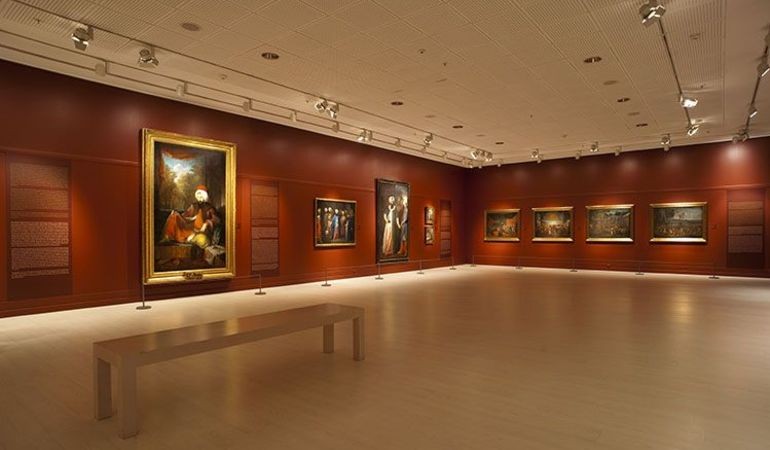
The Orientalist Painting Collection features significant
works by European, Ottoman, and Turkish artists, offering a rich visual
narrative of the Ottoman world as seen through both Western and local
perspectives.
Highlights include masterpieces by Osman Hamdi Bey, such
as his most famous painting, The Tortoise Trainer (1906), as well as:
- Kökenoğlu Rıza Efendi (1871)
- Two Musician Girls (1880)
- Girl with Pink Cap (1904)
Other notable works include:
- Foreign Ambassadors Received at the Topkapı Palace during the Reign of
Sultan Ahmed III (1725), by Jean-Baptiste van Mour
- Sultan Ahmed III Receiving the Dutch Ambassador Cornelis Calkoen (1727), by Jean-Baptiste van Mour
- Harem of the Topkapı Palace (1652), by
Franz Hermann
- Enjoying Coffee, by an unknown artist of
the French school
- A Woman in Turkish Dress, by
Jean-Étienne Liotard
- Enjoyment of Göksu Creek, by Fausto
Zonaro
- Housemaid (1880), by Jules Joseph Lefebvre
- Portrait of Charles Gravier, Count of Vergennes, in Turkish Attire, by Antoine de Favray
- Portrait of the Countess of Vergennes in Turkish Attire, by Antoine de Favray
Anatolian Weights and
Measures Collection
The Anatolian Weights and Measures Collection comprises
over 10,000 objects, spanning from prehistoric times to the present day. It
includes a wide variety of scales and measuring instruments used across
Anatolia for measuring weight, length, and volume.
These objects illustrate measurement practices in diverse
fields such as commerce, architecture, land surveying, shipping, jewelry
making, and pharmacy, providing valuable insight into daily life and
technological development throughout history.
Kütahya Tiles and
Ceramics Collection
The Kütahya Tiles and Ceramics Collection began in the
1980s under the auspices of the Suna and İnan Kıraç Foundation. Today, it
consists of more than 800 pieces, primarily dating from the 18th to the 20th
centuries.
Although only a selection of the collection is on display
at any given time, these works offer an excellent overview of the artistry,
craftsmanship, and stylistic diversity of Kütahya ceramic production.