
Canakkale Troy Museum
Europe, Turkey
 1 / 8
1 / 8Museum Information
Opening Hours
08:30 – 17:30
Open Days
About Canakkale Troy Museum
Troy
Museum
The construction of the Troy Museum began in 2013 after
the architectural team composed of Ömer Selçuk Baz, Okan Bal, Cenk Kurtel,
Mehmet Yılmaz, and Berrin Yavuz won the National Architectural Project
Competition. Located in Tevfikiye Village in the central district of Çanakkale,
the museum stands on a 90,000 m² plot and features a 12,765 m² closed
exhibition and administrative area, along with 37,250 m² of open-air display
and landscaped visitor zones.
Designed as a four-story structure (ground floor plus
three levels), the museum is organized around a 480-meter-long spiral ramp that
guides visitors through its immersive exhibition narrative.
At the Troy Museum, the archaeological history and
cultural legacy of Troy and the broader Troas Region—immortalized by Homer in
the Iliad—are brought to life through artifacts discovered during
excavations.
A Seven-Part Narrative Journey
Visitors follow a storyline divided into seven main
themes:
1.
Archaeology of the Troas Region
2.
Troy in the Bronze Age
3.
The Iliad and the Trojan War
4.
Troas and Ilion in Antiquity
5.
Eastern Roman and Ottoman Periods
6.
History of Archaeology
7.
Traces of Troy
The museum experience symbolically begins while
descending the entrance ramp, where niches along the wall narrate the
multiple settlement layers of Troy through gravestones, sculptures,
reconstructions, and large-format visuals.Before entering the main galleries,
an orientation section introduces visitors to the fundamentals of archaeology—archaeometric
dating techniques, ancient period terminology, and concepts such as
“Neolithic,” “Chalcolithic,” “Bronze Age,” “Iron Age,” “mound,” “restoration,”
and “conservation”—supported by diagrams, texts, and interactive tools.
GROUND
FLOOR – Troas and Its Ancient Cities
The ground floor presents the Troas Region in its
geographical and archaeological context, showcasing important ancient cities
such as:
- Assos
- Tenedos
- Parion
- Alexandria Troas
- Smintheion
- Lampsakos
- Thymbria
- Tavolia
- Imbros
These are accompanied by excavation information and
collections featuring:
terracotta figurines, medical instruments, stone and bone tools, marble
artifacts, gold objects, terracotta vessels, masks, miniatures, and glassware.
Highlighted Artifacts
Parion Bronze Amphora (4th
Century BC)
Discovered in 2005 in Parion’s southern necropolis, this
bronze amphora is adorned with scenes of ecstatic satyrs and maenads performing
rituals of Dionysos. The handles feature finely crafted Eros figures, and the
base is decorated with Ionian motifs inlaid with silver.
Assos – The Musicians
Group (4th Century BC)
Found in the western necropolis of Assos, this set of
terracotta figurines depicts musicians and performers associated with the cult
of Dionysos. Their craftsmanship and rich symbolism shed light on Assos’ social
and cultural life during the Classical Period.
Çan – Altıkulaç
Sarcophagus (Late 5th Century BC)
A rare example showing exceptionally preserved painted
scenes, the sarcophagus reflects the artistic style influenced by Persian rule
in Anatolia. The vivid depictions of warriors, garments, and weaponry make this
one of the most important Classical-era painted sarcophagi found in Türkiye.
Aphrodite Figurine from
Dardanos Tumulus (1st Century BC)
This terracotta figurine with white coating and gilded
details represents a local copy of the renowned Knidos Aphrodite. Unlike other
copies, it carries a serpent-shaped armlet symbolizing Asklepios, setting it
apart in ancient art.
Kouros Statue (6th Century
BC)
Originating from Lapseki, this Archaic-era marble kouros
stands out with its characteristic stance and bead-like hair rows. It is among
the most striking examples of early sculpture in the region.
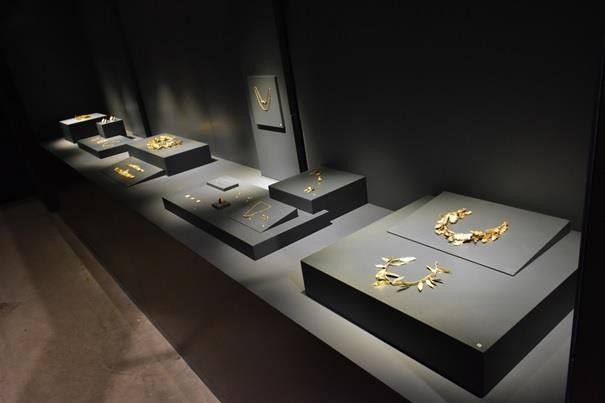
At the core of this level lies the museum’s treasure:
The Troy Gold Collection,
Displayed in a specially illuminated room.
FIRST
RAMP – Early Troas Settlements
Artifacts from early Troas settlements—including
Beşiktepe, Kumtepe, and Sivritepe—introduce visitors to prehistoric life:
- Amphora fragments
- Idols
- Grinding stones
- Axes
- Spindle whorls
- Bone needles
- Early Bronze Age copper friezes and tin pieces
This section is enriched with drawings, maps, and
reconstructions.
FIRST
FLOOR – Bronze Age Troy
This level focuses on the development, layers, and daily
life of Troy during the Bronze Age, particularly Troy II and Troy
VI–VII, the city’s most powerful phases.
Exhibits highlight:
- Craftsmanship
- Daily life artifacts
- Trade networks
- Architectural techniques preserved in rural traditions
- Pottery production and kilning
- Textile and wall-building practices
A dramatic ship display emphasizes Troy’s maritime
significance, while an immersive projection illustrates the destruction of the
city at the end of the Late Bronze Age.
The Treaty of Muwatalli
and Alaksandu (13th Century BC)
A key feature is the replica of the treaty between the
Hittite King Muwatalli II and the King of Wilusa (Troy), Alaksandu—identified
by some scholars with Paris of the Iliad. This document provides crucial
insight into the political role of Troy during Late Bronze Age conflicts among
the Hittites, Mycenaeans (Ahhiyawa), and other regional powers.