
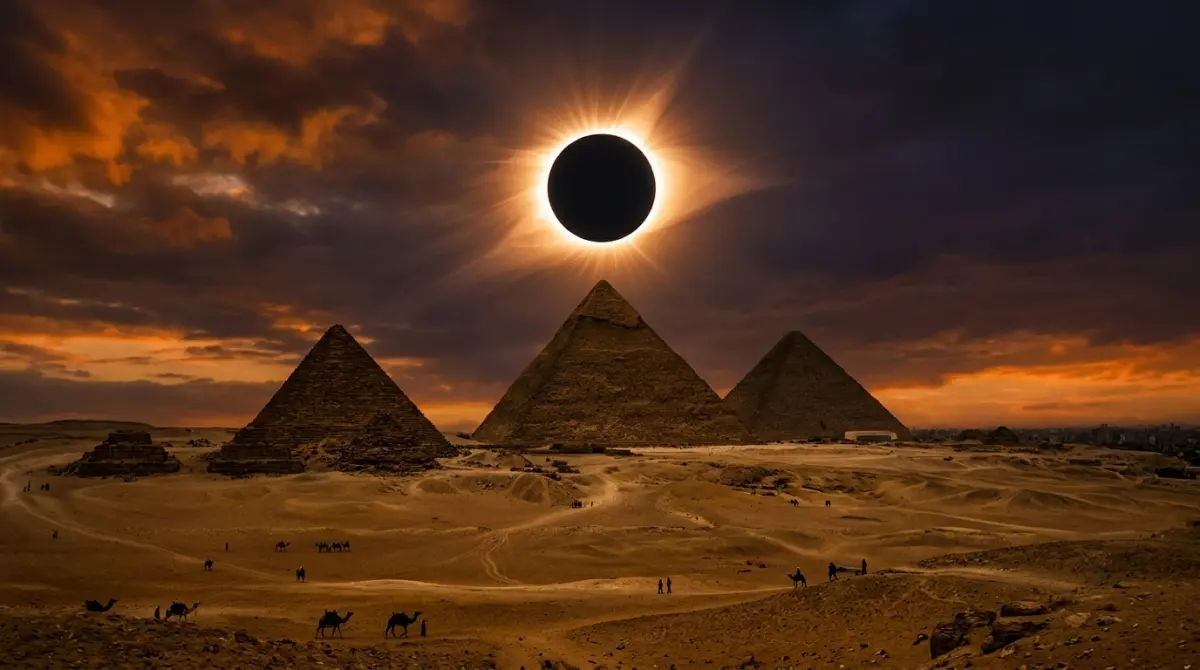
The 2027 Total Solar Eclipse will take place on August 2, 2027, creating a path of totality that stretches from the Atlantic Ocean through southern Europe, North Africa and parts of the Middle East before continuing toward the Indian Ocean. It is expected to be one of the most significant astronomical travel events of the decade, particularly because totality will exceed six minutes in parts of Egypt.
The eclipse will be total across sections of Spain, Morocco, Algeria, Tunisia, Libya, Egypt, Saudi Arabia, Yemen and Somalia. Outside the relatively narrow path of totality, a partial solar eclipse will be visible across a much larger area covering most of Europe, much of Africa, the Middle East and parts of Asia.
Egypt will be especially important for eclipse travelers. Near the point of greatest duration, totality is calculated to reach approximately 6 minutes and 23 seconds, while Luxor is expected to experience approximately 6 minutes and 22 seconds of totality.
Travelers planning specifically around this event can explore our 2027 Total Solar Eclipse Tours, including Egypt, Tunisia and multi-country itineraries designed around the August 2 eclipse.
When Is the 2027 Total Solar Eclipse?
The total solar eclipse will occur on Monday, August 2, 2027. The exact local time of the eclipse depends on where an observer is positioned along its path, because the Moon's shadow will move from west to east across the Atlantic, Mediterranean, North Africa and Middle East.
The path first reaches the Spain and Gibraltar region before continuing across North Africa. It then crosses the Red Sea and parts of the Arabian Peninsula before eventually moving toward the Indian Ocean.
For travelers, this makes the eclipse unusual because there is no single viewing destination. Several countries offer totality, but the duration, Sun altitude, climate, accessibility and surrounding travel experiences differ significantly.
2027 Solar Eclipse Date & Time
The date to remember is:
Monday, August 2, 2027
In Luxor, Egypt, the partial eclipse is calculated to begin at approximately 11:40 AM local time. Maximum eclipse occurs at approximately 1:05 PM, and the partial phase ends at approximately 2:26 PM. Totality itself is expected to last approximately 6 minutes and 22 seconds.
The timing will be different elsewhere along the path, so travelers should always use coordinates and local eclipse calculations for their specific viewing site rather than relying on the timing of another city.
How Long Will Totality Last?
The maximum duration of the 2027 eclipse is calculated at approximately 6 minutes and 23 seconds near the point of greatest duration in Egypt. NASA eclipse calculations place the greatest duration at about 6 minutes 23.2 seconds.
That is an exceptionally long period of totality.
However, the entire eclipse event lasts much longer than the total phase. Visitors first experience a partial eclipse as the Moon gradually covers the Sun. Totality occurs only when the Moon completely covers the solar disk for observers positioned inside the path of totality. After totality, the Moon gradually moves away and the partial phase continues.
This distinction is important when planning transportation, viewing areas and tour schedules. Travelers should expect eclipse-day arrangements to cover several hours rather than arriving only for the few minutes of totality.
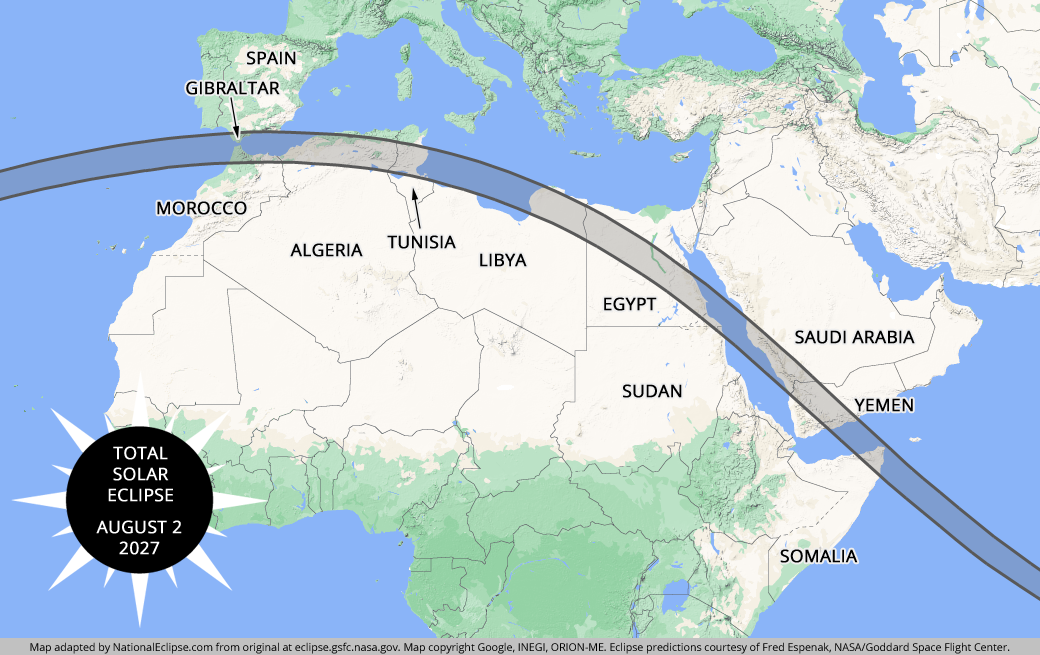
2027 Total Solar Eclipse Path of Totality
The path of totality is the narrow geographical corridor where the Moon completely covers the Sun. Observers outside this corridor may see a substantial partial eclipse, but they will not experience totality.
NASA's eclipse calculations show the Moon's umbral shadow traveling across the Atlantic and through southern Europe, North Africa and the Middle East. The total eclipse path includes Spain, Morocco, Algeria, Tunisia, Libya, Egypt, Saudi Arabia, Yemen and Somalia.
This long geographical path gives travelers several choices, but being somewhere in a country crossed by the eclipse does not automatically guarantee totality. The exact location matters.
Countries in the Path of Totality
The main countries and territories associated with the total eclipse path include:
The eclipse therefore creates a remarkable travel corridor stretching across the Mediterranean, North Africa and the Arabian Peninsula.
Southern Spain offers one of the European opportunities to experience totality, while North Africa provides a much longer stretch of the eclipse path. Egypt becomes particularly important because the region around Luxor lies close to the area where totality reaches its greatest duration.
Major Cities and Regions Along the Eclipse Path
Not every major city in these countries falls directly on the centerline, so travelers need to distinguish between general eclipse visibility and actual totality.
Some of the most notable locations associated with the path include Cádiz, Gibraltar, Tangier, areas of Algeria and Tunisia, Benghazi, Luxor and Jeddah.
Luxor stands out because it combines three characteristics that are particularly attractive for international eclipse travel: a very long period of totality, a location deep inside the eclipse corridor and access to some of Egypt's most important archaeological attractions.
Where Can You See the 2027 Total Solar Eclipse?
The 2027 eclipse can be approached as both an astronomical event and an international travel experience. The path crosses destinations with very different landscapes, infrastructure and cultural attractions.
Southern Europe offers access from Spain, while the North African portion crosses Morocco, Algeria, Tunisia, Libya and Egypt. The eclipse then moves across the Red Sea toward Saudi Arabia and Yemen before continuing toward Somalia and the Indian Ocean.
For many international visitors, the choice is therefore not simply about where totality occurs. Travelers may also consider the duration of totality, transportation, accommodation, historical climate, sightseeing opportunities and how easily the eclipse can be incorporated into a longer itinerary.
Spain and North Africa
Spain provides the main European opportunity for totality during the August 2 event. The path then crosses the Strait of Gibraltar and continues through North Africa.
Morocco and Algeria are situated earlier along the African section of the eclipse path. Tunisia and Libya follow as the shadow continues east.
Tunisia is particularly interesting for travelers who want to combine eclipse viewing with North African cultural sightseeing. A journey can incorporate Tunis, Carthage, Sidi Bou Said and El Jem before or after the eclipse.
Travelers considering this option can explore the 6-Day Tunisia Total Solar Eclipse Tour 2027 or the shorter 5-Day Tunisia Solar Eclipse Tour 2027.
Accommodation options connected with eclipse travel around Sfax can also be found through our Solar Eclipse Sfax Hotels page.
Egypt and the Middle East
As the Moon's shadow moves farther east, it reaches Egypt and crosses areas where the duration of totality becomes exceptionally long.
NASA calculates the point of greatest eclipse at approximately 25°30'N, 33°11'E, with the Sun more than 81 degrees above the horizon and a totality duration exceeding six minutes. The eclipse path around this point is roughly 258 km wide.
After crossing Egypt, the eclipse continues across the Red Sea and into Saudi Arabia, Yemen and Somalia.
For travelers primarily interested in combining a major eclipse with a substantial cultural journey, Egypt therefore has a particularly strong position along the 2027 path.
Best Places to See the 2027 Total Solar Eclipse
There is no universal "best" location because different travelers prioritize different factors.
An astronomy-focused traveler may prioritize totality duration and historical cloud statistics. Another traveler may want comfortable accommodation, transportation and organized viewing arrangements. Others may want the eclipse to be part of a longer cultural vacation.
For that reason, Luxor, Egypt and Tunisia are among the destinations worth considering carefully.
Luxor, Egypt
Luxor is expected to be one of the most important destinations for the 2027 Total Solar Eclipse.
According to current eclipse calculations, totality in Luxor will last approximately 6 minutes and 22 seconds, with maximum eclipse around 1:05 PM local time.
The attraction of Luxor goes far beyond duration.
Luxor is one of the world's major archaeological destinations. Travelers can visit the Valley of the Kings, Karnak Temple, Luxor Temple and other monuments of ancient Thebes as part of the same journey.
This allows the eclipse to become the centerpiece of a broader Egypt itinerary rather than an isolated one-day event.
Visitors who want to explore several parts of the country can consider the 12-Day Egypt Total Solar Eclipse Tour 2027 – Cairo, Luxor, Aswan, Hurghada & Nile Cruise.
Sfax, Tunisia
Tunisia provides another North African option along the 2027 eclipse corridor.
Sfax can be incorporated into an itinerary covering some of Tunisia's best-known historical destinations. Rather than traveling solely for eclipse day, visitors can combine the astronomical event with Tunis, ancient Carthage, Sidi Bou Said and the Roman amphitheatre at El Jem.
This makes Tunisia particularly suitable for travelers seeking a shorter North African eclipse trip.
Other Major Viewing Destinations
Other potential viewing areas stretch from southern Spain through Morocco and Algeria and onward toward Libya, Saudi Arabia and the Arabian Peninsula.
When comparing them, travelers should look beyond whether a destination is technically inside the path. The position within that path can affect totality duration, while local logistics and weather can have an equally important impact on the experience.
A location close to the centerline generally provides longer totality than one near the northern or southern limits of the path. NASA notes that observers must be between the path boundaries to experience the total phase.
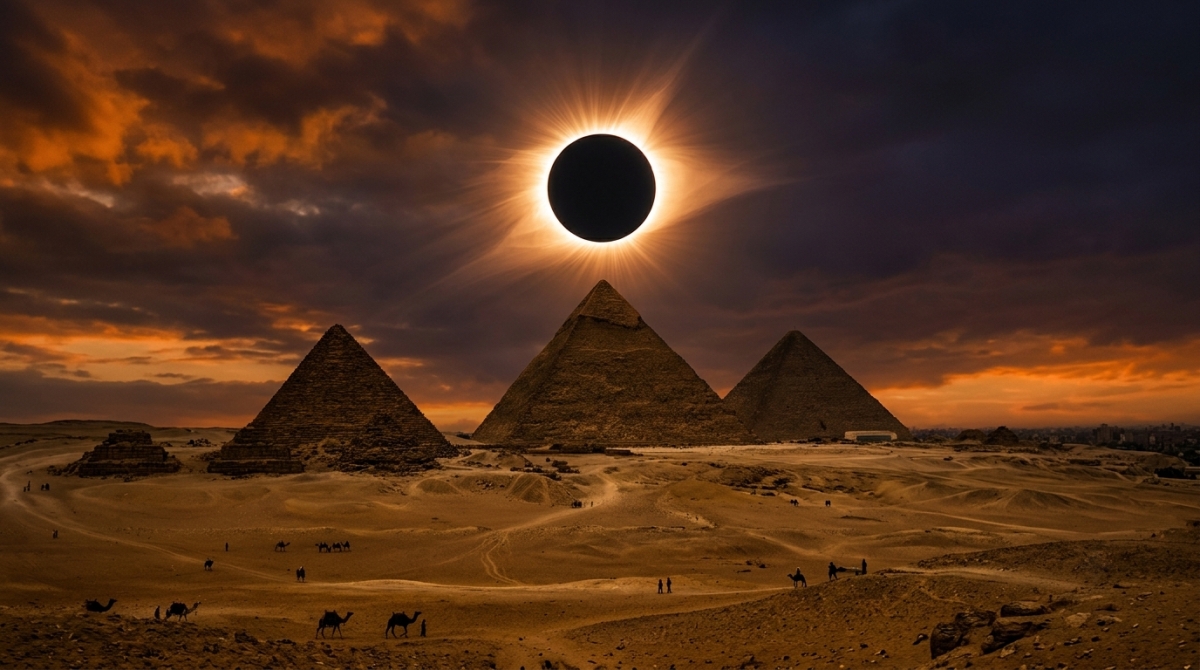
2027 Total Solar Eclipse in Egypt
Egypt is likely to become one of the central international destinations for the August 2027 eclipse.
The path crosses the country from west to east and includes several locations experiencing lengthy totality. Current calculations list approximately 6 minutes 8 seconds in Asyut, 6 minutes 22 seconds in Luxor and 5 minutes 31 seconds at Siwa Oasis.
The combination of eclipse conditions and established tourism infrastructure gives visitors several ways to build an itinerary around the event.
A trip may begin in Cairo with the Pyramids of Giza and other historical attractions before continuing south to Luxor. Longer itineraries can incorporate Aswan, a Nile cruise and the Red Sea.
Luxor and the Nile Valley
For eclipse travelers, Luxor has the advantage of being both a viewing destination and a major cultural destination.
The city lies on the Nile and provides access to archaeological sites on both banks of the river. Visitors can explore Karnak Temple and Luxor Temple on the east bank, while the west bank includes the Valley of the Kings and other ancient monuments.
Because eclipse day represents only one part of the trip, this concentration of attractions makes it possible to create a substantial itinerary around the astronomical event.
Travelers looking for a more compact program can consider the 7-Day Egypt Total Solar Eclipse Tour 2027 – Hurghada, Luxor & Cairo.
Combining the Eclipse With an Egypt Trip
One of the main advantages of choosing Egypt is the number of itinerary combinations available.
Cairo + Luxor provides a straightforward cultural route connecting the capital and the Nile Valley.
Cairo + Nile Cruise + Luxor adds a slower journey through Upper Egypt and allows visitors to experience historical sites along the Nile.
Hurghada + Luxor + Cairo combines the Red Sea, the eclipse and Egypt's major historical destinations.
The 8-Day Egypt Total Solar Eclipse Tour 2027 – Nile Cruise & Cairo Experience is designed for travelers interested in combining the eclipse with the Nile, while the 12-day itinerary extends the journey to Cairo, Luxor, Aswan and Hurghada.
2027 Total Solar Eclipse in Tunisia
Tunisia offers a different type of eclipse journey.
While Egypt is likely to attract considerable attention because of the duration around Luxor, Tunisia provides an opportunity to experience the eclipse as part of a compact Mediterranean and North African cultural itinerary.
Visitors can combine eclipse viewing with Tunis, Carthage, Sidi Bou Said, El Jem and Sfax, creating a trip that covers Roman archaeology, historic medinas and Mediterranean landscapes.
Sfax and the Eclipse Path
Sfax is situated on Tunisia's eastern coast and is an important location when considering eclipse travel in the country.
Travel planning should take the exact viewing location into account rather than assuming that every point around a city will provide identical eclipse circumstances. The position relative to the centerline can influence both the duration and timing of totality.
Accommodation demand can also increase significantly around major eclipse destinations, which makes advance planning particularly important.
Combining the Eclipse With a Tunisia Tour
A Tunisia eclipse itinerary does not need to focus exclusively on Sfax.
Travelers can begin in Tunis, visit the archaeological remains of Carthage and the coastal village of Sidi Bou Said, continue toward El Jem and then incorporate eclipse viewing into the southern or central part of the itinerary.
Our Tunisia Total Solar Eclipse itineraries include both shorter and extended options for travelers who want to combine the eclipse with the country's historical attractions.
2027 Total Solar Eclipse Tours & Packages
Organized eclipse travel can simplify one of the main challenges surrounding major astronomical events: coordinating accommodation, transportation, sightseeing and eclipse-day logistics around a fixed date.
Unlike a normal vacation, the eclipse cannot be moved to another day if travel arrangements go wrong. August 2, 2027 is fixed, making advance planning particularly important.
Our Total Solar Eclipse Tours & Packages include Egypt-focused itineraries, Tunisia programs and longer multi-country journeys.
Egypt Solar Eclipse Tours
Travelers primarily interested in Egypt can choose between several itinerary lengths.
The 7-day program connects Hurghada, Luxor and Cairo and works well for travelers seeking a relatively compact trip.
The 8-day program combines Cairo with a Nile cruise and eclipse experience.
The more extensive 12-day program connects Cairo, Luxor, Aswan, Hurghada and a Nile cruise, allowing the eclipse to sit within a broader exploration of Egypt.
These different formats allow travelers to choose between a short eclipse-centered holiday and a more complete Egypt journey.
Multi-Country Solar Eclipse Tours
The eclipse can also become part of a much larger Mediterranean and Middle Eastern trip.
The 15-Day Türkiye & Egypt Total Solar Eclipse Tour 2027 combines Türkiye's Aegean and Anatolian heritage with Egypt and the Red Sea.
Travelers interested in adding Jordan can consider the 13-Day Türkiye, Egypt, Red Sea & Jordan Petra Eclipse Tour 2027.
There is also a longer 15-Day Türkiye, Egypt & Jordan Heritage Tour 2027 for travelers who want the eclipse to form part of a wider cultural journey.
For an even broader Mediterranean itinerary, the 16-Day Greece, Türkiye & Egypt Solar Eclipse Tour 2027 combines Greece, Istanbul, Türkiye and Egypt within one trip.
Tunisia Solar Eclipse Tours
Tunisia programs provide a more concentrated North African alternative.
The 5-Day Tunisia Solar Eclipse Tour 2027 covers major cultural destinations including Tunis, Carthage, El Jem and Sidi Bou Said.
Travelers wanting an additional day can choose the 6-Day Tunisia Total Solar Eclipse Tour 2027.
Both options are suited to travelers who want to combine the eclipse with Tunisia's archaeological and Mediterranean heritage.
How to Plan Your 2027 Solar Eclipse Trip
Planning an eclipse trip requires more precision than planning an ordinary holiday.
The date cannot change, totality is restricted to a geographical corridor, and accommodation and transportation demand may become concentrated around desirable viewing areas.
The first decision should therefore be the viewing destination.
After selecting the country and region, travelers can determine how many days they want before and after eclipse day. This is where an organized itinerary can be particularly useful, as sightseeing can be structured around the fixed astronomical event.
When to Book Flights, Hotels and Tours
Travelers planning to visit popular locations such as Luxor should consider booking well in advance.
Large astronomical events can create unusually concentrated demand because thousands of travelers need accommodation in the same geographical area on the same dates.
The most important arrangements include:
International flights
Accommodation
Transportation between cities
Eclipse-day transfers
Viewing location
Sightseeing before and after the eclipse
Travel insurance
Appropriate solar viewing equipment
Travelers considering an organized journey can compare available options through the 2027 Solar Eclipse Tours collection before choosing an itinerary.
Choosing the Right Eclipse Destination
The longest totality is not necessarily the only factor that should determine where you travel.
Consider:
Duration of totality: Locations closer to the central part of the path generally provide a longer total phase.
Weather: A technically perfect astronomical location offers little benefit if clouds obscure the Sun. Long-term climate data can help with planning, although no historical average can guarantee clear weather on eclipse day.
Accessibility: Consider airports, roads and transportation to the actual viewing location.
Accommodation: Eclipse destinations can experience exceptional demand.
Surrounding attractions: A destination with substantial cultural or natural attractions can turn the eclipse into a complete vacation.
Tour structure: Some travelers may prefer a dedicated eclipse itinerary, while others may choose a multi-country journey.
For travelers who want both long totality and extensive sightseeing, Luxor and the wider Egypt itinerary are particularly compelling options.
How to Watch the 2027 Total Solar Eclipse Safely
Safe solar viewing is essential.
During the partial phases of a solar eclipse, looking directly at the Sun without appropriate eye protection can cause serious eye injury. Proper solar viewing glasses or viewers designed for direct observation of the Sun should be used.
Ordinary sunglasses are not a substitute for eclipse glasses.
Cameras, binoculars and telescopes also require appropriate solar filters. Concentrated sunlight passing through optical equipment can damage eyes and equipment.
During the brief phase of totality, when the Sun's bright surface is completely covered, observers inside the path of totality can view the corona directly. Eye protection must be put back on as soon as the bright solar surface begins to reappear.
Anyone planning eclipse photography should prepare and test equipment before eclipse day rather than attempting to learn camera settings during the event.
2027 Solar Eclipse Weather & Viewing Conditions
Weather is one of the few major variables that cannot be controlled.
The astronomical path can be calculated years in advance, but a local weather forecast only becomes meaningful much closer to eclipse day. Historical climate information is useful for comparing destinations, but it should not be treated as a guarantee.
Timeanddate's historical data currently shows very low average cloud cover for several Egyptian locations along the eclipse path, including Luxor and Asyut, while noting that actual forecasts only become available shortly before the event.
This is another reason Egypt is receiving substantial attention from eclipse travelers.
However, travelers should still plan for heat. August conditions in Upper Egypt can be extremely hot, and the eclipse occurs around the middle of the day. Shade, hydration, appropriate clothing and a well-organized viewing area therefore become important practical considerations.
A good eclipse plan should ideally include some operational flexibility. If local conditions require adjustments, having transportation and knowledgeable local coordination may provide more options than relying on a single fixed point without support.
Frequently Asked Questions
When is the 2027 total solar eclipse?
The eclipse will occur on Monday, August 2, 2027. Totality will cross parts of southern Spain, North Africa and the Middle East before continuing toward the Indian Ocean.
Where is the best place to see the 2027 eclipse?
There is no single best location for every traveler, but Luxor, Egypt is one of the most significant viewing destinations because it lies close to the area of greatest eclipse and is expected to experience approximately 6 minutes and 22 seconds of totality.
Which countries are in the 2027 path of totality?
The path includes Spain, Morocco, Algeria, Tunisia, Libya, Egypt, Saudi Arabia, Yemen and Somalia. Gibraltar is also crossed by the eclipse corridor.
How long will the 2027 total solar eclipse last?
The maximum calculated duration of totality is approximately 6 minutes and 23 seconds near the point of greatest duration in Egypt. The duration at individual destinations varies according to their position within the eclipse path.
Is Egypt a good place to see the 2027 eclipse?
Egypt is one of the major destinations along the eclipse path. Luxor is expected to experience approximately 6 minutes and 22 seconds of totality, while the region also allows travelers to combine eclipse viewing with Cairo, the Nile Valley, Aswan, ancient Egyptian archaeological sites and the Red Sea.
Are there organized tours for the 2027 solar eclipse?
Yes. Travelers can choose Egypt-only programs, Tunisia itineraries and multi-country journeys combining destinations such as Türkiye, Greece, Egypt and Jordan. The complete selection can be viewed under Total Solar Eclipse Tours 2027.
The August 2, 2027 Total Solar Eclipse is more than a few minutes of darkness. For travelers positioned inside the path of totality, it offers an opportunity to experience one of nature's most dramatic astronomical events while exploring some of the world's most historically significant destinations.
Whether the journey leads to Luxor and the Nile, Tunisia and Carthage, or a longer Mediterranean itinerary through Türkiye, Greece, Egypt and Jordan, planning early gives travelers a wider choice of routes, hotels and eclipse experiences.
Loading comments…