
Ankara Anıtkabir
Europe, Turkey
 1 / 7
1 / 7Museum Information
Opening Hours
09:00 – 16:00
Open Days
About Ankara Anıtkabir
Mustafa Kemal Atatürk—the great leader of the Turkish War
of Independence, the founder of the Republic of Türkiye, and the architect of
the Turkish Revolutions—devoted his 57-year life to securing the independence
of the Turkish nation and guiding it to the level of contemporary civilization.
The Great Leader passed away on 10 November 1938.
Atatürk, who transformed Türkiye into a modern nation
with institutions aligned with contemporary civilization, is a leader who
belongs not only to the Turkish nation but also to the history of humanity. The
idea of constructing a mausoleum that would reflect his greatness in every
aspect, symbolize his principles and reforms, and represent his vision of
modernization emerged as the shared desire of the Turkish people in the deep
sorrow of his passing.
In the construction of Anıtkabir, porous and easily
shaped travertine in various colors was used as exterior cladding over
reinforced concrete, while marble was used in the interior of the mausoleum.
White travertine used in the sculpture groups, lion
statues, and the mausoleum columns was brought from Pınarbaşı (Kayseri), while
additional white travertine for interior tower walls came from Polatlı and
Malıköy. Black and red travertine from Boğazköprü (Kayseri) was used in the
paving of the ceremonial square and towers. Yellow travertine from Eskipazar
(Çankırı) was used for the victory reliefs, the outer walls of the Hall of
Honor, and the surrounding colonnades.
The cream, red, and black marble used in the floor of the
Hall of Honor came from Çanakkale, Hatay, and Adana respectively. The
tiger-skin patterned marble used on the interior walls was brought from Afyon,
and green marble from Bilecik. The monolithic 40-ton sarcophagus stone came
from Osmaniye (Adana), and the white marble facing its side walls from Afyon.
ARCHITECTURAL
CHARACTERISTICS OF ANITKABIR
The years 1940–1950 in Turkish architecture are known as
the “Second National Architectural Period,” characterized by monumental design,
symmetry, and the use of cut stone. Anıtkabir reflects the defining features of
this period.
Alongside this style, elements of Seljuk and Ottoman
architecture and ornamentation appear frequently. For example, the saw-tooth
border at the junction of the walls and roofs of the towers reflects Seljuk
stone craftsmanship. Stone motifs such as çarkıfelek and rosette
found in several towers (e.g., Mehmetçik Tower, Museum Directorate) are also
common in Seljuk and Ottoman art.
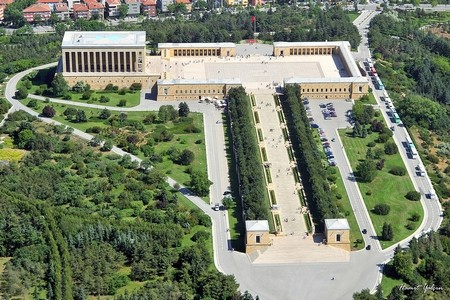
Covering an area of approximately 750,000 m², Anıtkabir
is composed of two main sections: the Peace Park and the Monumental
Block.
A. PEACE PARK
Inspired by Atatürk’s principle, “Peace at Home, Peace in
the World,” the Peace Park was created using trees and saplings brought from
various countries and regions of Türkiye.
Tree species were brought from Afghanistan, the United
States, Germany, Austria, Belgium, China, Denmark, Finland, France, India,
Iraq, the United Kingdom, Spain, Israel, Sweden, Italy, Japan, Canada, Cyprus,
Egypt, Norway, Portugal, Yugoslavia, and Greece. Today, the Peace Park contains
about 48,500 ornamental trees, shrubs, and plants from 104 different species.
B. MONUMENTAL BLOCK
The Monumental Block consists of three main parts:
1.
Lions’ Road
2.
Ceremonial Square
3.
Mausoleum
INDEPENDENCE TOWER
The inscription on the tower bears Atatürk’s words:
"This nation has lived without independence, cannot live without
independence, and will not live without independence. Either independence or
death." (1919)
Inside the tower are a scale model of Anıtkabir and
illuminated information panels.
LIBERTY TOWER
Located at the left entrance of Lions’ Road, its interior
relief depicts an angel holding the “Declaration of Liberty” and a rearing
horse symbolizing freedom and independence. The tower also houses photos
showing the construction stages of Anıtkabir and samples of stones used in its
building.
WOMEN’S STATUE GROUP
Standing before the Independence Tower are three women
dressed in traditional clothing. The two on the sides hold a wreath made of
wheat sheaves, symbolizing the fertility of the homeland. The woman on the left
raises a bowl, praying for mercy for Atatürk, while the central figure covers
her face in grief.
MEN’S STATUE GROUP
In front of the Liberty Tower, three men represent
various segments of Turkish society: a soldier with a helmet and greatcoat, a
young intellectual holding a book, and a villager in traditional attire. Their
solemn expressions convey the grief, dignity, and determination of the Turkish
nation.
LIONS’ ROAD
This 262-meter path was designed to prepare visitors
spiritually for Atatürk’s presence. On each side stand 24 seated lion statues
carved in Hittite style—symbolizing power and tranquility—reflecting Atatürk’s
deep respect for Anatolian civilizations.
CEREMONIAL SQUARE
Located at the end of Lions’ Road, the 129 × 84.25 m
square can accommodate 15,000 people. Its paving consists of 373 carpet- and
kilim-patterned travertine panels in black, red, yellow, and white.
MEHMETÇİK TOWER
The outer relief depicts a mother bidding farewell to her
son going off to defend the homeland. Inside is the “Atatürk and Turkish
Revolution Library,” serving researchers on weekdays.
VICTORY TOWER
Its walls display the dates and quotations from Atatürk’s
three major victories. Inside is the gun carriage that transported Atatürk’s
coffin from Dolmabahçe Palace on 19 November 1938.
TOMB OF İSMET İNÖNÜ
Between the Peace and Victory Towers lies the symbolic
sarcophagus of İsmet İnönü—Atatürk’s closest comrade, Commander of the Western
Front, and the second President of Türkiye. He was buried here on 28 December
1973.
PEACE TOWER
Its relief depicts villagers working peacefully,
protected by a soldier symbolizing the Turkish army as the guardian of peace.
Atatürk’s famous words on peace appear on the walls, and his Lincoln
automobiles (1935–1938) are exhibited inside.
APRIL 23rd TOWER
Its relief represents the opening of the Turkish Grand
National Assembly on April 23, 1920. Atatürk’s 1936–1938 Cadillac automobile is
also displayed here.
FLAGPOLE
Located at the ceremonial square staircase, the 33.53 m
steel flagpole is the tallest single-piece pole in Europe. It was produced in
the United States and donated to Anıtkabir in 1946. The base relief symbolizes
civilization, power, victory, and peace.
NATIONAL PACT (MİSAK-I
MİLLİ) TOWER
A relief of four hands gripping a sword hilt symbolizes
national unity and determination. This tower contains the special signature
book for official delegations and panels showing important ceremonies held at
Anıtkabir.
ANITKABİR ATATÜRK MUSEUM
Opened on 21 June 1960, the museum displays Atatürk’s
personal belongings, uniforms, gifts, decorations, and items donated by his
adopted daughters Afet İnan, Rukiye Erkin, and Sabiha Gökçen.
REFORM TOWER
Dedicated to Atatürk’s reforms, this tower exhibits his
clothing and includes a wax statue of Atatürk created by Prof. Dr. Yılmaz
Büyükerşen.
REPUBLIC TOWER
This tower houses models of the Manastır Military High
School, the Sivas and Erzurum Congress buildings, and the First Turkish Grand
National Assembly building, along with period photographs.
ART GALLERY
Located between the Republic and Defense of Rights
Towers, the gallery exhibits Atatürk’s personal library and oil paintings
depicting him with visiting foreign dignitaries. Documentary films on Atatürk,
the War of Independence, and Anıtkabir are also screened here.
DEFENSE OF RIGHTS TOWER
Its exterior relief symbolizes the national unity that
formed the foundation of the War of Independence. Inside are periodic
exhibitions on the War of Independence and a model of the Military Academy
where Atatürk studied.
RELIEF OF THE SAKARYA
BATTLE
This large composition depicts the hardships of
civilians, the determination of the nation, and the eventual victory under
Atatürk’s leadership.
RELIEF OF THE GREAT
OFFENSIVE
The scene includes Atatürk giving the historic order
“Armies, your goal is the Mediterranean—forward!” along with symbolic
representations of the heroism and sacrifice of the Turkish army.
MAUSOLEUM
The most important section of Anıtkabir, the Mausoleum
sits atop 42 steps with a ceremonial rostrum at the center. The façade contains
Atatürk’s Address to the Youth and the Tenth Anniversary Speech, both inscribed
in gilded lettering.
HALL OF HONOR
Visitors enter through bronze doors. Atatürk’s symbolic
sarcophagus—made of a single block of red marble weighing 40 tons—stands in the
central niche. The hall is richly decorated with marble and mosaic, and
illuminated by twelve bronze torches representing eternity.
BURIAL CHAMBER
Atatürk’s remains lie directly beneath the symbolic
sarcophagus, in an octagonal chamber designed in Seljuk and Ottoman
architectural style. The walls and floor are covered in black, white, and red
marble. In the center stands a red marble tombstone surrounded by brass urns
containing soil brought from all Turkish provinces and the Turkish Republic of
Northern Cyprus.