
Çankırı Museum
Europe, Turkey
 1 / 9
1 / 9Museum Information
Opening Hours
09:00 – 17:00
Open Days
About Çankırı Museum
Çankırı Museum
The origins of Çankırı Museum date back to 9 June 1972,
when a collection of 116 artifacts gathered from the region was first displayed
on the ground floor of the Halkevi (Public Education Center). The museum
continued its activities here until 1976. With the demolition of the Halkevi
building to make way for the 100th Year Cultural Center, the museum was
temporarily relocated to Çankırı High School, where one classroom served as
storage and administrative offices.
After the completion of the Cultural Center, the museum
reopened to visitors on 23 August 1981, occupying the second floor of
the new building. However, as the collection grew steadily and the facilities
became insufficient both physically and functionally, a need arose for a
modern, sustainable, and culturally engaging museum building.
As part of this initiative, the former Government
House (Eski Hükümet Konağı)—a notable structure from the reign of Sultan
Abdülhamid II—was restored and converted into the new Çankırı Museum,
officially opening in 2017.
Today, the museum features 3,000 m² of indoor and 600
m² of outdoor exhibition space, presenting rich collections across its
Archaeology, Ethnography, and Paleontology Halls.
Paleontology Hall – The
Çorakyerler Fossil Site
The museum’s paleontological collection began with joint
rescue excavations conducted by Ankara University and the Museum Directorate in
1997, revealing fossils of various prehistoric animals. Since 2001, the
excavations have continued as a Ministry-approved project under the direction
of Prof. Dr. Ayla Sevim Erol, focusing on the Çorakyerler Vertebrate
Fossil Site, located approximately 5 km from the city center.
This remarkable locality, dated to 8–8.5 million years
ago (Late Miocene) through magnetostratigraphic studies and faunal
comparisons, is considered one of the most significant fossil sites in Türkiye
and the world, both for its well-preserved specimens and its high species
diversity.
Fossils uncovered here shed light on ancient life,
migration routes, and the paleogeography of the region. The finds belong to the
families Bovidae, Giraffidae, Suidae, Rhinocerotidae,
Equidae, Proboscidea, Carnivora, Primates (tailless
monkeys), Rodentia, and Gastropoda.
One of the highlights is the Saber-Toothed Cat fossil,
unique to Türkiye as the only known specimen of its kind. Over 3,000 fossils
discovered at the site are currently preserved in the museum. The Natural
History Hall presents these finds through specimens, digital displays,
dioramas, and extensive information panels.
Archaeology Hall
Located on the ground floor, the Archaeology Hall
showcases artifacts from the Chalcolithic and Bronze Ages, as well as
the Hittite, Hellenistic, Roman, and Byzantine
periods, arranged chronologically in dedicated sections. The hall also features
liturgical objects from the Byzantine era and Christian heritage dated to the
18th–19th centuries.
Exhibits are displayed under thematic headings:
- Chalcolithic and Bronze Ages
- Hittite Civilization
- Hellenistic Period
- Roman Period
- Byzantine Period
- Coin Collection
A special thematic area in the central space is dedicated
to the İnandık Vase, represented here with a high-quality replica
alongside a model illustrating the excavation site at İnandık Höyük—one of the
best-known artifacts in Anatolian archaeology.
The museum’s collection of ancient glass artifacts is
among Türkiye’s most significant. The numismatic section spans a wide
chronology beginning with Archaic Greek coins and continuing through Classical,
Hellenistic, Roman (Republic, Imperial, Late Roman), and Byzantine coinage, as
well as early Islamic coins from the Umayyad era and coins of Turkish-Islamic
states.
Ethnography Hall
Located on the first floor, this section presents
ethnographic objects reflecting the lifestyle, craftsmanship, and sociocultural
traditions of Çankırı and its surroundings, dating from the Ottoman and Early
Republican periods. Exhibits include:
- Traditional Kitchen and Utensils
- Turkish-Islamic Artifacts
- Weaving and Textiles
- Traditional Clothing
- Yaran Culture
- Mevlevi Heritage
- Weaponry
- Medicine and Healing Traditions
- Lighting Devices
- Measuring Instruments
- The İstiklal (Independence) Road
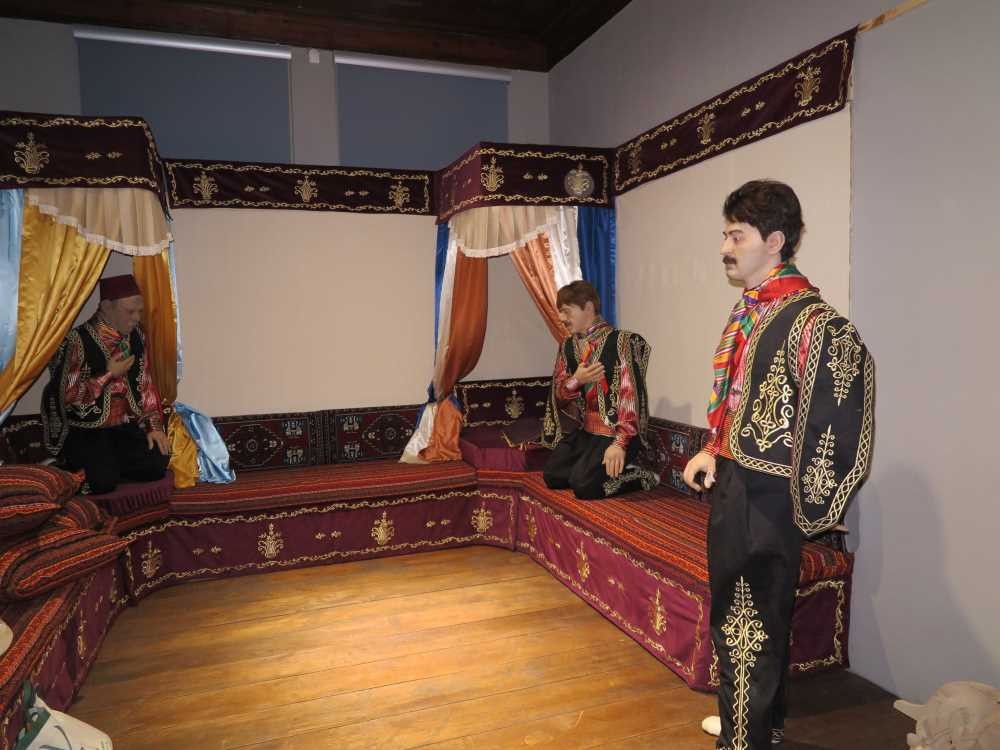
Yaran Culture
Rooted in Ahi traditions, Yaran gatherings embody
virtues such as brotherhood, honesty, generosity, humility, and discipline.
These sociocultural assemblies, still practiced in Çankırı and its villages,
are introduced through an immersive diorama in the museum.
The Serpent-Wrapped
Chalice Statue
This sculpture, featuring the ancient healing symbol of a
serpent entwined around a cup, is displayed in this hall. It originally
belonged to the Çankırı Darüşşifası, a medical complex built in 1235 by
Cemaleddin Ferruh, an atabeg of Seljuk Sultan Alaeddin Keykubat. The exhibit
also includes information on şifa tasları (healing bowls) traditionally
used for protection against illness and the evil eye.