
Eskişehir ETİ Archaeology Museum
Europe, Turkey
 1 / 10
Museum Information
Opening Hours
08:00 – 17:00
Open Days
About Eskişehir ETİ Archaeology Museum
The Eskişehir ETİ
Archaeology Museum is recognized by the Ministry of Culture and Tourism as
Türkiye’s first museum realized by the private sector, from project design to
exhibition implementation. The museum stands as a successful example of
public–private cooperation in the preservation and presentation of cultural
heritage.
Architectural Structure
& Facilities
Construction of the museum complex was completed in 2010,
with the administrative building put into service the same year. Built on a
site of approximately 1,300 m², the museum consists of three separate blocks
with a total usable indoor area of 4,000 m².
- Administrative Block
- Basement: Conservation laboratory and photography studio
- Ground floor: Cafeteria
- 1st & 2nd floors: Library and administrative offices
- B Block
- Ground floor: Exhibition hall, conference and multi-purpose event
space
- Basement: Storage areas
- 1st floor: Archaeological exhibition galleries
- C Block
- Ground floor: Semi-open exhibition and temporary exhibition hall
- Basement: Storage areas
- 1st floor: Archaeological exhibition galleries
The museum garden features the display of immovable stone
artifacts.
Historical Background
The foundations of museum activities in Eskişehir date
back to 1945, when movable cultural assets collected from the city and
surrounding districts were stored in a depot museum at Alaeddin Mosque.
In 1966, the Eskişehir Museum Directorate was officially established at the
Kurşunlu Mosque Complex in the Odunpazarı district and opened to the public.
In 1974, museum activities continued in a new building on Atatürk Boulevard in
the Akarbaşı neighborhood.
Due to spatial limitations and the need for a modern
museum concept, the museum was closed to visitors in 2001. Following a protocol
signed on 28 February 2007 between the Ministry of Culture and Tourism and the
ETİ Companies Group, the construction of the new museum building was sponsored
by ETİ.
The Eskişehir ETİ Archaeology Museum was officially
opened to the public on 28 May 2011 by the President of the Republic of
Türkiye.
Collections &
Exhibitions
The museum’s collection consists of artifacts acquired
through purchase, donation, and confiscation, as well as findings obtained
mainly from archaeological excavations and surface surveys conducted at ancient
sites across Eskişehir.
The exhibition focuses particularly on significant
archaeological sites such as:
- Dorylaion (Şarhöyük – Tepebaşı)
- Pessinus (Ballıhisar – Sivrihisar)
- Han Underground City (Yazılıkaya – Han)
- Keçiçayırı (Bardakçı – Seyitgazi)
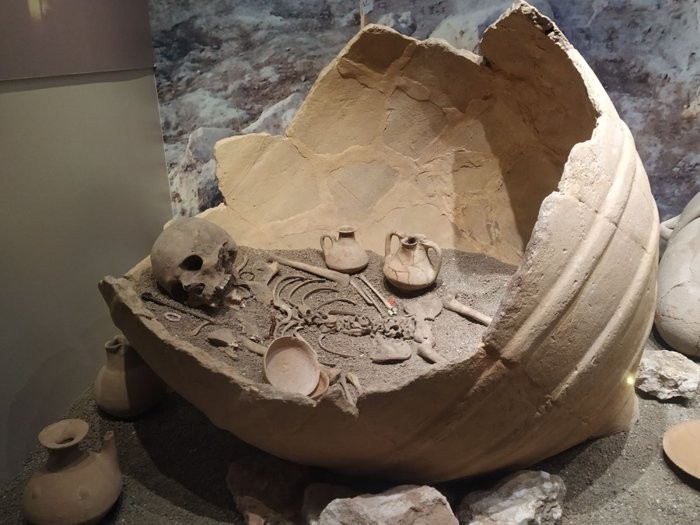
- Çavlum Old Hittite Necropolis (Odunpazarı – Çavlum)
- Demircihöyük (Çukurhisar – Tepebaşı)
- Karacahisar (Odunpazarı – Karacaşehir)
- Küllüoba (Yenikent – Seyitgazi)
Artifacts are displayed chronologically, accompanied by
key archaeological findings.
Highlights of the
Collection
Exhibited works include:
- Marble statues and figurines
- Architectural fragments and stelae
- Terracotta daily-use vessels and idols
- Glass vessels and beads
- Metal containers, weapons, and tools
- Jewelry and coins
The museum houses approximately 22,500 movable cultural
assets, representing periods from the Neolithic, Chalcolithic, Bronze Age,
Hittite, Phrygian, Hellenistic, Roman, Byzantine, Seljuk, and Ottoman eras.
Of these, around 2,000 artifacts are displayed in 1,800
m² of exhibition space, while the remaining 20,500 artifacts are carefully
preserved in 900 m² of museum storage areas.