
Hagia Sophia of Trabzon
Europe, Turkey
Museum Information
Open Days
About Hagia Sophia of Trabzon
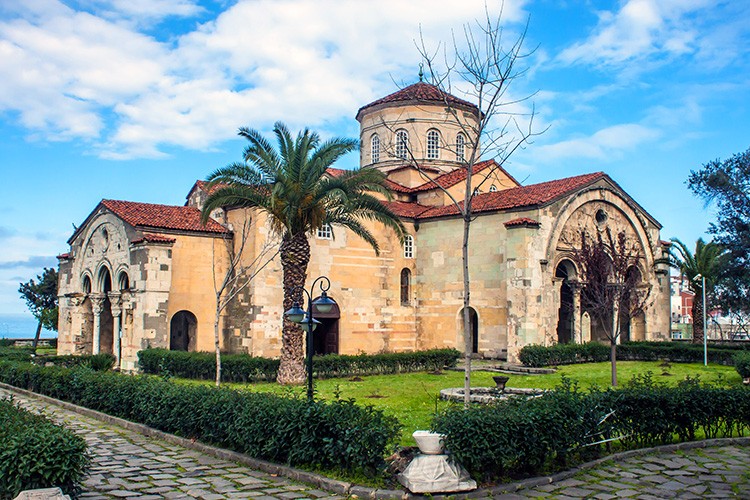
Hagia Sophia of Trabzon (officially Hagia Sophia
Mosque; Greek: Hagia Sophia, meaning “Holy Wisdom”) is a former
Byzantine church later converted into a mosque, located in the Fatih District
of Trabzon, Türkiye. Built between 1250 and 1260 during the reign of Manuel I
Komnenos, it is considered one of the best-preserved architectural legacies of
the Empire of Trebizond.
The monument stands on a rocky promontory overlooking the
Black Sea. Although originally constructed close to the shoreline, land
reclamation and coastal road construction in the 20th and 21st centuries have
left the building approximately half a kilometer inland.
Historical Background
Following the Latin occupation of Constantinople in 1204,
Trabzon became one of the new centers of Byzantine authority. During the 13th
century, the Empire of Trebizond undertook extensive construction activities,
among which Hagia Sophia emerged as a major religious monument dedicated to
Holy Wisdom.
Originally built as a monastery church, the structure
reflects a remarkable synthesis of architectural traditions. While its general
form follows the Byzantine provincial style, it also incorporates Georgian
influences—notably the onion-shaped dome—and Seljuk stonework, particularly
visible in decorative elements on the façades.
After the Ottoman conquest of Trabzon in 1461, the church
continued to function as a Christian place of worship for a period. It was
converted into a mosque in the late 16th or 17th century, with sources
differing on the exact date. Throughout its history, the building served
various purposes, including a military headquarters, hospital, and storage
facility during the Russian occupation in World War I.
In 1964, Hagia Sophia was converted into a museum
following restoration efforts that revealed its outstanding Byzantine frescoes.
On 28 June 2013, after legal and administrative changes, the building was
reopened for worship and resumed its function as a mosque.
Architecture
Hagia Sophia of Trabzon is regarded as one of the finest
examples of Late Byzantine church architecture. It follows a cross-in-square
plan crowned by a high drum dome. The north, west, and south sides feature
porticoed porches, while the roof system combines domes and vaults at varying
heights, all covered with tiles.
The stone craftsmanship is of exceptional quality.
Decorative elements demonstrate a harmonious blend of Christian iconography and
Islamic Seljuk motifs, particularly visible in the geometric interlace
patterns, medallions, and muqarnas niches on the façades.
A freestanding bell tower, located west of the main
building, was constructed in 1427 and decorated with wall paintings in 1443. It
is believed to have been used for astronomical observations and possibly as a
lighthouse.
Frescoes and Artistic
Features
The interior of Hagia Sophia is renowned for its
13th-century frescoes, which were completed around 1260. These paintings depict
scenes from the New Testament and are considered masterpieces of Byzantine art.
- The central dome features Christ Pantokrator, symbolizing Christ as
the ruler of the universe.
- Beneath the dome is a band of inscriptions and a choir of angels,
followed by a frieze of additional angel figures.
- Between the windows are depictions of the Twelve Apostles.
- The pendentives and wall surfaces illustrate scenes such as the
Nativity, Baptism, Crucifixion, Resurrection, and the Last Judgment.
- In the apse vault, the Ascension (Anelipsis) scene is prominently
displayed.
On the southern façade, a sculpted frieze narrates the Creation of Adam and Eve, while the keystone of the main arch bears the double-headed eagle, the emblem of the Komnenos dynasty, which ruled Trabzon for 257 years