
Mersin Anemurium Archaeological Site
Europe, Turkey
 1 / 10
Museum Information
Opening Hours
09:00 – 17:00
Open Days
About Mersin Anemurium Archaeological Site
The Ancient City of Anemurium is located within
the boundaries of Ören Neighborhood in Anamur District, Mersin Province.
Historical sources and modern research indicate that during the Roman period,
Anemurium was one of the most significant economic and political centers of
both Cilicia and Anatolia.
The name Anemurium means “Windy Cape.”
Although the exact date and founders of the city remain unknown, its mention in
ancient harbor lists confirms its existence as early as the 4th century BCE.
During the reign of King Antiochus IV of Commagene, the city minted its
own coins and remained under his control until AD 72, after which it
became part of the Roman Empire until AD 382.
By the first half of the 3rd century AD, Anemurium
had reached a peak of prosperity and urban development. Major construction
projects during this period included a theater, odeon, basilica, baths,
aqueducts, and hundreds of tomb structures. However, in AD 260, the
city was captured by the Sassanids, leading to instability and the
construction of new defensive walls.
During the Early Byzantine period, especially in
the 5th and 6th centuries, Anemurium flourished once again. Numerous
churches, baths, and public buildings adorned with rich floor mosaics
were constructed. Unfortunately, a devastating earthquake in AD 580
caused extensive destruction. Despite this, the city remained inhabited
continuously for nearly 700 years, from the 1st to the 7th century AD,
making Anemurium one of the most important archaeological sites in the
Mediterranean region.
Necropolis
The Anemurium Necropolis is the largest and
richest burial area in the Cilicia region, extending northeast of the city.
Approximately 350 tomb structures, dated between the 1st and 4th
centuries AD, have been identified. Most tombs are barrel-vaulted,
many of which remain well preserved. The necropolis also includes exedrae,
truncated cone-shaped tombs, domed tombs, baldachin-style tombs, and rock-cut
graves. Some tombs feature frescoes and mosaics, and several were
designed to accommodate funerary banquets and commemorative ceremonies.
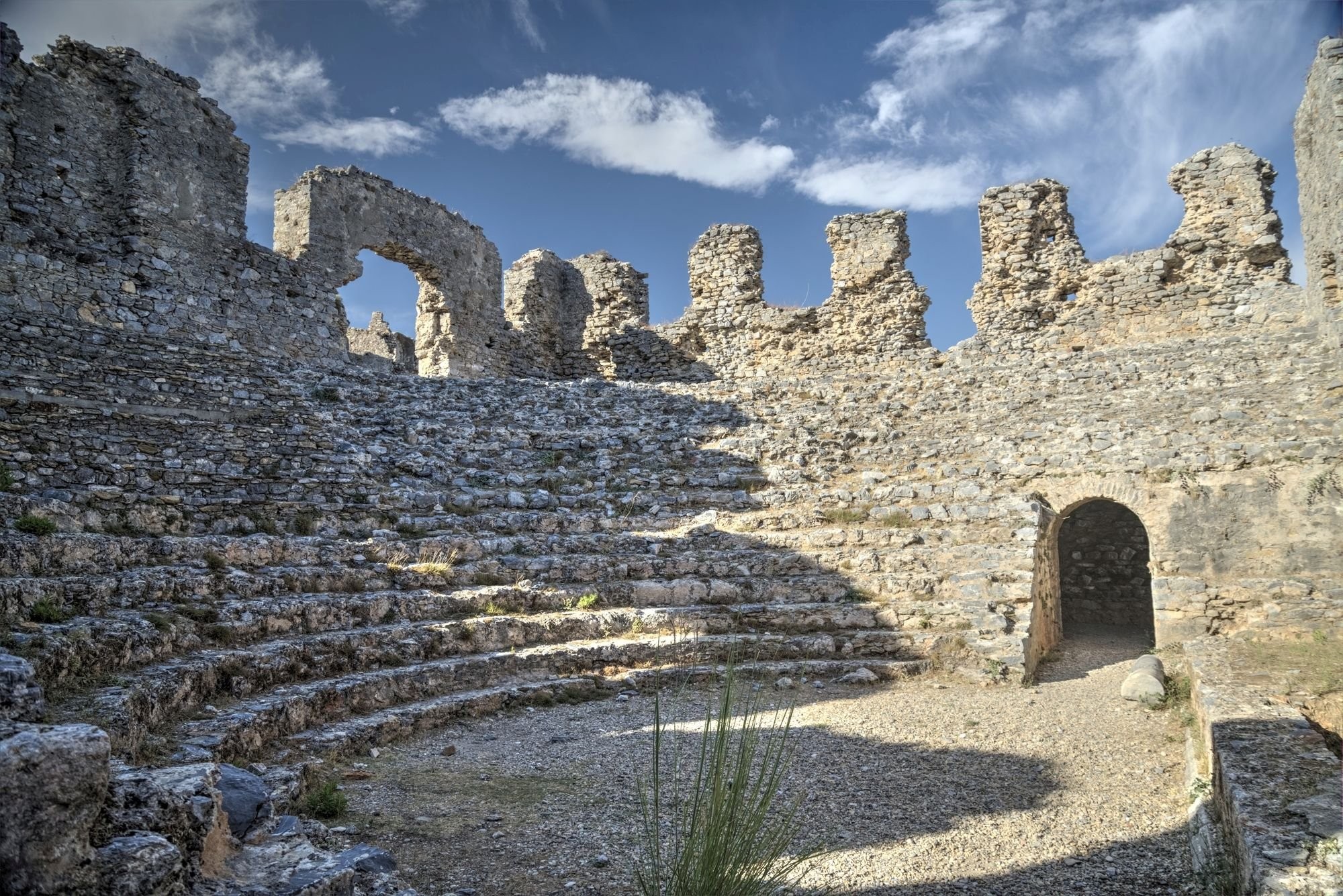
Odeon
Believed to have been constructed in the late 2nd or
early 3rd century AD, the odeon is one of the best-preserved structures in
Anemurium. Measuring 31 × 21 meters, the building had a seating capacity
of approximately 900 people and features a two-story, four-sided plan.
It consists of 15 seating rows, an orchestra area, a stage building, and
a U-shaped vaulted gallery on the lower level. Both the orchestra and
the vaulted gallery floors are decorated with mosaics.
Public Bath
Another remarkably preserved structure is the public
bath complex, which survives almost up to its roof. Measuring 30 × 25
meters, the bathhouse is two stories high. The first floor includes five
vaulted rooms on the eastern side, while the second floor—accessible by a
staircase of approximately 30 steps—contains 12 rooms, corridors, and a large
main hall. Many of these spaces are adorned with mosaic floors. Excavations
indicate that the earliest construction phase dates back to the Late
Republican–Early Imperial period.
Tethys Mosaic
Northwest of the odeon, near the modern asphalt road,
lies a structure whose wall foundations are still visible. Although its exact
function is unknown, it is believed to have been a public building
rather than a private residence. One of its rooms contains a highly significant
mosaic depicting a female figure surrounded by dolphins and fish,
rendered in dark blue, light blue, red, and yellow tesserae. Based on the
marine imagery, the figure is thought to represent Tethys, the sea
goddess. The mosaic is believed to date to the second half of the 3rd
century AD or the early 4th century AD.