
Free Cancellation
-high.jpg&w=1920&q=75 "10 Days Russian Capitals and Golden Ring Tour")
-high.jpg&w=1920&q=75 "The Golden Ring Tour")
-high.jpg&w=1920&q=75 "Images of Russia St. Petersburg – Moscow 8 Day 7 Night Tour")
-high.jpg&w=1920&q=75 "Muslim Heritage Tour St. Petersburg — Kazan — Moscow 11 Day 10 Night")
-high.jpg&w=1920&q=75 "The Jewels of Russia: Moscow, St. Petersburg and Novgorod")
-high.jpg&w=1920&q=75 "10 Days 9 Nights Two Capitals of Russia and Golden Ring")
-high.jpg&w=1920&q=75 "Backroads Of Russia On Route 12 Days")
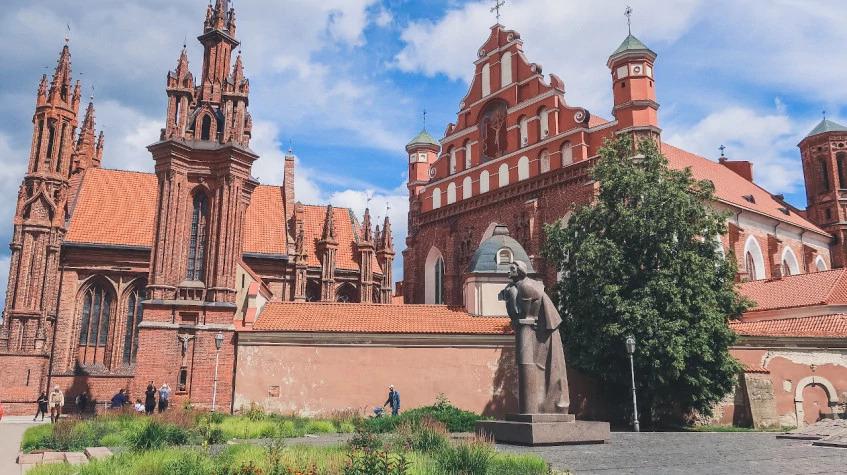
-high.jpg&w=1920&q=75 "8 Days Baltic Triangle Tour")
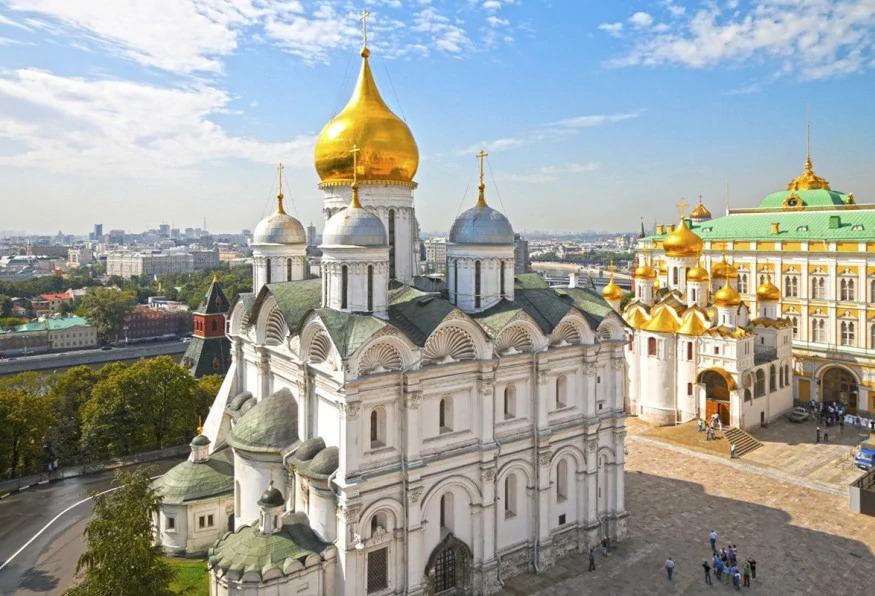
-high.jpg&w=1920&q=75 "10 Days 9 Nights Russian Religion, Culture, Traditions Tour Packages")
-high.jpg&w=1920&q=75 "Russia With Nothern Light 10 Day 9 Night Tour Packages")
-high.jpg&w=1920&q=75 "8 Days / 7 Nights Anta Family Groups")
St Petersburg tours revolve around the Hermitage Museum's vast art collection, the pastel palaces along the Neva River and canals, and the imperial estates just outside the city. Built by Peter the Great as a window onto Europe, the city carries a different character from Moscow, laid out on islands and waterways rather than around a single fortified center; the wider set of Russia tours covers both cities for travelers planning a longer trip. The historic center, together with the group of related monuments at Peterhof and elsewhere, is listed as a single UNESCO World Heritage Site, one of the largest such listings in Russia.
Because so much of what matters here sits inside a handful of major sites, St Petersburg rewards a slower pace than a typical city stop. The Hermitage alone can take a full day, and the palace grounds at Peterhof and Pushkin are worth a half-day excursion each, so most visitors plan at least three to five days to see the city properly.
The State Hermitage Museum occupies the Winter Palace and four connected buildings along the Palace Embankment, holding more than three million items across galleries that range from Egyptian antiquities to Rembrandt, Matisse and Picasso. The Winter Palace's malachite and jasper rooms and the sweep of the Jordan Staircase are part of the exhibit in their own right, separate from the art on the walls.
Peterhof, on the Gulf of Finland about 30 kilometers west of the city, is known for its Grand Cascade, a terraced arrangement of gilded statues and fountains that runs without pumps, using gravity alone. Catherine Palace, in the town of Pushkin southeast of the city, holds the reconstructed Amber Room and a baroque blue-and-gold facade that stretches more than 300 meters.
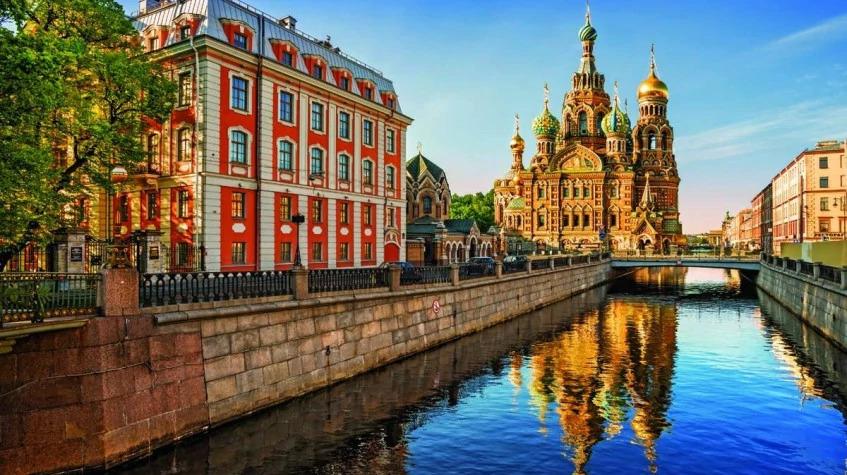
The Church of the Savior on Spilled Blood, with its mosaic-covered onion domes, stands on the site of Alexander II's assassination and is most striking when viewed from across the Griboyedov Canal. Nevsky Prospekt, the city's main avenue, runs from the Admiralty to the Alexander Nevsky Monastery and passes Kazan Cathedral's curved colonnade along the way. Canal boat rides give a waterline view of the palace facades that line the Fontanka and Moika rivers.
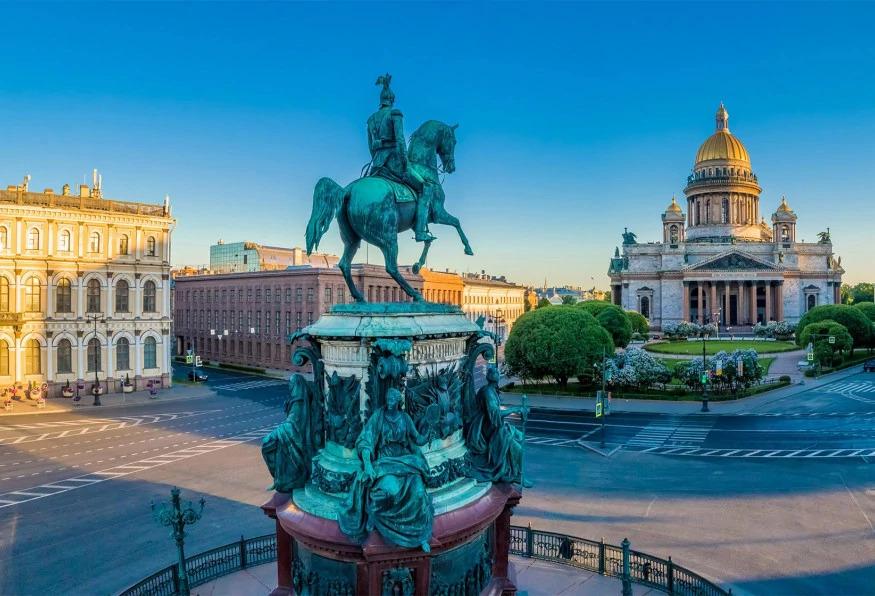
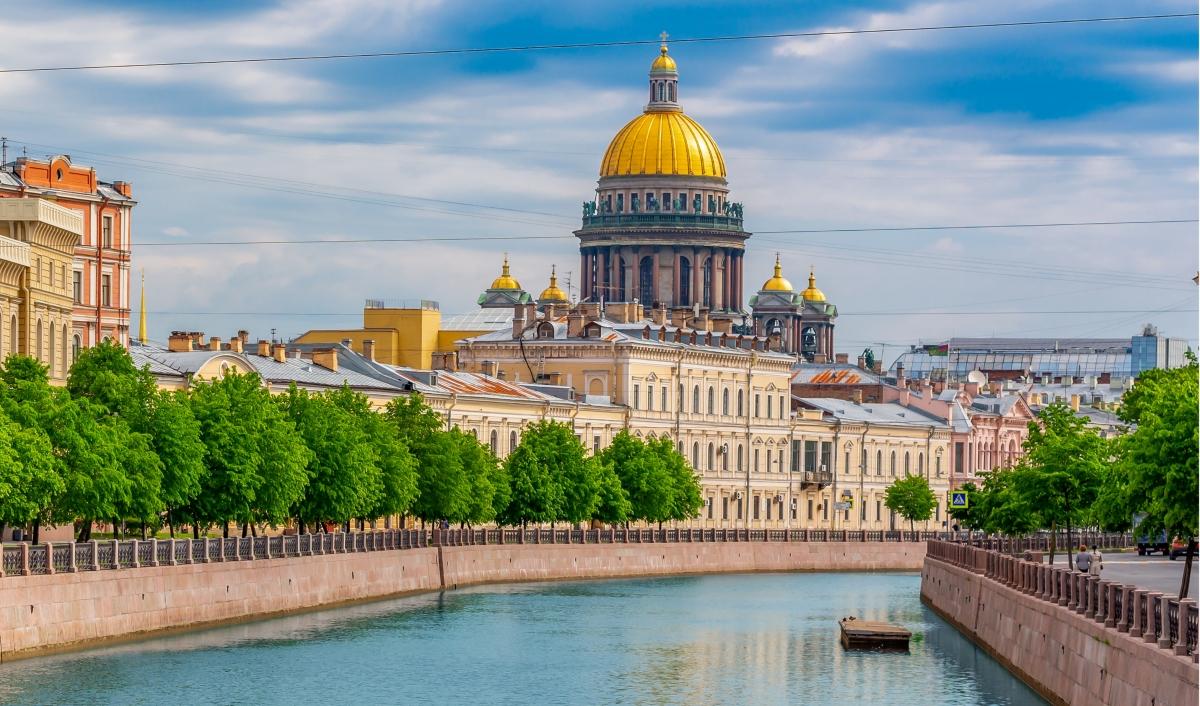
St Isaac's Cathedral took 40 years to build and holds one of the largest domes of its kind, covered in more than 100 kilograms of gold leaf. Its colonnade, reached by a narrow stairway, gives a rooftop view over the historic center that takes in the Admiralty spire, the Neva embankments and the surrounding rooftops.
Peter and Paul Fortress, on its own island in the Neva, was the city's original 1703 stronghold and now holds the cathedral where most of the Romanov tsars are buried, its gilded spire visible across the river from the Hermitage. The fortress also held political prisoners under both the tsars and the early Soviet government, and a small museum inside the walls covers this later use alongside its original military role. A noon cannon shot fired from the fortress walls is a long-running city tradition.
Vasilyevsky Island sits at the point where the Neva River splits before reaching the Gulf of Finland, marked by the red Rostral Columns and the old Stock Exchange building on its eastern spit. The Kunstkamera, founded by Peter the Great in 1727 as Russia's first museum, holds an anatomical and ethnographic collection that predates the Hermitage by decades and still occupies its original building across the river from the Winter Palace.
The Mariinsky Theatre has staged ballet and opera since 1860 and remains closely associated with Russian classical repertoire, including productions of Tchaikovsky's Swan Lake and The Nutcracker performed in the city where both premiered; a newer second stage, opened in 2013 next to the original building, expanded the company's capacity for opera. The Faberge Museum, housed in the restored Shuvalov Palace along the Fontanka River, displays several of the jeweled Imperial Easter Eggs made for the Romanov family, giving a more focused stop than the Hermitage for visitors short on time.
The historic center is compact enough to cover much of it on foot, with the Hermitage, St Isaac's Cathedral and Nevsky Prospekt all within a walkable core along the Neva embankment. Sites farther out, including Peterhof, Catherine Palace and Peter and Paul Fortress, are usually reached by organized transport, hydrofoil or the metro rather than on foot, since distances between them stretch well beyond a comfortable walk.
Beyond Peterhof and Catherine Palace, the wider group of imperial estates around St Petersburg includes Pavlovsk, an English-style landscaped park built for Catherine the Great's son Paul, and Gatchina, a moated palace that later served as a residence for several tsars. Both sit farther from the center than the two main palaces and suit a second or third day trip for visitors staying a week or longer.
The White Nights, from roughly late May to mid-July, keep the sky lit through much of the night and coincide with the city's busiest tourist season and outdoor festivals. Late spring and early fall bring smaller crowds at the major museums while keeping reasonable weather for walking the canals.
Because the Hermitage, the palace estates and the historic center each take real time, a multi-day plan works better than a single fast pass through the highlights. The 5 Days Saint Petersburg City Tour groups the Hermitage, Peterhof and the historic center into a single itinerary, which suits travelers who want the main sites covered without piecing the schedule together themselves.