
Free Cancellation
-high.jpg&w=1920&q=75 "12 Days Best of Eastern Europe Tour")
-high.jpg&w=1920&q=75 "Private VIP Gourmet & Cultural Tour: Prague, Vienna & Budapest in 7 Days")
-high.jpg&w=1920&q=75 "11 Days Cook, Taste & Explore: Prague – Vienna – Budapest")
-high.jpg&w=1920&q=75 "Private Central Europe Tour: Prague, Vienna & Budapest in 7 Days")
Bratislava sits on the Danube in the southwest corner of Slovakia, closer to Vienna than to any other national capital in Europe. Centuries as a Habsburg coronation town left the city with a compact old town, a hilltop castle, and a river promenade that can all be covered in a single day. Tours centered on Slovakia often use Bratislava as the starting point, since its airport and train links connect directly to Vienna and Budapest.
Eleven kings and queens were crowned in the city's cathedral between 1563 and 1830, after Bratislava (then Pressburg) became the coronation seat of the Kingdom of Hungary following the Ottoman advance on Buda. That history still shapes the layout of the old town, where a line of brass crowns set into the pavement marks the former coronation procession route from the cathedral to the main square.
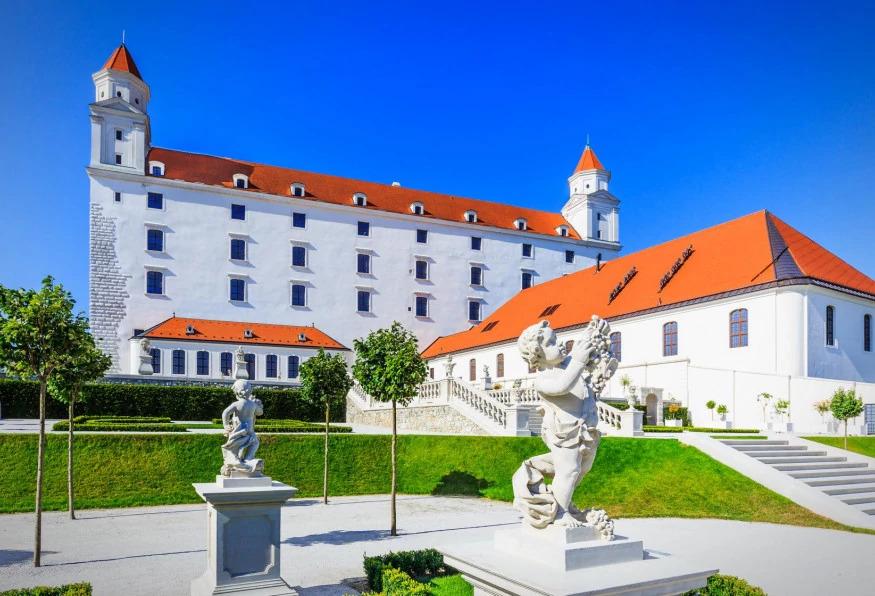
The white, rectangular Bratislava Castle stands on a hill above the Danube and has watched over the city since the ninth century, though the current Baroque form dates mostly from an eighteenth-century rebuilding. Inside, the Slovak National Museum's history collection covers the castle's role through the Habsburg period, and the courtyard terraces give wide views over the river and the old town rooftops below. Down the hill, Michael's Gate is the only surviving gatehouse from the medieval city walls and now marks the entrance to a warren of narrow lanes lined with cafes and small shops. The Main Square anchors the old town, framed by the Old Town Hall and a Baroque fountain, and a short walk away sits the bronze figure of Cumil, a workman peering out of a manhole cover that has become one of the city's most photographed street details.
St. Martin's Cathedral, a Gothic church on the western edge of the old town, hosted the coronations that defined Bratislava's history, and its spire is topped with a gilded replica of the Hungarian crown rather than a plain cross. From the cathedral, the old town opens onto the Danube, where a riverside promenade runs beneath the modern SNP Bridge. An observation deck built into the bridge's pylon, informally known as the UFO, gives an elevated view back over the castle, the cathedral spire, and the flat Petrzalka district across the water. The riverfront is easy walking distance from both the castle and the main square, making it a natural finish to a day spent in the historic core.
Devin Castle sits on a limestone cliff a few kilometers west of central Bratislava, at the point where the Morava River meets the Danube and the borders of Slovakia and Austria come together. The site has been fortified since Celtic and Roman times, and the ruins that stand today date mainly from medieval and early modern rebuilding before the castle was destroyed by Napoleon's troops in 1809. During the Cold War the surrounding riverbank marked the Iron Curtain, and the castle now serves as a reminder of that border history as well as a scenic lookout over two countries. It is a common half-day addition to a Bratislava itinerary, reachable by bus or river cruise from the city center.
Visitors who want the city's main sights arranged into a single itinerary can look at the 4 Days Bratislava City Package, which covers the castle, old town, and river area over a short stay. Because the city is so compact, a few days is generally enough to see the core sights without needing to rush between them, leaving room for a side trip to Devin or across the border to Vienna.
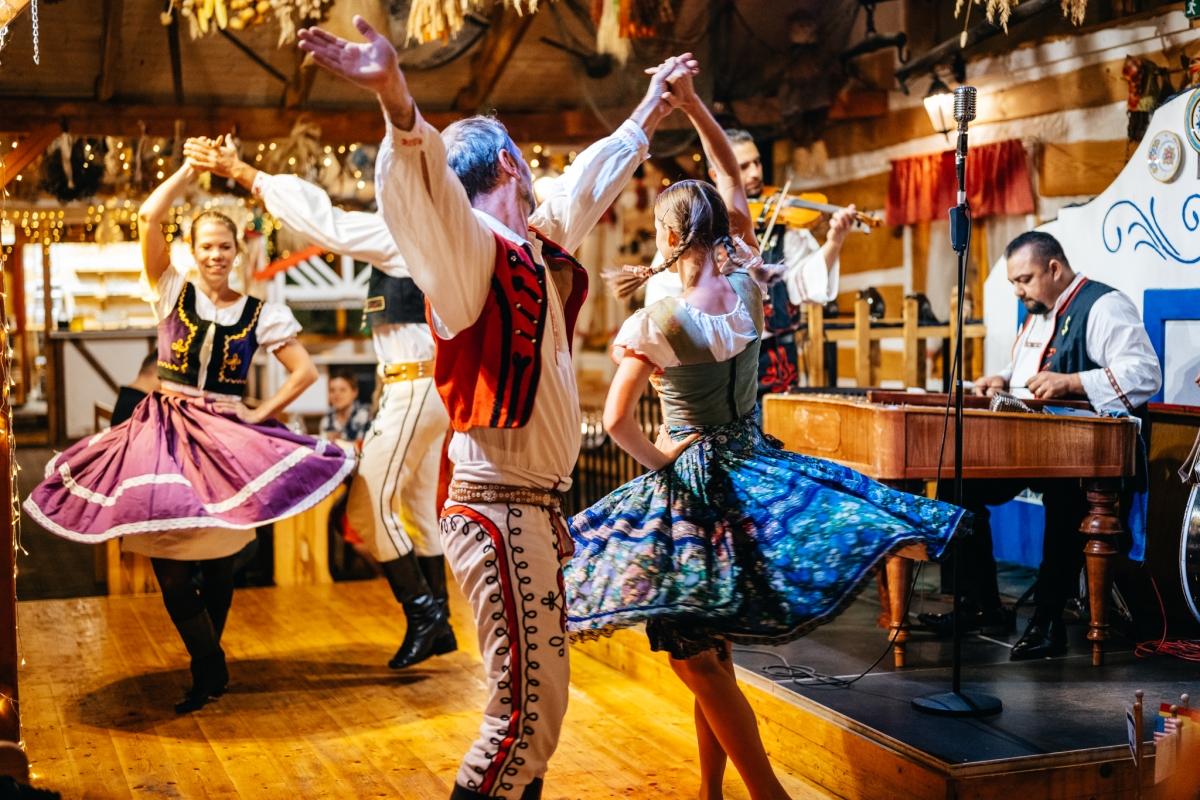
Bratislava's old town keeps a strong cafe tradition from its Habsburg-era coffeehouses, several of which still operate with their original wood paneling and marble tables near the Main Square. Local menus lean on dishes such as bryndzove halusky, small potato dumplings served with a sharp sheep's cheese and bits of bacon, a dish considered close to a national staple across Slovakia. Christmas markets fill the Main Square and the area around the Old Town Hall each December, drawing visitors for mulled wine and stalls selling regional crafts. Combined with the wine cellars of the nearby Little Carpathians, the food and drink scene gives visitors a reason to slow down between the city's historic sights.
Bratislava's location makes it one of the few capitals where a neighboring capital is a same-day trip. Vienna is roughly an hour away by train or by boat along the Danube, and Budapest is about two and a half hours by train, so many visitors combine Bratislava with one or both cities rather than treating it as a standalone stop. That proximity, combined with the small scale of the old town, keeps Bratislava a manageable base for travelers who want a Central European capital without the scale of Vienna or Budapest.
North of the city, the Little Carpathian hills hold a string of wine-growing villages such as Raca, Svaty Jur, and Modra, where vineyards have been cultivated since medieval times. Wine cellars in these villages remain open for tastings, and the Raca district holds an annual grape harvest festival each autumn. The hills also offer walking and cycling routes with views back toward Bratislava and, on clear days, across the Danube plain toward Austria and Hungary. A trip out to the Little Carpathians works well as a slower alternative to the city's main historic sights, especially for visitors staying more than a couple of days.