
Free Cancellation
-high.jpg&w=1920&q=75 "12 Days Best of Eastern Europe Tour")
-high.jpg&w=1920&q=75 "Private VIP Gourmet & Cultural Tour: Prague, Vienna & Budapest in 7 Days")
-high.jpg&w=1920&q=75 "11 Days Cook, Taste & Explore: Prague – Vienna – Budapest")
-high.jpg&w=1920&q=75 "Private Central Europe Tour: Prague, Vienna & Budapest in 7 Days")
Slovakia is a landlocked country in Central Europe, bordered by Austria, the Czech Republic, Hungary, Poland, and Ukraine. Much of its territory is mountainous, running from the Little Carpathians near the capital up to the High Tatras along the Polish border, and that terrain has kept large stretches of forest, cave systems, and traditional villages intact. Tours grouped under Europe often pair Slovakia with its neighbors, but the country has enough on its own, from alpine hiking to wooden churches, to fill a dedicated trip.
Bratislava, the capital, sits at the country's southwestern edge on the Danube and functions as the main gateway for most visitors, but Slovakia's tourism draw extends well beyond the capital into the mountains and countryside further east. The country's small size, roughly the same land area as Belgium and the Netherlands combined, means that the High Tatras, the eastern cities, and the wooden church trail are all reachable within a single loop itinerary.
The High Tatras form the highest range of the Carpathian Mountains, with Gerlachovsky stit reaching 2,655 meters as the tallest peak in the entire mountain chain. The town of Poprad serves as the main gateway, and from there a network of trails and cable cars climbs into the range, past glacial lakes such as Strbske Pleso toward jagged granite peaks that hold snow into early summer. To the south, Slovak Paradise National Park offers a different kind of mountain landscape, with narrow limestone gorges, waterfalls, and trails fitted with ladders and chains that let hikers climb directly up through the ravines rather than around them. Both areas draw hikers in summer and skiers in winter, and together they cover the mountain half of what Slovakia has to offer.
Slovakia's Carpathian region holds a scattered group of wooden churches built by Orthodox, Greek Catholic, and Protestant communities between the 16th and 18th centuries, several of which are inscribed as a UNESCO World Heritage site. Built without metal nails, the churches show construction techniques particular to the region and often sit in small villages far from the country's main roads. Vlkolinec, near the town of Ruzomberok, preserves a full settlement of traditional log houses and is itself a UNESCO-listed village rather than a single building. Together these sites give a view of rural Slovak life that predates the country's industrial towns, and they are usually visited as stops along a route through central and eastern Slovakia rather than as a single destination.
Kosice, in the far east, is Slovakia's second-largest city and centers on St. Elisabeth Cathedral, the largest and easternmost Gothic cathedral in the country. Its long main street, lined with Baroque and Neoclassical facades, was fully pedestrianized well before that became common practice in the region. Further west, Banska Stiavnica, a former silver and gold mining town set among old mine shafts and artificial lakes built to power the mining works, is another UNESCO-listed site that shows a different side of Slovak history than the capital's Habsburg-era streets. These towns, along with Bratislava itself, give Slovakia a spread of historic centers well beyond its capital. Kosice held the title of European Capital of Culture in 2013, a recognition that spurred renovation of much of its historic core and added galleries and performance spaces around the main street.
Slovakia sits on extensive limestone karst, and the Slovak Karst, shared in part with Hungary's Aggtelek Karst, holds hundreds of cave systems, a number of which are open to visitors. The Dobsinska Ice Cave preserves permanent ice formations even in summer and ranks among the largest ice caves in Europe, while the Domica cave system connects underground to Hungary's Baradla cave. Several of these show caves, including Domica and the Ochtinska Aragonite Cave, are fitted with guided walkways for visitors, giving an accessible look at formations that took thousands of years to develop. These caves add a below-ground counterpart to the country's mountain scenery and are typically visited as day stops for travelers already touring the eastern part of the country.
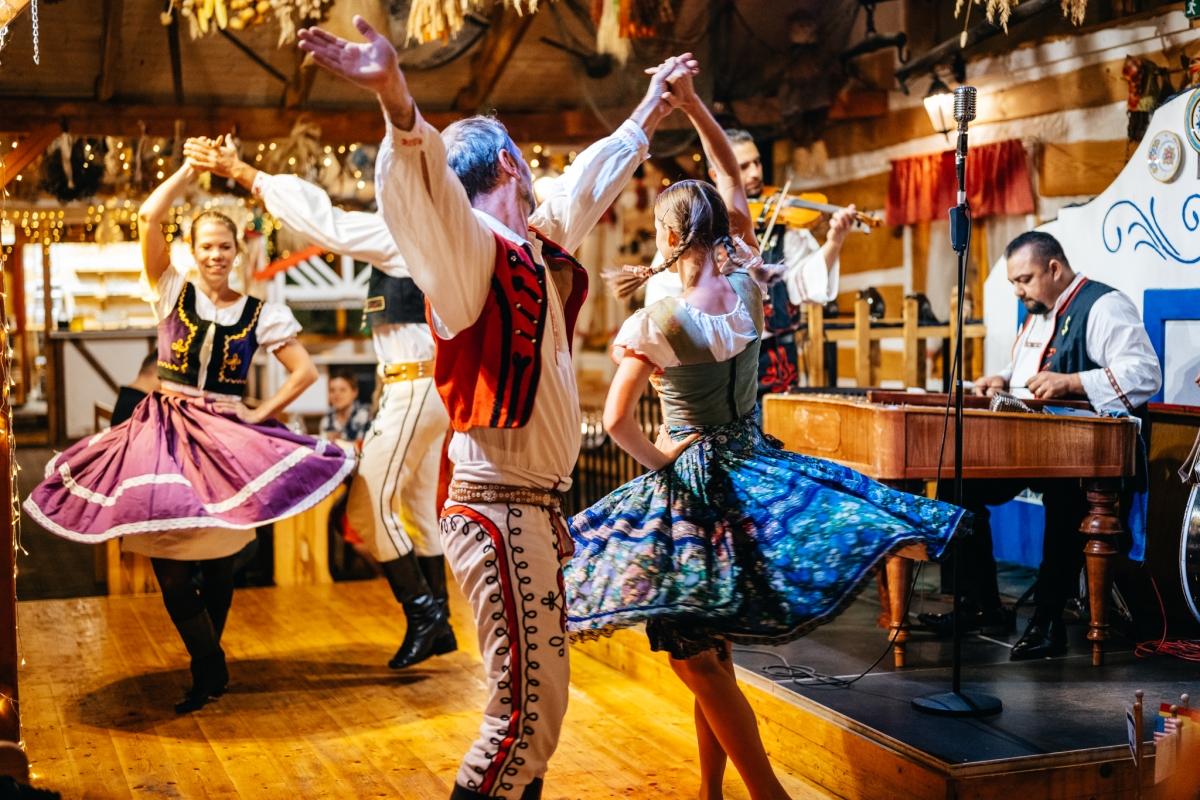
Slovak cooking reflects the country's mountain and farming background, built around dishes such as bryndzove halusky, potato dumplings with sheep's cheese, alongside hearty soups and cured meats suited to a cold mountain climate. Sheep farming remains active in parts of the Tatras foothills, and some mountain huts still produce bryndza cheese using traditional methods passed down through farming families. Folk festivals held in villages across the country, particularly in the region around Vychodna, bring out traditional costume, music, and dance that trace back generations. These rural traditions run alongside Slovakia's historic towns and mountain trails, giving visitors interested in local culture as much to see as those focused on hiking or architecture.
Most trips into Slovakia begin in Bratislava, where the 4 Days Bratislava City Package covers the capital's castle and old town before travelers head further into the country. From Bratislava, rail and road links run east toward Poprad and the High Tatras, and further on to Kosice, making a west-to-east route through the country practical without doubling back. Slovakia's compact size keeps travel times between these regions manageable, so a single trip can realistically combine mountain hiking, a cave visit, and at least one of the historic towns outside the capital.
.png)
.png)