
-high.jpg&w=1920&q=75 "19 Days Europe Balkan Countries Tour")
PopularFree Cancellation
-high.jpg&w=1920&q=75 "21 Day Europe Balkan Combined Tour")
-high.jpg&w=1920&q=75 "16 Days Grand Balkan Countries Tour")
-high.jpg&w=1920&q=75 "23 Days Balkan Countries Combined Tour")
-high.jpg&w=1920&q=75 "24 Days Europe Balkan Countries Tour")
-high.jpg&w=1920&q=75 "13 Days Yugoslavia Long Tour")
-high.jpg&w=1920&q=75 "23 Days Asia Europe and Balkan Countries Tour")
-high.jpg&w=1920&q=75 "7 Day Greece, Albania & North Macedonia Discovery Tour")
-high.jpg&w=1920&q=75 "Balkan Itinerary 14 Day 13 Night")
-high.jpg&w=1920&q=75 "Best Balkan Tour Packages 13 Day 12 Night")
Ohrid sits on the northeastern shore of Lake Ohrid in North Macedonia, one of Europe's oldest and deepest lakes. The town and the lake together form a UNESCO World Heritage Site, and with around 40,000 residents Ohrid is small enough that the old quarter, the lake promenade, and the fortress are all within walking distance of each other. Travelers mapping out a longer trip can start from the full set of Macedonia tours before focusing on time around the lake.
Layers of Illyrian, Roman, Byzantine, and Ottoman history sit close together in Ohrid's old quarter, where cobblestone lanes climb from the waterfront toward a hilltop fortress. The town remains an important center for the Macedonian Orthodox Church, and its churches and monasteries draw pilgrims as well as visitors interested in Byzantine art. Many travelers add Ohrid to a wider Balkan itinerary, given its short driving distance from Skopje and neighboring Albania.
Lake Ohrid is thought to be more than a million years old, making it one of the oldest lakes in the world, and at around 288 meters it is also among Europe's deepest. Its isolation over that span of time allowed a number of endemic species to develop, including the Ohrid trout, a fish long associated with the local diet and economy.
UNESCO listed the Ohrid region for both natural and cultural reasons, recognizing the lake's ecology alongside the town's churches and historic center. Boats run from the waterfront for visitors who want to see the cliffs and monasteries around the shoreline from the water rather than only from town.
The lake's clear water and series of small beaches along its shoreline make it a popular swimming spot in the warmer months, a contrast to the ancient churches and fortress walls that dominate the town above. Only a handful of lakes elsewhere in the world, such as Lake Baikal, share Ohrid's combination of extreme age and isolated evolution.
The lake is shared with neighboring Albania, which controls its southwestern shore, and cooperative management between the two countries has helped protect the watershed that feeds it. Fishing villages on the Albanian side offer a quieter, less developed contrast to the Macedonian town across the water.
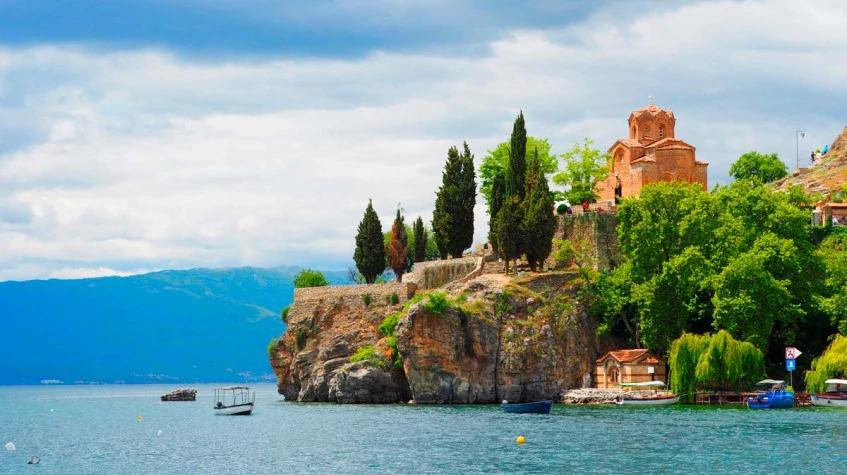
The Church of St. John at Kaneo stands on a cliff above the lake and is the single most photographed site in Ohrid, its small stone walls and single dome set against the water below. A short walk along the shoreline path connects it to the old town.
At Plaošnik, archaeologists uncovered the remains of an early Christian basilica along with the reconstructed monastery of St. Clement and St. Panteleimon, tied to the Slavic literacy movement that Saints Clement and Naum led in Ohrid in the ninth and tenth centuries. Local tradition holds that the town once had 365 churches, one for each day of the year, and while the number is legend rather than record, the density of religious buildings in such a small area is real.
Sveta Sofija, one of the town's oldest churches, preserves layers of Byzantine frescoes beneath later Ottoman-era additions that once turned the building into a mosque. Restoration work has since uncovered many of the original wall paintings, and the church now doubles as a concert venue during the summer festival season.
Ohrid's collection of medieval icons, some dating to the eleventh century, is considered among the most significant in the world and is displayed in a dedicated Icon Gallery within the old town. Many of the works came from the town's own churches and monasteries, painted by local workshops during the centuries when Ohrid was a center of Byzantine religious art.
Samuel's Fortress climbs the hill above the old town, its walls dating to the reign of Tsar Samuil in the tenth century, though the site was fortified long before his rule. Sections of the walls have been restored, and the fortress is lit at night, giving the old town skyline its distinctive silhouette after dark.
Below the fortress, the Ancient Theatre of Ohrid dates to the Hellenistic period and remains in use for performances during the summer, making it one of the few ancient theatres in the region still active rather than preserved purely as a ruin.
Several of the fortress's original gates and towers remain standing, and municipal restoration projects over the past two decades have stabilized sections of wall that had fallen into disrepair. The site hosts occasional open-air events, taking advantage of the same high vantage point that once made it valuable for defense.
The Monastery of St. Naum sits near the lake's southern end close to the Albanian border, built above natural springs that feed into the water and known for peacocks that roam its grounds. Boat trips from Ohrid town reach the springs and monastery in around an hour.
Just north of the lake, the town of Struga shares the same shoreline and marks the point where the Black Drin River drains toward the Adriatic. The Daily Tour Struga – the Pearl of the Black Drin covers this side of the lake, a straightforward addition for visitors basing themselves in Ohrid.
South of Ohrid town, the Bay of Bones museum at Peštani reconstructs a Bronze Age pile-dwelling settlement on wooden platforms above the water, built over the same foundations uncovered by underwater archaeologists nearby. It offers a different angle on the lake's history, centered on prehistoric life rather than the Byzantine and Ottoman periods that dominate the old town.
.jpg)