
Mevlana Museum – Konya
Europe, Turkey
 1 / 3
1 / 3Museum Information
Opening Hours
09:00 – 16:40
Open Days
About Mevlana Museum – Konya
Mevlana Museum –
Konya
The Mevlana Museum is located in the Mevlana Dervish
Lodge (Mevlana Dergâhı) in the Karatay district of Konya, Turkey. Following the
proclamation of the Republic, the dervish lodge was opened to the public in
1926 under the name “Konya Museum of Antiquities (Konya Asâr-ı Atîka Müzesi)”.
After a new arrangement in 1954, it was officially renamed the Mevlana Museum.
The museum stands on the former rose garden of the Seljuk
Palace, which was gifted by Sultan Alaeddin Keykubad to Sultan al-ʿUlamāʾ
Bahaeddin Veled, the father of Mevlana Jalal al-Din Rumi. When Bahaeddin Veled
passed away in 1231, he was buried at this location. Although his followers
wished to build a mausoleum over his grave, Mevlana rejected the idea, saying, “What
could be a better tomb than the sky itself?” However, after Mevlana’s death
in 1273, his son Sultan Veled accepted the requests, and the mausoleum known as
the Kubbe-i Hadra (Green Dome) was constructed in 1274 by the architect
Bedreddin of Tabriz, resting on four massive pillars.
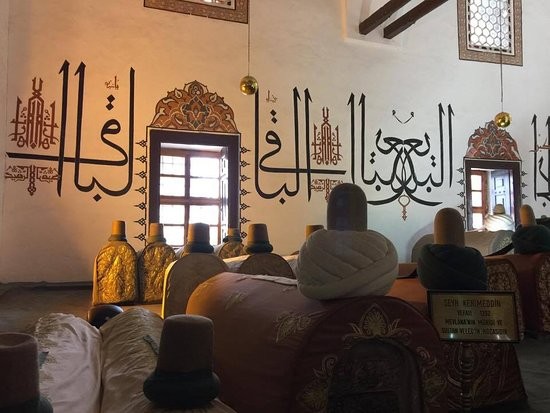
The core structure of the Mevlana Museum is the tomb of
Mevlana Jalal al-Din Rumi.
Museum Complex and Architecture
The museum courtyard is entered through the Dervişân
Gate. Along the north and west sides of the courtyard are the dervish cells. To
the south, after the kitchen (matbah) and the Hürrem Paşa Mausoleum, the
courtyard ends at the Hâmûşân (Gate of the Silent Ones), which opens onto the
Üçler Cemetery. On the eastern side, the main complex includes the mausoleums
of Sinan Paşa, Fatma Hatun, and Hasan Paşa, as well as the semahane (ritual
hall), mosque, and the main building housing the tombs of Mevlana and his family
members.
Within the courtyard are a covered fountain (şadırvan)
commissioned by Sultan Selim I in 1512, the Şeb-i Arûs Pool, and a fountain
known as the selsebil on the northern side.
Today, together with the surrounding rose gardens, the museum complex covers an
area of approximately 18,000 square meters.
Collections and Treasures of the Museum
The museum exhibits valuable objects related to Mevlana
and the Mevlevi Order, including manuscripts, calligraphic panels, oil lamps,
and musical instruments.
Specialized Library
The Specialized Library, founded in 1854 by Postnişin
Mehmed Said Hemdem Çelebi, houses over 4,000 handwritten manuscripts bound in
2,756 volumes, dating from the Seljuk, Karamanid, and Ottoman periods.
Notable Artifacts
Mevlana’s Sarcophagus
Mevlana’s wooden sarcophagus was crafted in 1274 from
kiln-dried walnut wood by Hümameddin Mehmed of Konya and Architect Abdülvahid,
son of Selimoğlu of Tabriz. The two turbaned sarcophagi at the front belong to
Mevlana and his son Sultan Veled, while the single turbaned sarcophagus behind
them is attributed to Bahaeddin Veled, although sources differ on this matter.
The surface of the sarcophagus is decorated with
geometric and vegetal motifs and calligraphic bands featuring verses from the
Masnavi and Divan-i Kabir. An inscription at the foot reads:
“Whoever visits this grave shall surely be blessed and
fortunate. This is the resting place of Mevlana Muhammad, son of Muhammad, son
of Husayn of Balkh. He is the sultan of scholars in the East and the West.”
Puşide (Mevlana’s
Tomb Cover)
Commissioned by Sultan Abdülhamid II in 1895, the
original puşide was made of satin fabric over leather. Due to wear, it was
replaced in 2021, and the original 126-year-old puşide has been placed under
protection.
The new cover, made of green velvet with Rumi-style
motifs, was designed by Architect and Illuminator Muammer Semih İrteş, while
the calligraphy and the basmala were executed by Master Calligrapher
Hüseyin Kutlu.
Masnavi
The Masnavi manuscript, written five years after
Mevlana’s death, is regarded as one of the oldest copies (nüsha-i kadim).
It contains all six volumes together and was copied in 1278 during the Seljuk
period by Mehmed bin Abdullah of Konya in naskh script.
Nisan Bowl
The Nisan Bowl was commissioned in 1327 by Ilkhanid ruler
Abu Saʿid Bahadur Khan using bronze with silver and gold inlay and presented to
the Mevlana Lodge. Rainwater collected in the bowl during April (Nisan) was
distributed to visitors for healing purposes, giving the object its name.
Life of Mevlana Jalal
al-Din Rumi
Born as Muhammad Jalal al-Din on 30 September 1207 in
Balkh (in present-day Afghanistan), Mevlana was the son of the renowned scholar
Bahaeddin Veled and Mümine Hatun. Following migration from Balkh, the family
traveled through Damascus and Aleppo before settling in Larende (Karaman) in
1222.
Mevlana married Gevher Hatun in 1225, with whom he had
two sons, Sultan Veled and Alaeddin Çelebi. After her death, he married Kerra
Hatun, and they had two children, Emir Âlim Çelebi and Melike Hatun.
Upon the invitation of Sultan Alaeddin Keykubad, the
family moved to Konya, the Seljuk capital. Mevlana taught for many years at the
Altun Aba (İplikçi) Madrasa. He passed away in Konya on 17 December 1273, at
the age of 66.
Encounter with Shams
of Tabriz
A turning point in Mevlana’s life was his meeting with
Shams-i Tabrizi in 1244 or 1245. This encounter profoundly transformed
Mevlana’s spiritual path. His close bond with Shams caused discomfort among his
followers, eventually leading to Shams’s departure. Mevlana dedicated his Divan
to Shams.
Works of Mevlana
- Divan-i Kabir (The Great Divan): A collection of ghazals and
quatrains, mostly written after Mevlana’s meeting with Shams.
- Masnavi: A six-volume Persian masterpiece of approximately 25,700
couplets, regarded as one of the most important works of Islamic mystical
literature.
- Fihi Ma Fih: A compilation of Mevlana’s discourses recorded by his
disciples.
- Majalis-i Sabʿa (Seven Sermons): Texts based on his sermons.
- Maktubat (Letters): A collection of letters written to various
individuals for different purposes.
Şeb-i Arûs (The
Wedding Night)
Şeb-i Arûs, meaning “the wedding night,”
symbolizes Mevlana’s union with the Divine Beloved and refers to the night of
his passing. Each year around 17 December, International Commemoration
Ceremonies of Vuslat (Union) are held in Konya to mark this occasion.