
Rahmi Koç Museum
Europe, Turkey
Museum Information
Opening Hours
09:30 – 17:00
Open Days
About Rahmi Koç Museum
Rahmi Koç Museum
Atatürk Special Collection
The objects exhibited in this section belong to Mustafa Kemal Atatürk
(1881–1938), the founder and first President of the Republic of Türkiye. The
collection was primarily assembled by Colonel Halil Nuri Yurdakul, who
played a significant role during the Turkish War of Independence and later
became one of Atatürk’s close associates. It was donated to the museum by his
son Prof. Dr. Yurdakul Yurdakul and his daughter-in-law Mrs.
Ayşe Acatay Yurdakul.
The collection also includes highly valuable personal belongings
of Latife Hanım, Atatürk’s late wife. These exceptional items are being
displayed to the public for the first time.
Among the highlights is the special wedding costume worn by Latife Hanım on
her wedding night, made of satin fabric and richly embroidered with
silver-colored beads, along with its matching embroidered waist sash. These
pieces were donated by Mr. Mehmet Sadık Öke.
A silver-beaded evening dress embroidered on silk, belonging to Latife Hanım,
has been loaned to the museum on a temporary basis by Mr. Mutlu İlmen.
Two silk pillowcases embroidered with gold thread from Latife Hanım’s trousseau
were also donated by Mr. Mehmet Sadık Öke.
Another notable object in the collection is Atatürk’s chest-style suitcase.
The suitcase bears the initials GMK, standing for Gazi Mustafa
Kemal, and is branded Innovation.
Dimensions: L: 60 cm – W: 72 cm – H: 115 cm
This section also features Atatürk’s eyeglasses and eyeglass case.
Time Magazine – March 1923
One of the rarest items in the collection is the March 1923 issue
of Time magazine, featuring Atatürk on its cover. This is the
fourth issue of Time and the first in which Atatürk appeared
on the cover. Only three copies are known to exist in Türkiye. This particular
example is preserved within a bound volume containing the first thirteen issues
of Time magazine.
G10 Locomotive and Tender
The first G10 locomotives entered service in 1910, with
production continuing until 1925. Known
as G10 and BR57 during their service in Prussia and
Germany, a total of 49 locomotives produced by various manufacturers
were brought to Türkiye at different times.
The G10 locomotive exhibited here was manufactured
by Borsig in 1912–1913 for Prussia. Featuring a 0-10-0
wheel arrangement, it initially served on the Prussian State Railways (KPEV)
before being transferred to Türkiye, where it operated for many years under
the Turkish State Railways (TCDD) with the number 55022.
Length: 18.9 m – Weight: 76 tons
Overall Dimensions: L: 37.2 m – W: 3.10 m – H: 4.50 m
Aviation
From a glider model inspired by the Wright Brothers to iconic
aircraft such as the Douglas DC-3 and the F-104S
Starfighter fighter jet, this collection presents outstanding examples
from the history of aviation. These exhibits can be seen in the Mustafa V.
Koç Building and the Outdoor Area.
Living History
This section features authentic reconstructions of 19th-century shops and
workshops, including a machine shop, olive oil factory, film set,
captain’s bridge, fishermen’s shelter, engine repair workshop, boat-building
workshop, scientific instruments shop, pharmacy, shoemaker, blacksmith,
watchmaker, ship outfitting shop, and toy shop. These spaces are arranged
throughout the Mustafa V. Koç Building, Tersane Building, and
the Outdoor Area to support the exhibition narrative.
Models and Toys
Scale models dating from the 1700s to the present day, crafted with
exceptional workmanship—many of them rare examples of their kind—form an
essential part of the museum’s collection. Distinguished model collections
related to steam engines, rail transport, maritime history, aviation, and
road transport are displayed throughout the relevant sections.
Miniature objects and toys from various countries and historical periods
are mainly exhibited in the Mustafa V. Koç Building, while a magical world
of miniature objects and dollhouses welcomes visitors at the Tersane Main
Entrance.
Scientific Instruments
This collection, which includes a 14th-century celestial
globe and a 19th-century transit telescope, sheds light on the
history of science through significant observation and measurement instruments.
The entire collection is on view in the Mustafa V. Koç Building.
Maritime
Rahmi M. Koç Museum holds one of Türkiye’s most extensive maritime
collections. Located in the Tersane section, the exhibition includes model
ships, full-scale boats and yachts, outboard motors, and the
rare Amphicar. In addition to the impressive Bosphorus Pleasure Boat,
smaller boats, canoes, and other vessels are also displayed.
Communication
Rare and historically significant examples of communication
technologies—such as the telegraph, telephone, dictaphone, gramophone,
camera, and television—illustrating the communication revolution born from the
union of science and industry can be seen in the Mustafa V. Koç Building.
Machinery
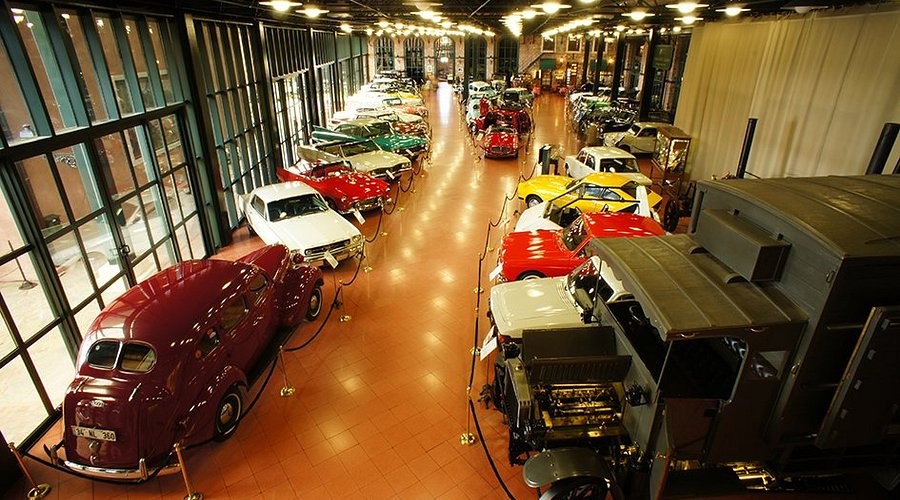
This collection of steam and diesel engines manufactured in Türkiye and
abroad offers valuable insight into the development of industry. Notable
exhibits include the steam main engine of the Kalender Ship in the
Mustafa V. Koç Building and the Marshall portable steam engine in the
Tersane Building.
Fenerbahçe Ferry
The Fenerbahçe Ferry, together with its sister ship Dolmabahçe
Ferry, was built in 1952 at the William Denny &
Brothers shipyard in Dumbarton, Glasgow. A member of the so-called
“garden-type” ferries, it entered service with Şirket-i
Hayriye (today’s Turkish Maritime Lines) on 14 May 1953.
Equipped with two Sulzer diesel engines, each producing 1,500
horsepower, the double-screw ferry could reach a speed of 18 knots. Its
large funnel and elegant wooden details make it a particularly striking vessel.
Since arriving at the Rahmi M. Koç Museum in 2009, the Fenerbahçe Ferry has
been open to visitors as a museum ship. It houses the Yalvaç Ural Toy
Collection and also hosts temporary exhibitions and educational programs.
The nostalgic café on board offers visitors a pleasant experience overlooking
the Golden Horn.
The Fenerbahçe Ferry has been loaned to the museum on a temporary basis by
the Istanbul Metropolitan Municipality