
Free Cancellation
French Polynesia Tours introduce travelers to a group of more than 100 islands and atolls scattered across the South Pacific, organized into five archipelagos: the Society Islands, the Marquesas, the Tuamotus, the Austral Islands and the Gambier Islands. Most visitors concentrate on the Society Islands, where Tahiti, Bora Bora and Moorea sit within a short flight or ferry ride of one another and offer the clearest introduction to Polynesian culture, volcanic scenery and coral lagoons.
As part of a wider Oceania itinerary or as a standalone trip, French Polynesia Tours typically begin in Tahiti before continuing on to one or two neighboring islands by air. Papeete, Tahiti's capital, serves as the region's main airport hub and its only sizeable town, with a produce and craft market that gives a practical introduction to Polynesian daily life before island-hopping begins.
Tahiti is both the largest island in French Polynesia and its main gateway, formed from two extinct volcanoes joined by a narrow isthmus. Beyond Papeete, the island's interior rises into steep, forested peaks cut by waterfalls, while black sand beaches line much of its coast, a reminder of its volcanic origin.
Bora Bora is known internationally for its overwater bungalows, a style of accommodation built out over the lagoon that originated in French Polynesia in the 1960s. A barrier reef encloses a lagoon of shifting shades of blue around the central peak of Mount Otemanu, and snorkeling trips to the reef's outer edge commonly encounter reef sharks and rays in shallow water.
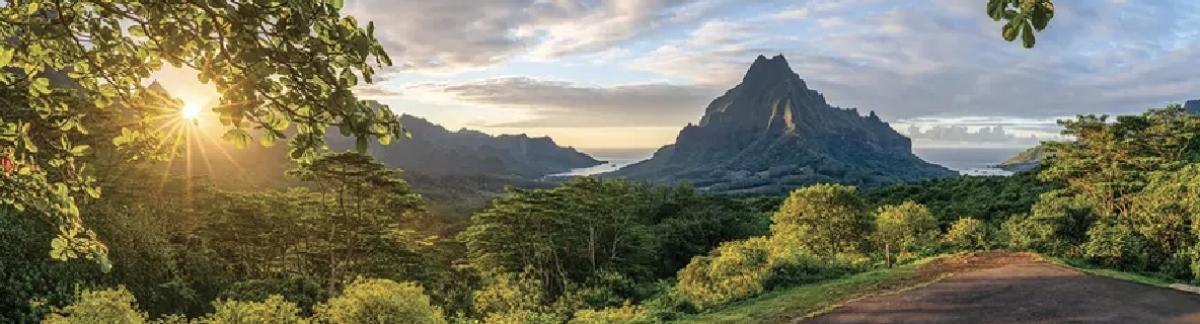
A short ferry ride from Papeete, Moorea presents a jagged volcanic skyline around Mount Rotui and two deep bays, Cook's Bay and Opunohu Bay, that cut into its coastline. The island's lagoon supports extensive coral gardens, and boat excursions here regularly include snorkeling with rays and reef sharks alongside stops at pineapple plantations inland. The Moorea Safari Tours with hotel transfert covers the island's interior and coastline in a single guided excursion, with transfers included from area hotels.
Black pearls, cultivated mainly around the atolls of the Tuamotu archipelago, are among French Polynesia's most valuable exports and a common purchase for visitors, sold in shops throughout Papeete and Bora Bora. Polynesian culture remains visible in dance, tattoo traditions and outrigger canoe racing, practices that trace back centuries before European contact in the eighteenth century.
Beyond the Society Islands, the Marquesas offer a more rugged, less visited landscape of sheer volcanic cliffs and deep bays, while the Tuamotus are low coral atolls built almost entirely around lagoons, better suited to diving than hiking. These outer island groups require additional flights from Tahiti and see far fewer visitors than Bora Bora or Moorea.
Air Tahiti operates most inter-island flights, connecting Papeete to Bora Bora, Moorea and the outer archipelagos, while ferries cover the short crossing between Tahiti and Moorea. Given the distances involved, most itineraries focus on two or three islands rather than attempting to cover the full territory in a single trip.
French cuisine and Polynesian ingredients mix on most menus, with fresh tuna and mahi mahi served raw in poisson cru, a dish of fish marinated in lime juice and coconut milk that appears on nearly every island. Vanilla, grown on trellises across several of the islands, remains one of the territory's longstanding agricultural exports alongside copra and, on the outer atolls, cultured pearls.
The dry season from May to October brings lower humidity and calmer seas, making it the more popular period for diving and lagoon excursions. The wetter months from November to April are warmer and quieter, though short tropical showers are more frequent.