
-high.jpg&w=1920&q=75 "Daily Harran Tour")
Free Cancellation
-high.jpg&w=1920&q=75 "15 Days Black Sea Eastern Turkey Tour")
-high.jpg&w=1920&q=75 "6-Day Mesopotamia Heritage Tour: Gaziantep, Sanliurfa, Nemrut, Mardin & Diyarbakir")
-high.jpg&w=1920&q=75 "8 Days South Anatolia Tour")
-high.jpg&w=1920&q=75 "Turkey Cultural Historical Heritage Tour 17 Day")
-high.jpg&w=1920&q=75 "Turkey Eastern Tour 16 Days")
-high.jpg&w=1920&q=75 "11-Day Mesopotamian & Eastern Anatolia Heritage Tour")
-high.jpg&w=1920&q=75 "Turkey Cultural Historical Heritage Tour 15 Days")
-high.jpg&w=1920&q=75 "10 Days Turkey South Eastern Tour")
-high.jpg&w=1920&q=75 "9 Day Ancient Mesopotamia & Southeastern Turkey Cultural Heritage Tour")
-high.jpg&w=1920&q=75 "Daily Sanliurfa City Tour from Gaziantep City")
-high.jpg&w=1920&q=75 "4 Days Nemrut Harran Tour")
-high.jpg&w=1920&q=75 "Daily Sanliurfa City Tour")
-high.jpg&w=1920&q=75 "10 Days Istanbul to Cappadocia South of Turkey Tour")
-high.jpg&w=1920&q=75 "Daily Sanliurfa City Tour from Mardin")
-high.jpg&w=1920&q=75 "3 Days Mount Nemrut Climbing & Sightseeing Tour")
Harran Tours cover a small town in Şanlıurfa Province near Turkey's border with Syria, best known for its distinctive beehive-shaped mud-brick houses and a history that stretches back thousands of years to ancient Mesopotamia. Harran, also known as Carrhae in classical sources, is associated in religious tradition with the biblical figure Abraham, who is said to have lived there before continuing on to Canaan.
Harran forms part of a wider Turkey itinerary through the southeast, typically visited as a day trip from Şanlıurfa given the short distance between the two.
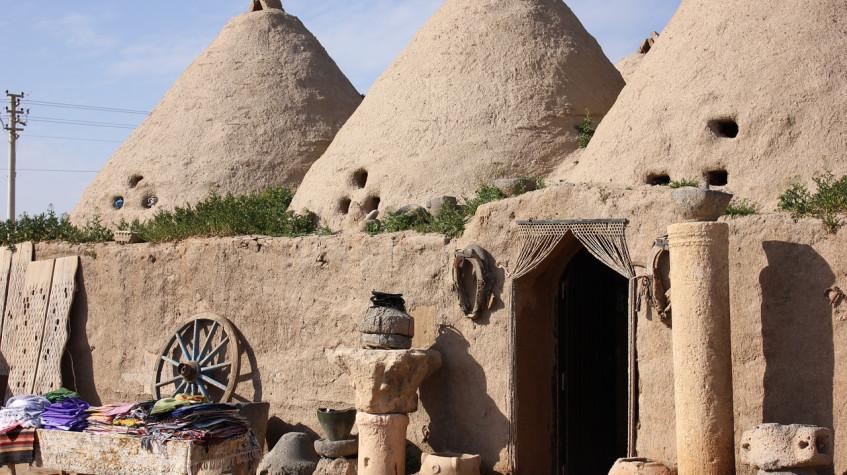
Harran's conical mud-brick houses, built without wood due to the scarcity of timber in the region, use a domed design that keeps interiors cool during the area's intense summer heat. A small number of these traditional structures remain inhabited or preserved for visitors, offering a rare surviving example of a building style once common across northern Mesopotamia.
The ruins of Harran University, believed to be one of the world's earliest centers of higher learning, sit near the remains of a large fortress and a partially standing minaret from the Ulu Cami, an early Islamic-era mosque. The site's long history spans Assyrian, Roman, Byzantine and Islamic periods, reflecting its position along ancient trade routes between Mesopotamia and Anatolia.
Harran remains a working agricultural town, with cotton fields extending across the surrounding plain thanks to irrigation from the Southeastern Anatolia Project. A small local market and a handful of restored beehive houses set up for visitors give a sense of daily life alongside the archaeological remains.
A short drive from Harran, the ruins of Sogmatar hold rock-cut temples and altars linked to star worship practiced before the region's conversion to Christianity and later Islam, set among low hills that are otherwise undeveloped.
Most visits take the form of a guided day trip from Şanlıurfa, such as a daily tour covering Harran's historic sites, often paired with a stop at the ancient site of Sogmatar nearby.
Weaving and pottery made in Harran's beehive-house workshops are sold at small stalls near the archaeological site, a modest craft tradition tied to the town's agricultural rhythms rather than large-scale tourism infrastructure.
Spring and autumn offer the most manageable temperatures for exploring the open ruins and beehive houses, since summer in this part of southeastern Turkey regularly brings extreme heat.