
-high.jpg&w=1920&q=75 "Sibiu City Tour")
Free Cancellation

-high.jpg&w=1920&q=75 "Daily City Tour Sibiu")
-high.jpg&w=1920&q=75 "8-Day Moldova and Romania Tour Package")
-high.jpg&w=1920&q=75 "11 Days Offer Tour in Romania")
-high.jpg&w=1920&q=75 "7 Days Discover in Transylvania")
-high.jpg&w=1920&q=75 "8 Days Offer Experience Transylvania")
-high.jpg&w=1920&q=75 "Balkan Big Tour: seven countries in three weeks")
-high.jpg&w=1920&q=75 "Castles & Capitals: Serbia, Hungary, Romania and Bulgaria in two weeks")
-high.jpg&w=1920&q=75 "10 Day Private Romania Tour: Bucharest, Transylvania, Maramureș & Bucovina")
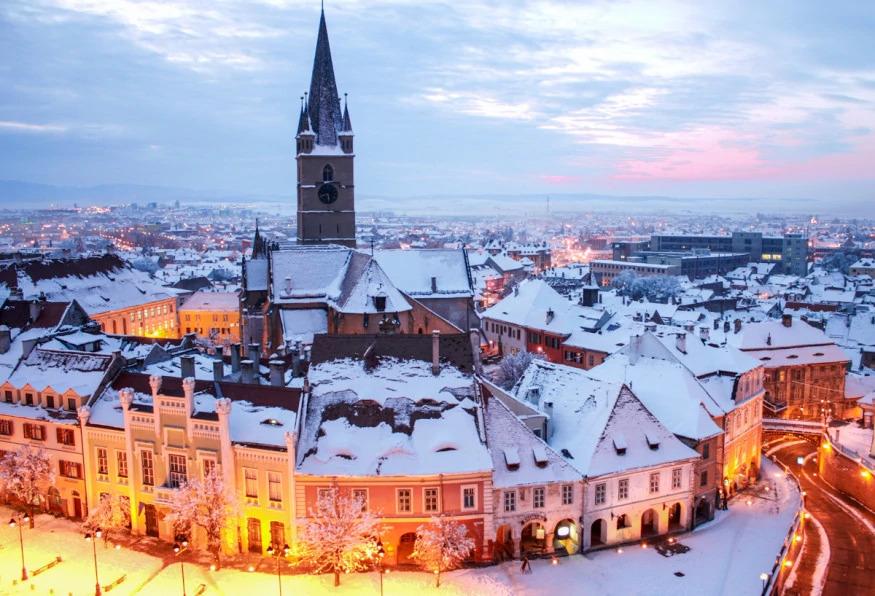
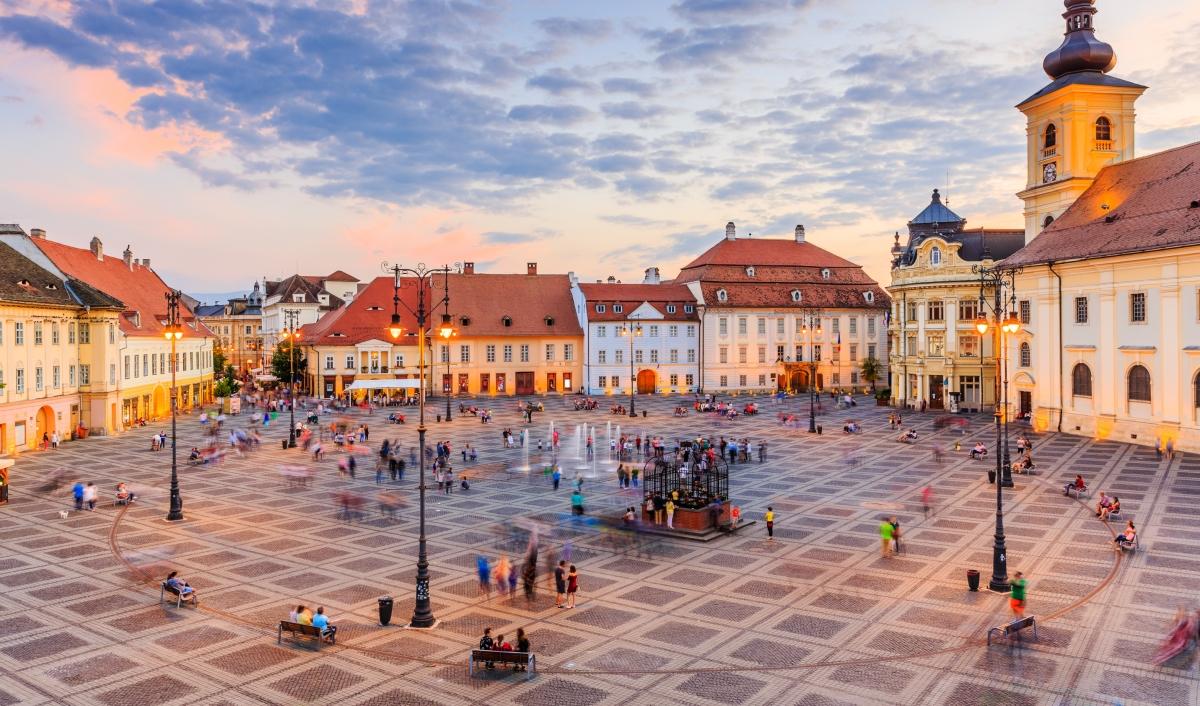
Sibiu was founded by Saxon settlers in the 12th century under the German name Hermannstadt, and it grew into one of Transylvania's wealthiest trading towns thanks to its position on routes linking Central Europe to the Balkans. That wealth built a walled town with three rings of fortifications and a pair of interlocking squares that still form the center of daily life. For centuries Sibiu also served as the political and religious center of the self-governing Transylvanian Saxons, a role reflected in the scale of its churches and civic buildings relative to its size. Visits to Sibiu usually sit within a wider Romania tour of Transylvania, and the town rewards two or three days rather than a single afternoon stop.
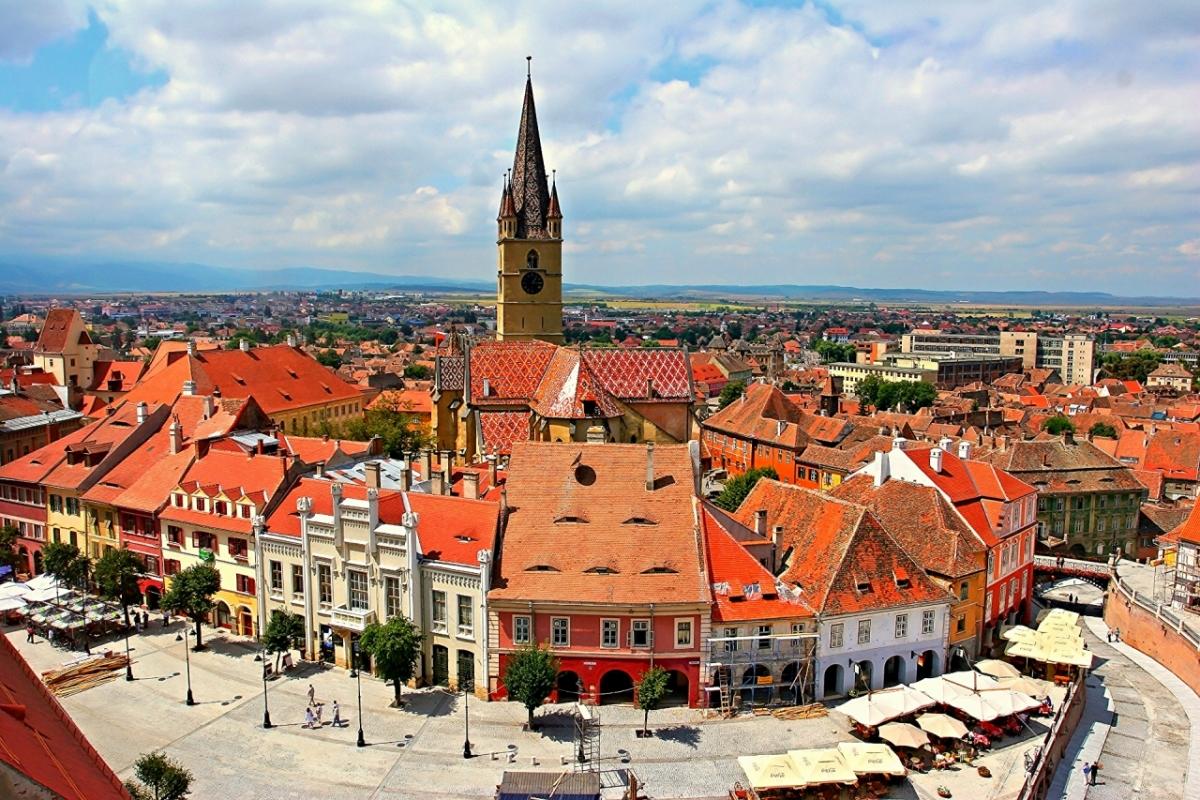
Unlike Brasov, which functions mainly as a base for castle day trips, Sibiu holds attention on its own streets and squares. The town's distinctive attic windows, cut into the sloped roofs of its historic houses and long nicknamed the "eyes of Sibiu," give the skyline a character found nowhere else in Romania. Restoration work ahead of Sibiu's year as European Capital of Culture in 2007 returned much of the old town to a condition close to its Saxon-era appearance. Strada Nicolae Balcescu, the main pedestrian street linking the train station to Piata Mare, is lined with cafes and shops set inside restored Saxon buildings and gives most visitors their first look at the town.
Piata Mare, the Large Square, anchors the upper town and is lined with former merchant houses, the Roman Catholic Church, and the Council Tower, which visitors can climb for a view across the roofline and its rows of eyed dormers. A narrow passage leads down to Piata Mica, the Small Square, and from there the Bridge of Lies, an iron footbridge built in the 1850s and now one of the oldest cast-iron bridges in Romania, crosses to the lower town. Merchants once used the space beneath Piata Mica for open-air trading, and the arcaded buildings ringing the square still hint at that commercial function. Local legend holds that the bridge creaks under anyone who tells a lie while standing on it, though the name more likely comes from merchants who broke promises made in the square nearby.
Beyond Piata Mare, Huet Square holds the Evangelical Cathedral of Saint Mary, a Gothic Lutheran church begun in the 14th century, which contains the tomb of Mihnea the Evil, a son of Vlad the Impaler who was assassinated in Sibiu in 1510. Sibiu was also home to one of the first printing presses in Southeastern Europe, which produced early Romanian-language religious texts in the 16th century. These details connect the town to the wider Transylvanian and Wallachian history found in Sighișoara and Bucharest.
Sibiu's designation as European Capital of Culture in 2007, shared that year with Luxembourg, brought a wave of restoration funding and put the town on the international festival circuit, including the Sibiu International Theatre Festival held each June. The Brukenthal National Museum, housed in a Baroque palace on Piata Mare, opened to the public in 1817 and ranks among the oldest museums in Romania, with a collection of European painting assembled by Governor Samuel von Brukenthal in the 18th century. Its holdings give Sibiu a cultural weight that goes beyond its architecture alone.
Three concentric rings of defensive walls once ringed Sibiu, and several of the guild towers that reinforced them still stand, including the Tower of Carpenters and the Tower of Potters, each named for the craft guild once responsible for its upkeep and defense. Walking the surviving stretches of wall between the upper and lower town gives a sense of how the medieval city organized its defense by trade rather than by district. The Stairs Passage, a narrow covered stairway connecting the two levels of the town, remains one of the most direct routes between them and a favorite for photographs of the town's layered geography.
Below, the lower town grew up along the Cibin river as the district for tanners, dyers and other trades that needed water and space the hilltop upper town could not provide. Colorful house facades and old workshop windows along its streets recall this working history, in contrast to the merchant grandeur of the squares above. Fewer visitors make it down here than to Piata Mare, which makes it a useful stop for travelers who want a quieter side of Sibiu.
Just outside Sibiu, the ASTRA National Museum Complex spreads traditional houses, watermills, and workshops gathered from across Romania over a large forested park on the shore of Dumbrava Lake, forming one of the largest open-air ethnographic museums in Europe. First established in 1905, the museum moved to its current lakeside site decades later and today displays traditional buildings brought in from villages throughout the country. The museum gives visitors a look at rural Romanian building traditions that complement the urban Saxon architecture found in the old town. Travelers can cover Sibiu's main sites, including the squares and towers, with the Sibiu City Tour, a practical option for a first pass through the old town.
May through September brings the clearest weather for walking the squares and climbing the Council Tower, and the Sibiu International Theatre Festival in June fills the town with outdoor performances. Winter is quieter and colder, though the Christmas market in Piata Mare ranks among the largest in Romania and draws visitors through December despite the cold. Shoulder months of April and October combine mild weather with smaller crowds at the main sights.