
Free Cancellation
-high.jpg&w=1920&q=75 "Venice 1 Day Tour from Milan by High Speed Train")

Milano, as Italians call the city, built its modern identity on design rather than monuments alone, and each April the city fills with visitors for Salone del Mobile, the world's largest furniture and design fair. Beyond the fair itself, satellite exhibitions known collectively as Fuorisalone spread installations through courtyards, showrooms and former industrial spaces across the city, turning entire neighborhoods into temporary galleries for a week.
For travelers combining stops along a wider Italy Tours route, Milano offers a different pace from Florence or Rome, one built around aperitivo hours, canal-side bars and design showrooms rather than ancient ruins. The Gothic Duomo still anchors the center, but the city's character shows more clearly in its neighborhoods than in any single monument.
Salone del Mobile has run since 1961 and now draws hundreds of thousands of visitors to the Fiera Milano exhibition halls each spring, alongside Fuorisalone events staged across districts such as Brera, Tortona and the Navigli. The Triennale di Milano, a design museum set in Parco Sempione, hosts rotating exhibitions on Italian architecture and product design year round, offering a calmer introduction to the same themes outside of fair week. Milano's status as a fashion capital, alongside Paris, London and New York, grew from this same industrial and design base rather than from royal courts or ateliers. That identity plays out twice a year at Milano Fashion Week, held each February and September, which adds runway shows and showroom appointments to the design calendar and draws designers and buyers into the city outside of the spring furniture fair.
The Navigli, a network of canals designed partly with input attributed to Leonardo da Vinci during his years in Milano, once carried marble for the Duomo's construction and goods between the city and the Po river system. Only two canals, the Naviglio Grande and Naviglio Pavese, remain visible today, lined with bars and restaurants that fill each evening for aperitivo, the pre-dinner ritual of a drink served with snacks that is widely considered a Milanese invention. On the last Sunday of most months, the Navigli also hosts one of the city's largest antiques and flea markets along the canal banks.
North of the Duomo, Brera keeps a village-like feel with cobblestone streets, small galleries and artisan workshops that have occupied the district since it was Milano's bohemian art quarter in the nineteenth century. The Accademia di Belle Arti, Milano's fine arts academy, still trains students here, and the surrounding streets hold antique dealers and independent boutiques alongside quieter courtyards away from the main shopping routes.
Risotto alla Milanese, colored golden with saffron, is the dish most associated with the city, traditionally served alongside ossobuco, a braised veal shank, in older trattorias around the center. Cotoletta alla Milanese, a breaded and pan-fried veal cutlet, and panettone, the domed sweet bread now sold across Italy at Christmas but developed in Milano, round out a short list of dishes that appear on menus throughout the city rather than only in areas geared toward visitors.
North of Porta Garibaldi, the Isola district was a working class neighborhood built around rail yards and small workshops before design studios, independent bookshops and bars moved in over the past two decades. The transformation mirrors Milano's broader shift from manufacturing city to design capital, and Isola remains one of the areas where that change shows most clearly at street level, its converted courtyards sitting a few blocks from the newer glass towers rising nearby.
Orange trams from the 1920s, nicknamed Ventotto after the number of the original model, still run on several Milano routes alongside modern rolling stock, making a slow loop through the center a low cost way to see the city between design districts. Route 1 in particular passes close to the Duomo and the university quarter, giving a street level view of Milano that the metro underneath misses entirely.
South of the center, Fondazione Prada occupies a former distillery reworked by architect Rem Koolhaas into exhibition spaces, a cinema and a permanent bar installation designed by filmmaker Wes Anderson. The complex signals a broader shift in Milano toward contemporary art institutions built inside converted industrial buildings, a pattern repeated at spaces such as Pirelli HangarBicocca in the city's northern outskirts, which stages large scale installations in a former locomotive factory.
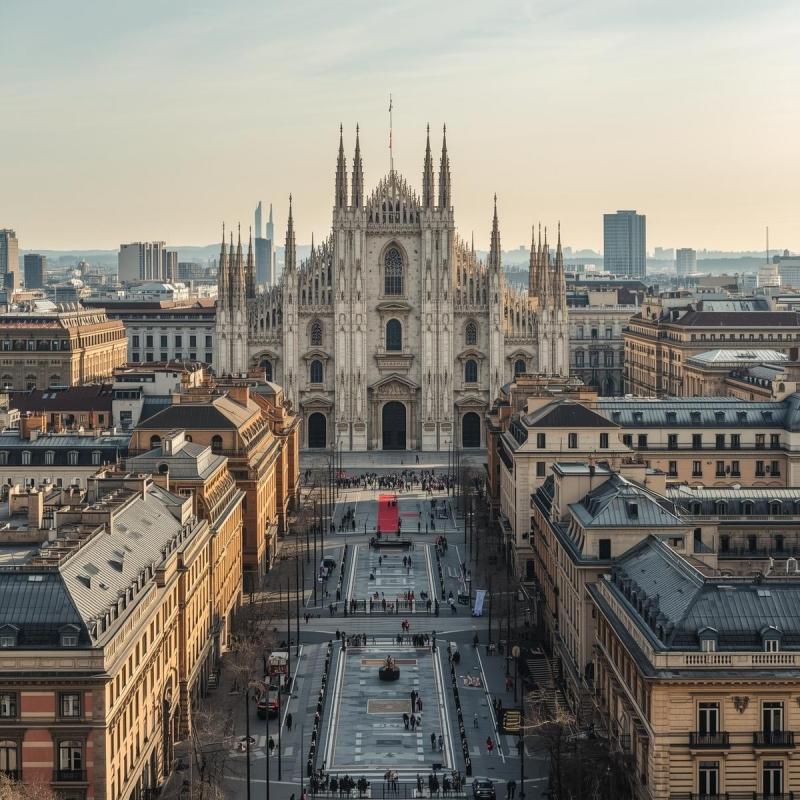
The Piazza del Duomo remains the natural starting point for any visit, with the cathedral's marble facade and forest of spires drawing the eye before travelers move on to the surrounding streets. An orientation tour is often the fastest way to connect these different sides of the city on a first visit, and City Sightseeing Milano covers the main center in a single guided route, useful for travelers deciding which district, Brera, the Navigli or the fashion quarter, to return to on foot afterward.
April brings the added energy of Salone del Mobile and Fuorisalone but also higher hotel rates and fuller restaurants, while late spring and early fall offer milder weather for exploring the Navigli and Brera on foot. Winters stay cool and often grey, though the Duomo's Christmas market in Piazza Duomo draws its own steady crowd through December. Outdoor aperitivo along the Navigli is at its most pleasant from May through September, when tables spread out along the canal banks into the evening.