-high.jpg&w=1920&q=75 "Sightseeing Tours Samatya: the Armenian District")
Free Cancellation
Taiwan fits a wide range of landscapes into a compact island: high-rise city life in Taipei, hot spring towns in the surrounding hills, marble gorges on the east coast, and tea-growing mountains in the central highlands. Despite its size, the island packs in distinctly different regional identities from north to south, and travelers researching the wider region often start with Asia tours before focusing in on Taiwan specifically.
Taipei anchors most itineraries, but Taiwan's High Speed Rail line connects the capital to west coast cities such as Taichung and Kaohsiung in a couple of hours, so even a short trip can reach well beyond the capital. The island's climate shifts from subtropical in the north to tropical in the south, with a mountainous spine running down the center that separates the busier west coast from a quieter, more rugged east coast. Taiwan's food culture, shaped by waves of migration from mainland China and decades of Japanese colonial rule, shows up everywhere from street stalls to formal dining rooms. Layers of Dutch, Qing dynasty, Japanese colonial, and postwar influence show up in the architecture and cuisine of nearly every city, adding depth to what might otherwise look like a compact single-region trip.
Taipei's night markets, among them Shilin, Raohe, and Ningxia, are where much of the city's food culture plays out after dark, with stalls selling oyster omelets, stinky tofu, grilled skewers, and bubble tea, itself a Taiwanese invention that has since spread worldwide. Beyond the markets, Taipei's dining ranges from the same street food served in sit-down form to branches of the dumpling chain Din Tai Fung, which started in the city. Above street level, Taipei 101 held the record for the world's tallest building when it opened in 2004 and remains the city's clearest landmark against the surrounding hills. An observation deck partway up looks out over a tuned mass damper, a giant steel pendulum installed to stabilize the tower against typhoons and earthquakes. Taipei's metro system makes it easy to reach most of these sights without a car.
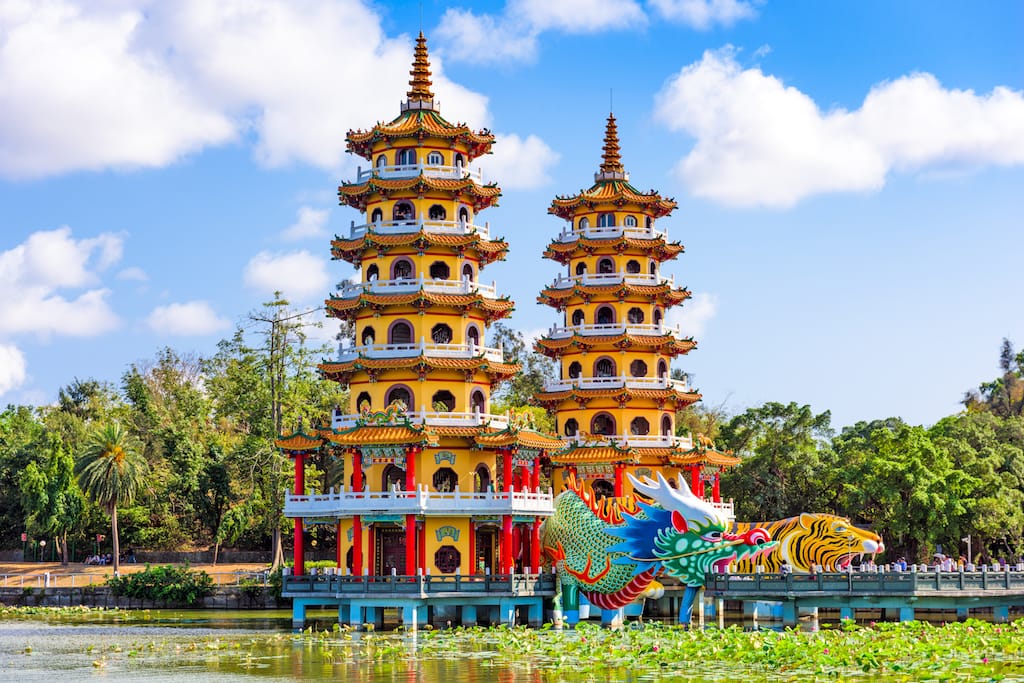
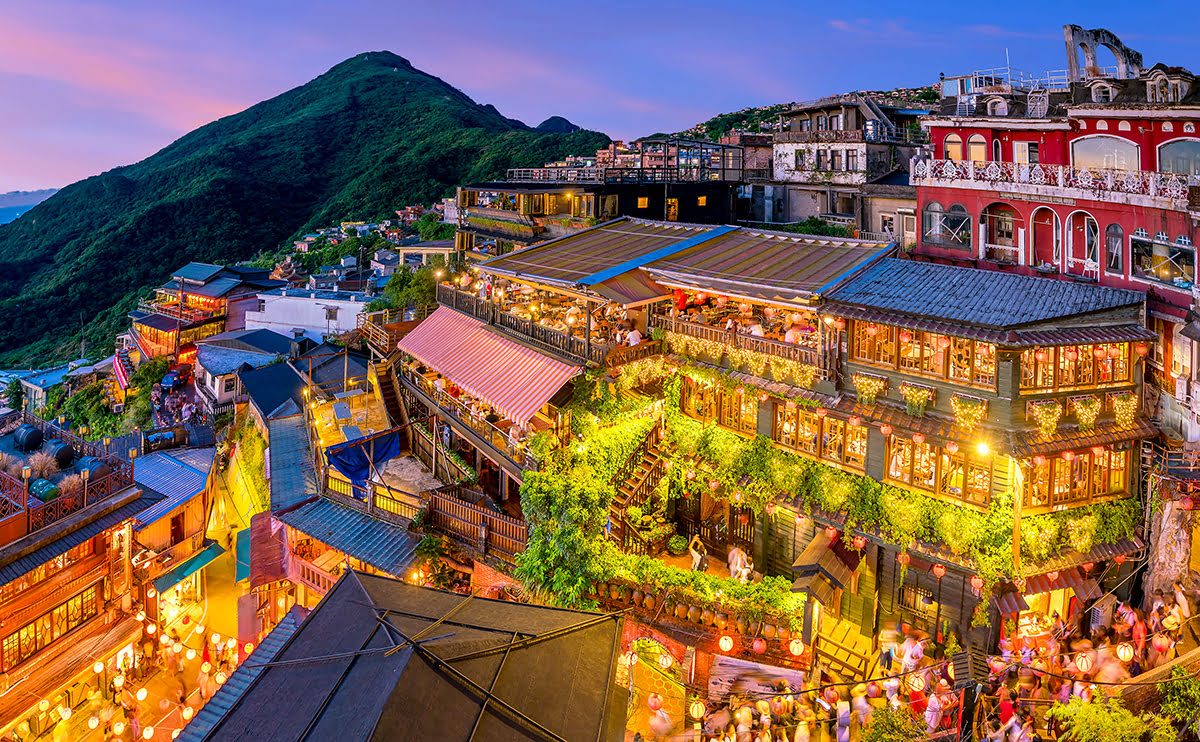
Longshan Temple in Taipei's Wanhua district dates to 1738 and remains an active place of worship dedicated to Guanyin, with incense smoke and evening chanting drawing worshippers and visitors throughout the day. Nearby, the Dihua Street area preserves rows of shophouses that once anchored the city's dried goods and herbal medicine trade, now mixed with cafes and design shops, especially busy in the weeks before Lunar New Year. A short train and bus ride from the capital, the hillside town of Jiufen built its narrow, lantern-lit lanes and teahouses on the profits of a gold rush during the Japanese colonial period, and it remains a popular day trip from Taipei. In central Taipei, the white-walled Chiang Kai-shek Memorial Hall and its surrounding plaza mark a different, more recent layer of the island's history, with an hourly changing of the guard ceremony that draws a steady stream of visitors. Further south, the port city of Tainan, Taiwan's oldest, holds a denser concentration of historic temples dating back to the island's Qing dynasty and Dutch colonial periods.
Beitou, at the northern edge of Taipei and reachable by metro, developed around a set of sulfur hot springs during the Japanese colonial period and still operates public and private bathhouses fed by the same thermal valley. Nearby Yangmingshan National Park adds a volcanic landscape of steaming vents and sulfur springs within the same metro area, an unusual pairing for a capital city. On the east coast, Taroko Gorge cuts through marble cliffs along the Liwu River inside Taroko National Park, with trails and a road that pass through tunnels carved directly into the rock. Swinging suspension bridges and lookout points along the gorge give close views of the marble walls, and the park's Shakadang Trail follows a turquoise stream for one of the more accessible walks in the area. Further south along the coast, the beach town of Kenting anchors Taiwan's southernmost national park, with a different, more tropical feel than the mountains further north.
Alishan, in the central mountains, is known for its narrow-gauge forest railway, originally built to haul cypress and cedar timber down from the highlands, along with sunrise viewpoints above a sea of clouds and the high-mountain oolong tea grown on its slopes. Tea houses throughout the area serve the local harvest, often with a view over the surrounding ridgelines, and many along the road up from Chiayi offer tastings that walk through the differences between the region's high-mountain oolong grades. The two areas sit close enough that some itineraries pair a night in Alishan with a glimpse of Yushan, Taiwan's highest peak at just under 4,000 meters, whose summit trail requires a permit. East of Alishan, Sun Moon Lake takes its name from the two halves of its shape, roughly round on one side and crescent on the other, and sits near Nantou in the central highlands at a lower, milder elevation than the mountains above it. A cable car connects the lakeside to the Formosan Aboriginal Culture Village, which focuses on the Thao people native to the lake area, and a bicycle path circling parts of the shoreline has become a popular way to take in the surrounding mountains at a slower pace.
Because Taiwan is compact and well connected by rail and highway, it is common to combine several of these stops in a single trip, moving from Taipei's markets and temples to a hot spring town and on to the mountains or the lake within a week or two. First-time visitors often base most of a trip in and around Taipei, while repeat visitors branch out further into the east coast and southern cities.