
Free Cancellation
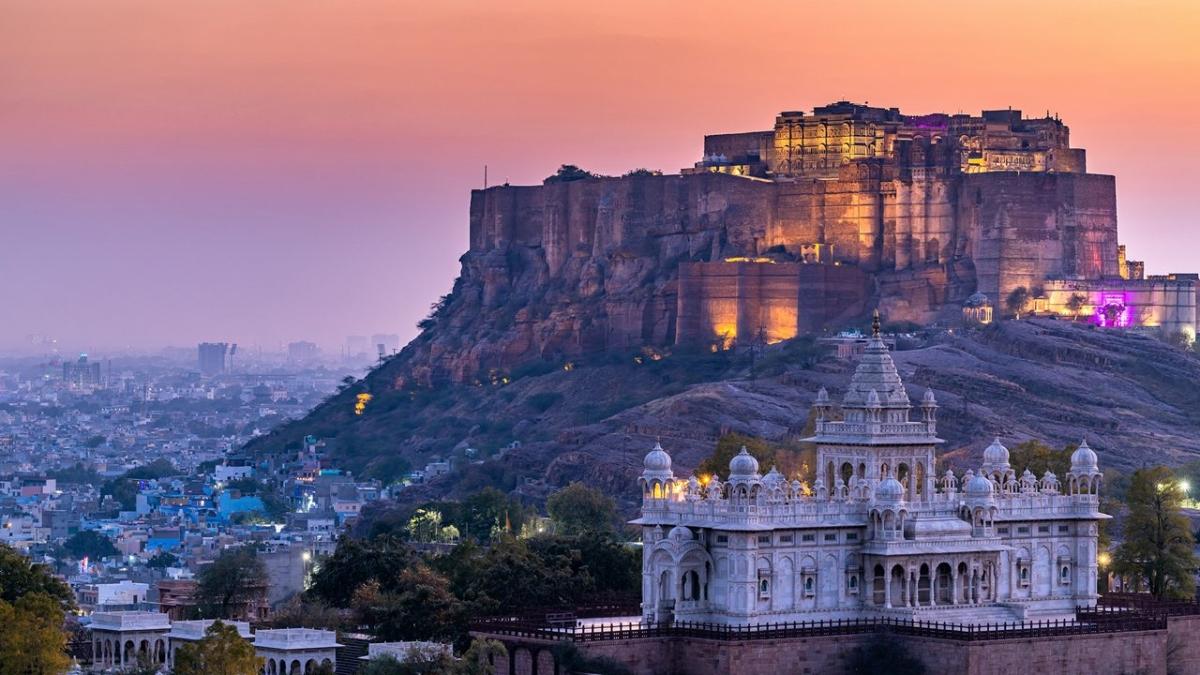
Jodhpur spreads out beneath Mehrangarh Fort in western Rajasthan, its old town known across India as the Blue City for the indigo wash applied to houses clustered at the base of the fort's cliff. Founded in 1459 by Rao Jodha, a chief of the Rathore clan, the city grew into the capital of the former Marwar kingdom and still carries the layout of a fortified desert capital, with narrow lanes winding uphill toward the fort gates.
Jodhpur sits at a natural crossing point between Jaisalmer, Udaipur and Jaipur, and frequently appears as a stop on longer Rajasthan routes tied into a broader India itinerary. Its own combination of fort, palace and old-city bazaar is substantial enough to warrant two full days before moving on, and its position roughly midway across the state keeps road transfers to neighboring Rajasthan cities within a manageable half-day.
Mehrangarh Fort rises about 400 feet above the city on a rocky outcrop, its walls up to 120 feet thick in places, and ranks among the largest and most complete forts in India. Founded in 1459 alongside the city itself, the fort was expanded by successive Marwar rulers over the following centuries and today houses a museum covering Rajput weaponry, palanquins and royal portraiture across a series of ornately carved palace apartments, including the Moti Mahal and Phool Mahal.
The indigo-washed houses that give Jodhpur its nickname spread out from the base of Mehrangarh through the old town's tangle of lanes. Explanations for the color vary, from an old caste marker used by Brahmin families to a practical measure against termites and summer heat, and today entire blocks of the old city carry the same wash regardless of who lives there. The clearest views over this stretch of rooftops come from the fort ramparts or from cafes built into old haveli buildings below, several of which have converted upper floors into guesthouses and rooftop seating without altering the lanes themselves.
Roughly five miles north of the current city, Mandore served as the capital of the Marwar kingdom before Rao Jodha shifted the seat of power to the new fort in 1459. The gardens there hold a set of red sandstone cenotaphs built in temple form for later Marwar rulers, alongside a rock garden and a hall containing more than 300 painted stone figures of regional deities.
On the opposite side of the city, Umaid Bhawan Palace was built between 1929 and 1943 as a famine relief project and remains partly a residence for Jodhpur's former royal family, partly a museum and partly a hotel. Designed by the British architect Henry Vaughan Lanchester, it blends Indo-Saracenic and art deco styles across roughly 26 acres of grounds and was for a time counted among the largest private residences in the world. Closer to Mehrangarh, Jaswant Thada is a white marble cenotaph built in 1899 in memory of Maharaja Jaswant Singh II, its thin marble panels letting sunlight filter through in a soft glow above terraced gardens that overlook a small lake.
Below the fort, the clock tower built in 1911 marks the entrance to Sardar Market, Jodhpur's main bazaar for spices, textiles and the mawa kachori and other sweets the city is known for. Stalls here also sell block-printed fabric, leather juttis and antiques, and the market stays busy well into the evening, a contrast to the quieter lanes higher up near the fort. Among the market's specialties, mirchi bada, a large chili stuffed with spiced potato and fried in gram-flour batter, and makhaniya lassi, a thick saffron-topped yogurt drink, are two dishes closely associated with the city.
As one of the fort cities most often paired with Jaisalmer on multi-day routes, Jodhpur features on itineraries such as the 6 Day Royal Rajasthan Heritage Tour By Car With Driver, which connects Jodhpur to neighboring desert cities by private car across the wider Marwar and Thar region.
October through March brings the most comfortable weather for climbing between the fort's courtyards and walking the old city's lanes. Temperatures climb sharply from April onward, and the peak of summer between May and June is generally too hot for extended sightseeing outside early morning hours.